Some pilgrimage routes begin at Romanesque cathedrals, others in medieval ports, others along moss-covered Roman roads. One, lesser known and notably quieter, passes near a castle wrapped in legend: Bran Castle, associated for more than a century with the cultural figure of Count Dracula.
The image is unexpected, and precisely for that reason compelling. A pilgrim with a backpack and scallop shell crossing the Carpathians, moving through deep forests and villages where time appears suspended, walking westward toward Santiago de Compostela from Europe’s eastern edge. This is neither metaphor nor tourism provocation. It is the Camino de Santiago in Romania.
The Camino is not a single route ending in Galicia. It is a living, expansive network shaped over centuries by millions of journeys. From Scandinavia to the Mediterranean, from the Atlantic to Eastern Europe, the Jacobean routes today form a cultural landscape exceeding 80,000 kilometers. Constantly evolving, this system is shaped as much by those who walk it today as by historical precedent.
Romania occupies the eastern margin of that network. For centuries, it functioned as a territory of passage and transition, often overlooked in Western European narratives. Today, through the work of walkers, researchers, and volunteers, it is re-emerging on the European Camino map. At the center of this process stands the Association of Friends of the Camino de Santiago in Romania (APCS Romania), an organization focused not only on waymarking routes, but on recovering historical memory, activating local communities, and redefining what long-distance pilgrimage can mean in the twenty-first century.
To understand how a Camino is built almost from the ground up, we spoke with Gabriela Greu, vice president of the association.
A Camino born from experience
Every Camino begins with a personal journey rather than an institutional plan. Someone walks, returns changed, and feels compelled to share what they encountered.
In Romania, the process unfolded in precisely this way. A small group of individuals who had walked the Camino elsewhere returned home convinced that the experience could not remain purely individual.
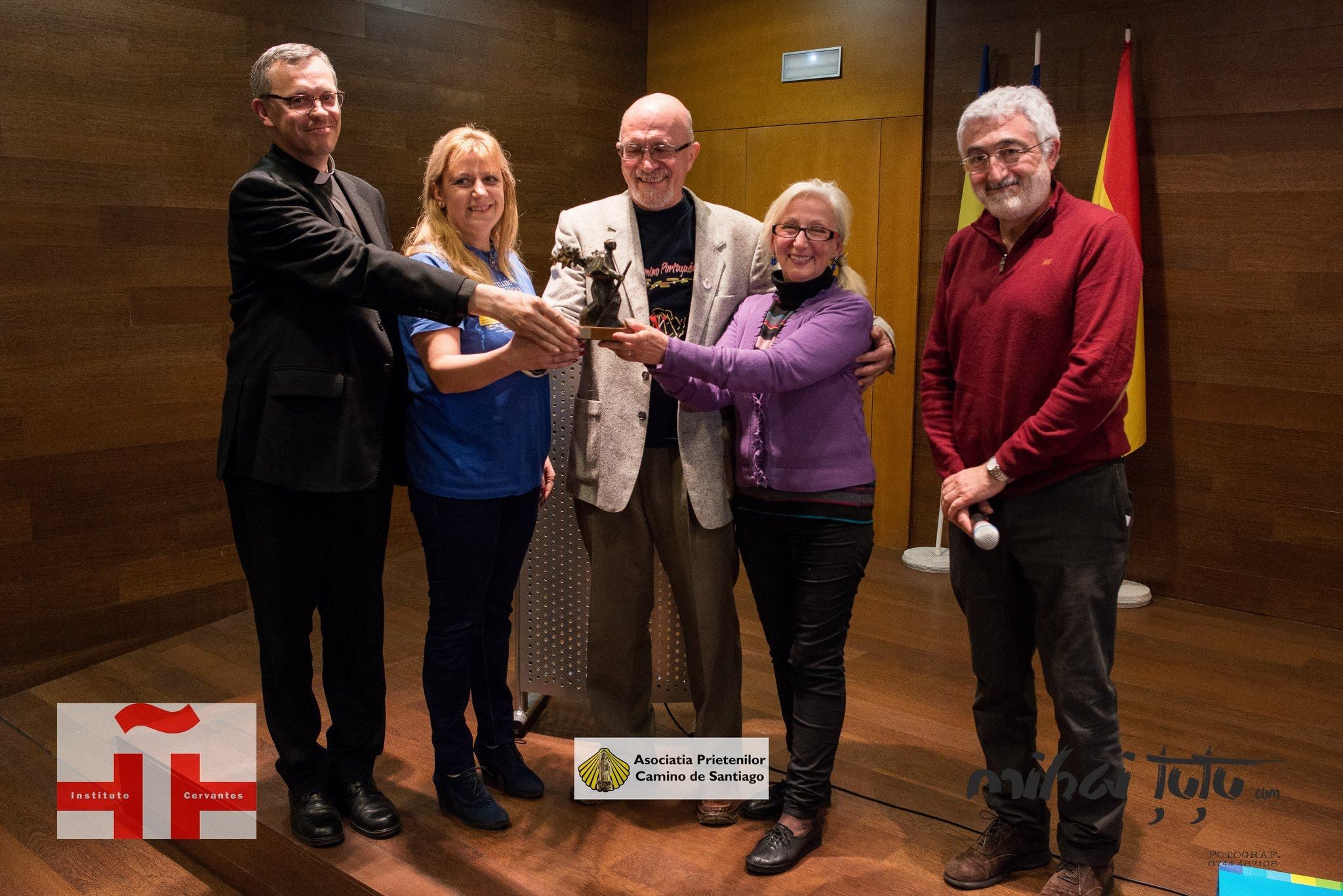
As Greu explains, “it all started with a small group of pilgrims who had personally walked the Camino de Santiago and wanted to share that experience in Romania. In 2016, this led to the founding of the Association of Friends of the Camino de Santiago, the first and only organization of its kind in the country.”
From the outset, the ambition was long-term. The goal was not to create a symbolic stretch or an isolated trail, but to integrate Romania fully into the broader European Camino system, with all its cultural and human implications.
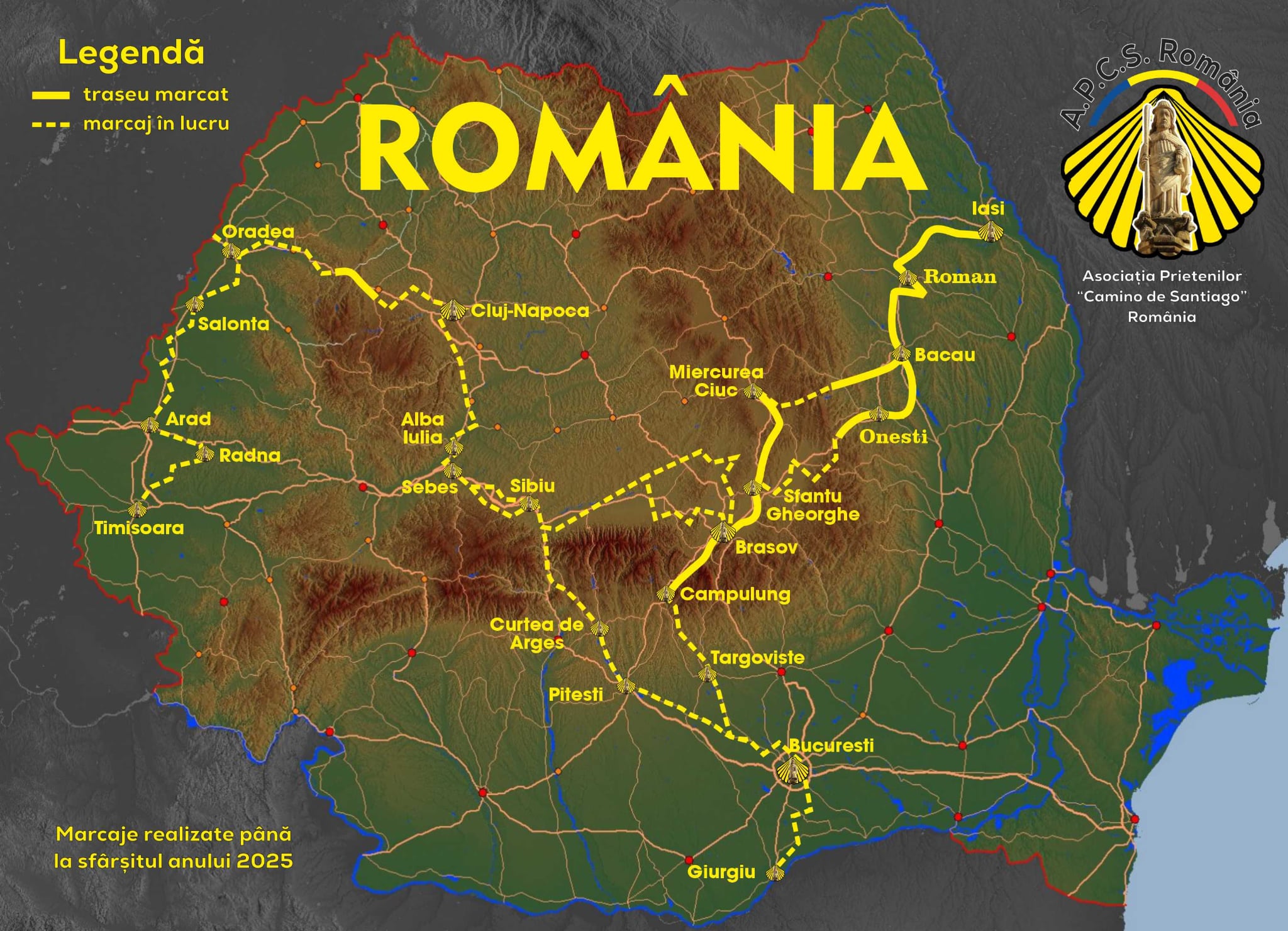
“Our vision,” Greu says, “is to reconnect Romania with the European pilgrimage network by developing a Romanian Camino of about 2,300 kilometers, contributing to the more than 80,000 kilometers of Jacobean routes across Europe.”
For such recognition, intention alone is insufficient. Historical continuity, territorial coherence, and a credible narrative are essential.
Un Camino, muchos Caminos a Santiago: sendas históricas y nuevas rutas
Medieval pilgrims and forgotten traces
One of the project’s central challenges was demonstrating that the Camino in Romania was not a contemporary invention, but a practice with historical roots.
The motivation, Greu notes, was initially experiential. Yet it soon found academic grounding. Research conducted by members of the association—most notably by its president, Professor Ion Nicolae of the University of Bucharest—identified historical indications that medieval pilgrims crossed what is now Romanian territory on their way to Compostela.
This research proved decisive. It allowed the association to design routes aligned with historic corridors of movement: medieval towns, religious sites, mountain passes, and natural transit routes that had long connected Eastern and Western Europe.
The Romanian Camino thus positions itself not as an exotic outlier, but as a missing element in a wider European mosaic. As Greu puts it, it “enriches Europe’s pilgrimage heritage by adding cultural diversity and new landscapes, and by creating a bridge between Eastern and Western Europe through a shared medieval practice.”
Building a Camino: Slow, bureaucratic, human
The Camino in Romania exists today, but remains under construction. Progress follows the rhythm typical of long-distance routes shaped by local realities. To date, approximately 600 kilometers have been waymarked. This work combines field exploration, negotiations with local authorities, and sustained volunteer coordination.
“So far,” Greu explains, “we have marked around 600 kilometers using scallop shells and yellow arrows, and in some areas metal panels. The process involves surveying routes, securing permissions from local authorities, and coordinating volunteers.”
The principal obstacle is not terrain, but administration. “Progress is slow because of bureaucratic procedures, but we advance step by step.” A deeper challenge is cultural. Long-distance walking pilgrimage—on foot, by bicycle, or on horseback—is relatively unfamiliar in a predominantly Orthodox country where Saint James is not part of everyday reference points.
Introducing this culture, maintaining volunteer momentum across large regions, and ensuring continuity all require sustained effort. Yet the route is gradually being adopted by the territory itself.
Communities along the Way
One of the project’s most significant aspects is local engagement. The Camino is not imposed; it is explained, discussed, and adapted.
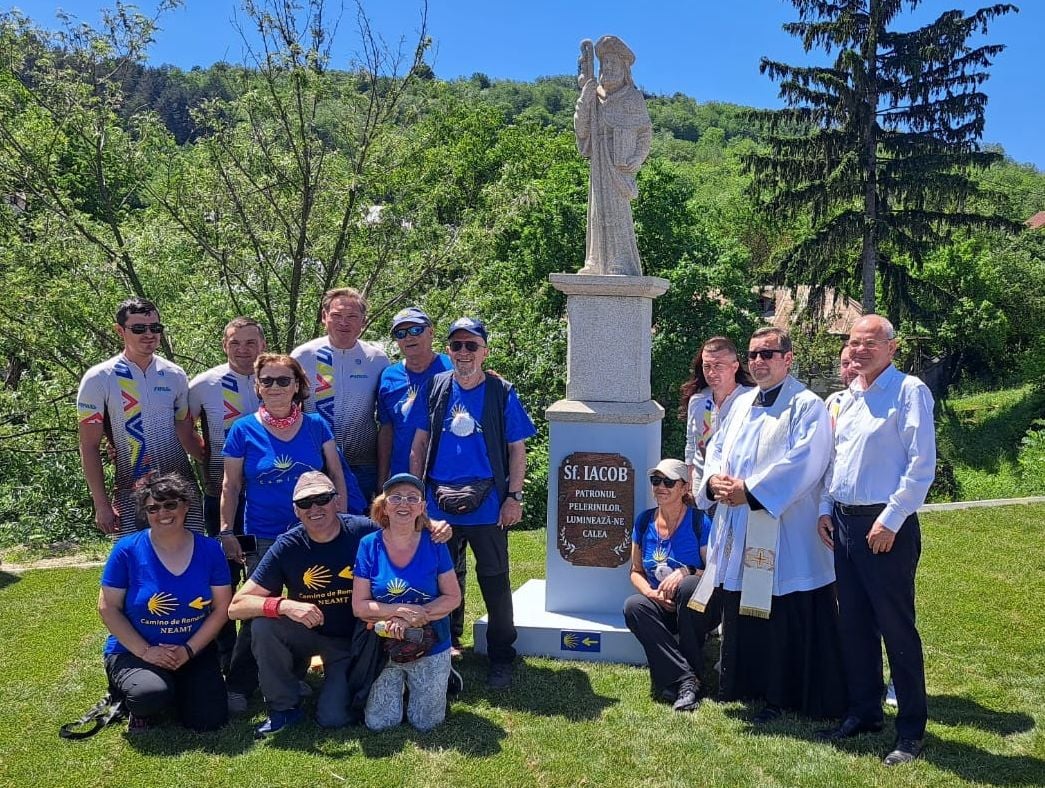
Some municipalities have chosen to mark stretches of the route using their own resources. Volunteers, association members, and even scouting groups have taken part in waymarking initiatives.
“This strengthens local identity and community involvement,” Greu notes.
The result is a Camino shaped organically rather than according to standardized tourism models—a route embedded in living landscapes rather than overlaid upon them.
Heritage, myth, and Dracula’s Castle
Walking in Romania means moving through a dense concentration of natural and cultural heritage. UNESCO-listed sites, medieval towns, monasteries, traditional villages, and mountain landscapes define an experience markedly different from the heavily traveled western Camino corridors.
The route passes locations such as the Sturdza Palace in Miclăușeni, the Black Church in Brașov, the former Church of Saint James in Câmpulung Muscel, and the village of Șirnea at the foot of the Piatra Craiului massif.
One site, however, stands out for its symbolic resonance: Bran Castle. Internationally associated with the Dracula myth, it introduces an almost literary contrast—a pilgrimage route passing one of Europe’s most enduring Gothic icons.
This intersection is not incidental. As Greu explains, “Bran Castle preserved (now in the town museum) a statue of Saint James that once belonged to Queen Marie of Romania. It is believed to have been a gift from a pilgrim returning from Santiago.”
The statue functions as material evidence of shared histories. “It symbolizes the historical presence of pilgrimage traditions in Romania and their connection to the Camino.”
Elsewhere, traces recur: churches in Oradea, Brașov, Sibiu, Sebeș, and Iași; scallop shells found in medieval graves; and visual representations of Camino legends, such as the miracle of Santo Domingo de la Calzada depicted in the fortified church of Ghelința.
A Camino still marked by silence
Today, the Romanian Camino offers something increasingly rare in Europe: quiet, low traffic, and a strong sense of place. Two official pilgrim accommodations currently operate—Casa Genoveva in Câmpulung Muscel and Casa Mărioara in Șirnea—supplemented by guesthouses and private lodging. The hospitality network remains modest but coherent.
Those who have already walked sections consistently highlight “silence, authenticity, and natural beauty.”
During the most recent Jubilee Year, association members walked parts of the route as a “Pilgrimage of Hope,” engaging with communities, churches, and local authorities not as visitors, but as walkers attentive to the landscapes and people they encountered.
Looking toward Europe, step by step
The future of the Romanian Camino lies in continued connection: extending waymarking, securing European funding, developing educational initiatives, and engaging younger generations.
“Our goal,” Greu says, “is to build an educational and cultural framework centered on Camino values such as empathy and solidarity, in cooperation with other European organizations.”
Cross-border links are already underway, including connections with Hungary—linking Oradea to Budapest—and with Ukraine, via the Podolic Way. Romania’s Camino is conceived not as an endpoint, but as a bridge.
Walking as legacy
For Gabriela Greu, the Camino is not only a cultural project. It is a personal transformation. “Walking the Camino changed my life. It became a passion and a mission.”
Working on the route is, for her, a way of leaving a tangible legacy—“creating something meaningful for future pilgrims, and for the country and its communities.”
Asked to recommend a section, she points without hesitation to the stretch between Câmpulung Muscel and Brașov. Beginning and ending at sites linked to Saint James, crossing striking landscapes, it encapsulates the diversity of the Romanian Camino.
From Dracula’s Castle to Santiago de Compostela, the Camino in Romania proposes a different kind of journey: less traveled, quieter, and unmistakably European. A reminder that the Camino does not end in Galicia. It begins, repeatedly, wherever someone chooses to walk.
AI Transparency Notice
PilgriMaps uses artificial intelligence tools to assist in the research, drafting and translation of editorial content. All AI-assisted content is reviewed, edited and verified by our editorial team before publication. We contrast information against primary sources, specialist literature and on-the-ground knowledge to ensure accuracy, cultural sensitivity and editorial integrity.
AI is one tool among many in our workflow. The judgement, curation and responsibility for everything published on this platform remain entirely human.
Viator Media S.L. — in compliance with the EU Artificial Intelligence Act (Regulation EU 2024/1689).
This post is also available in: