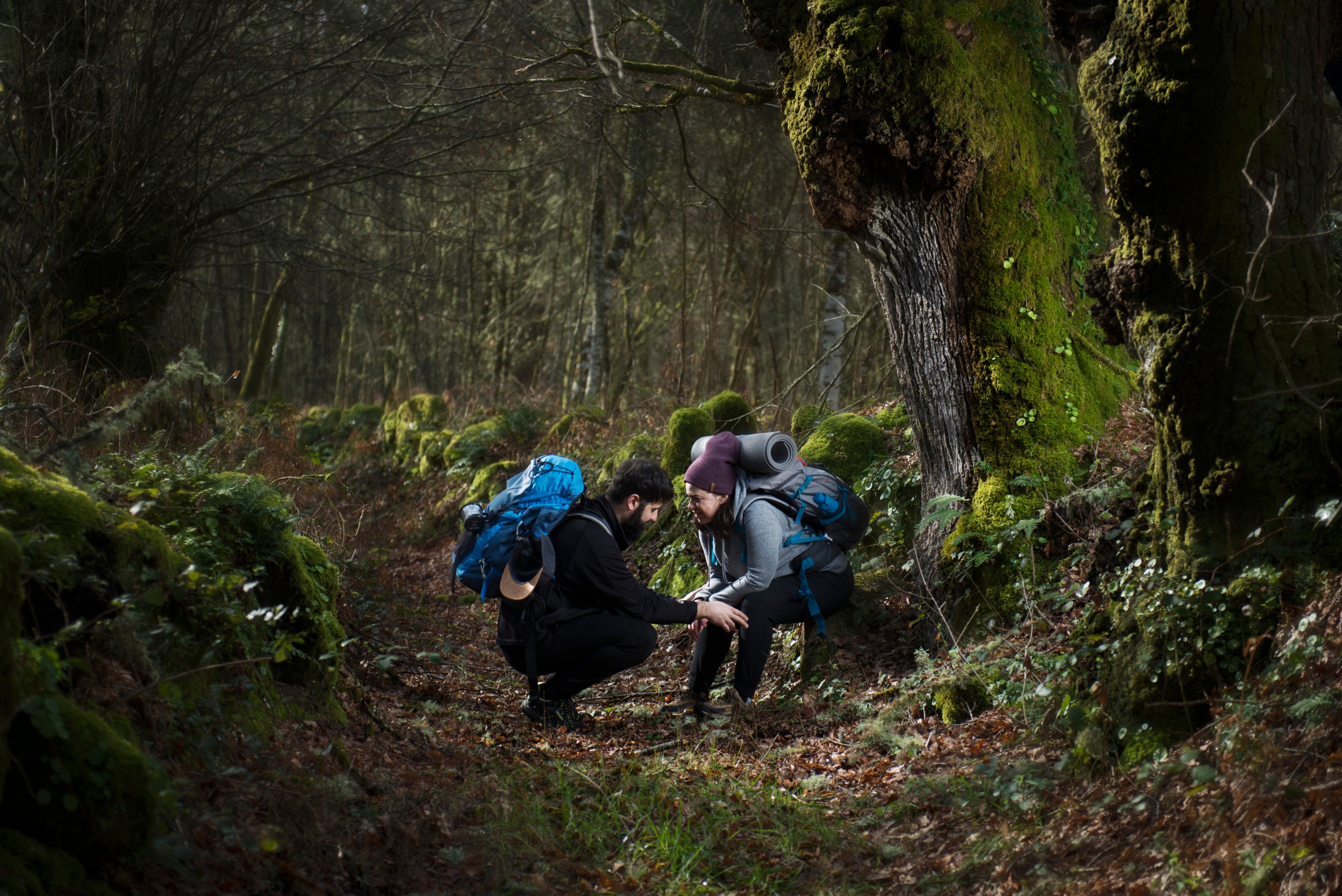
Saint-Jean-Pied-de-Port, day one. Two people who do not know each other begin climbing the Pyrenees at the same hour, each for reasons they will not tell anyone for at least three days. They cross paths at the first fountain, lose each other, find each other again at the hostel in Roncesvalles, where eighty strangers sleep twenty centimeters apart and snore in seven languages. By the fifth day they are walking at the same pace without having discussed it. By the eighth, one of them is quietly calculating which village the other will stop in for the night. Neither will use the word for it. Both already know what it is.
The phenomenon even has a popular name — amores del Camino — and a considerable scale: in 2025, 530,987 pilgrims reached Santiago de Compostela, over 93% of them on foot. That is an enormous factory of proximity between strangers. Why does walking slowly together carry such a high rate of emotional ignition? The answer — unromantic and well documented — is that the Camino sets in motion at least three mechanisms that psychology knows well and that, taken together, resemble something very close to a trap.
The body moves and the brain looks for someone to blame
In 1974, two Canadian psychologists — Donald Dutton and Arthur Aron — had a group of men cross a swaying suspension bridge over the Capilano canyon, seventy meters above the ground. Halfway across, a young research assistant stopped them for a fake survey and left her number. A second group met the same woman on a low, solid bridge. The men from the high bridge called her back far more often (Dutton and Aron, Journal of Personality and Social Psychology, 1974). The explanation became a classic: the body, shaken by fear, produces an accelerated heartbeat, short breath, sweaty palms. The brain reads these signals and attributes their cause to the person standing nearby. This is called misattribution of arousal. In plain terms: we mistake adrenaline for desire.
Now transpose the experiment onto a twenty-five-kilometer ascent. The heart beats harder, endorphins circulate, breath is short, legs tremble. This is a state of permanent physiological activation, sustained over days. The brain — faithful to its interpretive laziness — looks for a story that makes sense of all that internal turbulence. And conveniently, walking alongside, is someone who is beginning to emerge from anonymity — someone the brain would rather explain wrongly than not explain at all.
Walking Together: Is Pilgrimage the Ultimate Relationship Test?
Walking in step changes who we are to each other
There is a second ingredient, more specific still to the act of walking. When two people move in synchrony, something in their mutual perception shifts. In a series of experiments published in Psychological Science, Scott Wiltermuth and Chip Heath (2009) showed that people who walk in coordinated step with another tend to cooperate more, sacrifice more for them, and feel them as closer — and this occurs even when the synchrony produces no consciously positive emotion. Later work connected moving in unison to increases in empathy and trust (Valdesolo and DeSteno, 2011). Military marches, religious processions, choirs swaying together have exploited this effect for millennia. The Camino produces it without commanding it: two gaits that, day after day, fall into alignment, build an intimacy that neither person chose.
To this is added the simple fact that walking loosens the tongue. Moving side by side rather than face to face, freed from the weight of sustained eye contact, people confide things they would not say across a table. Three days of mud are worth months of social drinks. Accelerated self-disclosure is one of the most powerful fuels of attraction, and the trail generates it in abundance.
The novelty that expands who we are
The third mechanism concerns not the lightning bolt but its duration. The psychologist Arthur Aron — the same of the bridge experiment — developed over the years a theory known as self-expansion: we are drawn to those who make us larger, who add worlds to our own. In research on established couples, those who shared novel and physically stimulating activities reported higher relationship quality than those who shared pleasant but routine ones (Aron, Norman, Aron, McKenna, and Heyman, 2000). The Camino is self-expansion in its purest and most concentrated form: landscapes never seen before, physical effort, foreign language, a self that discovers it is capable of things it never attempted at home. Falling in love with the person accompanying us while we become a larger version of ourselves is almost a reflex.
There is a detail that pilgrims know and that the statistics confirm indirectly. For the first time, in 2024, foreign pilgrims outnumbered Spanish ones, reaching 58% of the total. The path is a crossroads of origins, ages, and biographies that would never have met elsewhere. Distance, rather than cooling things, ignites them. This is also called discovery arousal — the same quality that makes travel itself so seductive.
When the path ends
Here is the part that romantic accounts prefer to omit. The three mechanisms are context-dependent. When the body stops trembling, when steps are no longer compelled to align, when novelty gives way to office schedules, the chemical scaffolding that held the enchantment together can crumble. Not always — but often enough to have generated a second popular saying about the Camino: that many loves end at Finisterre, where the land and the journey stop together. Relationships born in activation tend to last when they find a way to keep expanding the people involved even afterward — when they cease to be daughters of geography and become a choice.
One question remains, relevant to the Camino as to any place that sells transformative experience. If the love kindled at twenty-five kilometers a day is born partly from adrenaline, shared pace, and the astonishment of the road, is it less real than love that begins in a living room? Or perhaps every love needs a swaying bridge, an ascent, something that makes the heart beat hard enough to force us to look for, somewhere alongside us, a person to whom we can give the credit.
Sources: D. Dutton and A. Aron, “Some Evidence for Heightened Sexual Attraction Under Conditions of High Anxiety,” Journal of Personality and Social Psychology 30(4), 1974; S. Wiltermuth and C. Heath, “Synchrony and Cooperation,” Psychological Science 20(1), 2009; P. Valdesolo and D. DeSteno, “Synchrony and the Social Tuning of Compassion,” Emotion, 2011; A. Aron, C. Norman, E. Aron, C. McKenna, and R. Heyman, “Couples’ Shared Participation in Novel and Arousing Activities and Experienced Relationship Quality,” Journal of Personality and Social Psychology 78(2), 2000; pilgrim data, Oficina de Acogida al Peregrino, Santiago de Compostela, 2024–2025.
AI Transparency Notice
PilgriMaps uses artificial intelligence tools to assist in the research, drafting and translation of editorial content. All AI-assisted content is reviewed, edited and verified by our editorial team before publication. We contrast information against primary sources, specialist literature and on-the-ground knowledge to ensure accuracy, cultural sensitivity and editorial integrity.
AI is one tool among many in our workflow. The judgement, curation and responsibility for everything published on this platform remain entirely human.
Viator Media S.L. — in compliance with the EU Artificial Intelligence Act (Regulation EU 2024/1689).
This post is also available in: