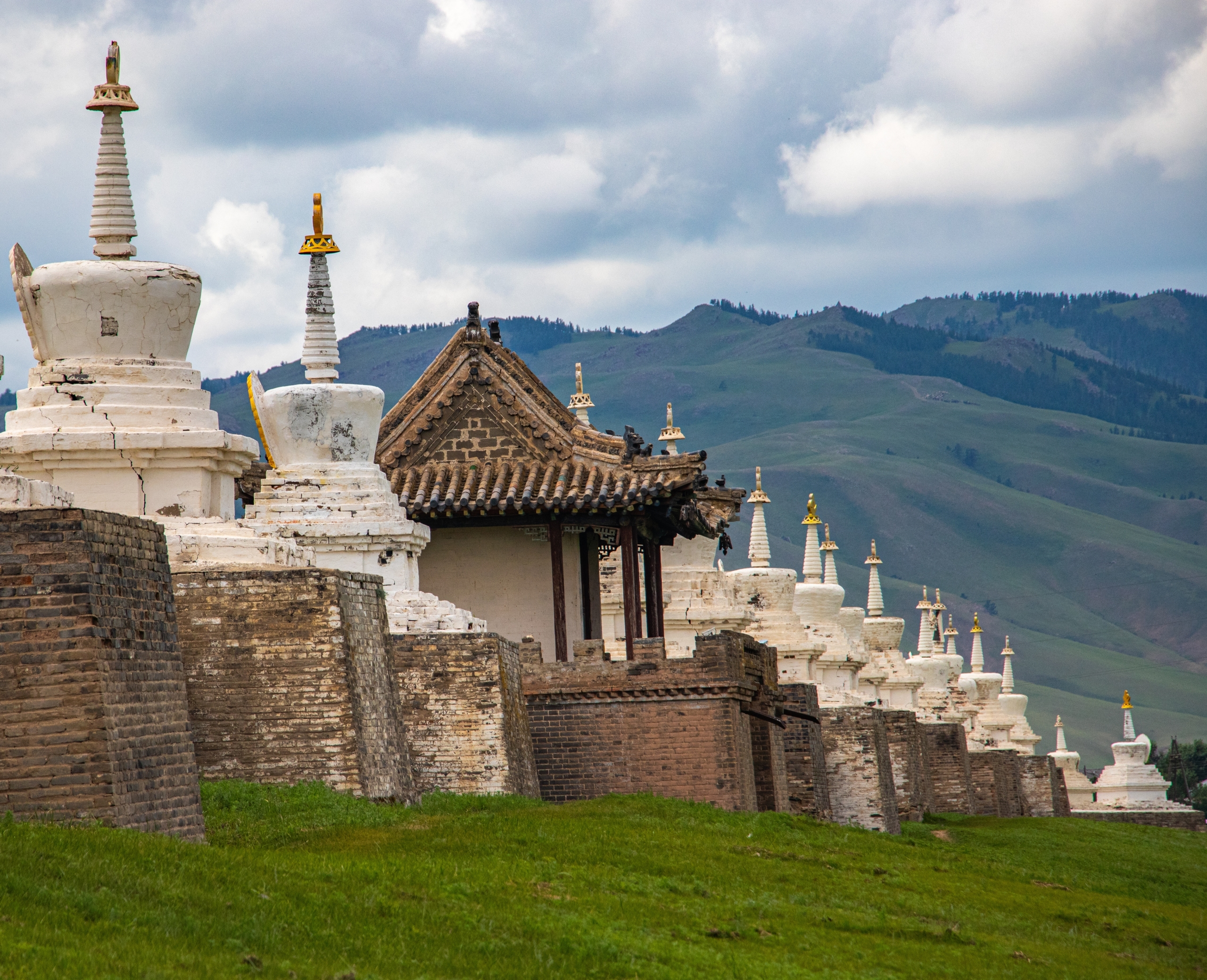
Rising from the open grasslands of central Mongolia, the walled silhouette of Erdene Zuu Monastery appears against the vast horizon of the Orkhon Valley. Its enclosure is punctuated by 108 white stupas, evenly spaced like a stone perimeter that traces the landscape rather than dominating it. For travelers moving through this region, Erdene Zuu offers a concentrated encounter with Mongolia’s layered past, where imperial ambition, artistic exchange, and monastic life intersect in a single site.
Located beside the archaeological remains of Karakorum, the former capital of the Mongol Empire, Erdene Zuu occupies a space shaped by continuity as much as rupture. It stands not only as the oldest surviving monastery in the country, but also as a material record of Mongolia’s transition from imperial center to Buddhist heartland.
Karakorum: From Imperial metropolis to cultural crossroads
Long before Erdene Zuu was founded, the Orkhon Valley formed the core of one of the largest land empires in history. Karakorum was established in the 13th century by Ögedei Khan, son of Genghis Khan, as the capital of a realm that stretched from the Yellow Sea to Eastern Europe. Rather than functioning solely as an administrative seat, the city developed into a hub of exchange under the relative stability often described as the Pax Mongolica.
Historical accounts describe a city where Persian merchants, Chinese artisans, Central Asian scholars, and European envoys lived and worked side by side. Karakorum contained Buddhist temples, mosques, Nestorian Christian churches, and Daoist shrines, arranged within ethnically and diplomatically defined quarters. Its urban fabric reflected a cosmopolitanism rare for its time, grounded in mobility, trade, and political pragmatism.
This period of prominence was brief. Within less than a century, shifts in imperial focus and military conflict led to the city’s destruction by Ming forces. Karakorum was abandoned, its structures dismantled or buried, leaving only scattered ruins. Although Marco Polo refers to the Mongol world in his writings, most scholars agree there is no reliable evidence that he personally visited Karakorum; his descriptions likely derived from courtly sources associated with Kublai Khan.
Today, visitors can walk among Karakorum’s remains, tracing foundation lines and encountering the carved stone turtles (bixi) that once marked ceremonial boundaries. The nearby Kharkhorin Archaeological Museum presents excavated artifacts—inscriptions, coins, sculpture fragments, and scale models—that help reconstruct the city’s former layout. Exploring these remains situates Erdene Zuu within a longer narrative of political power giving way to monastic settlement.
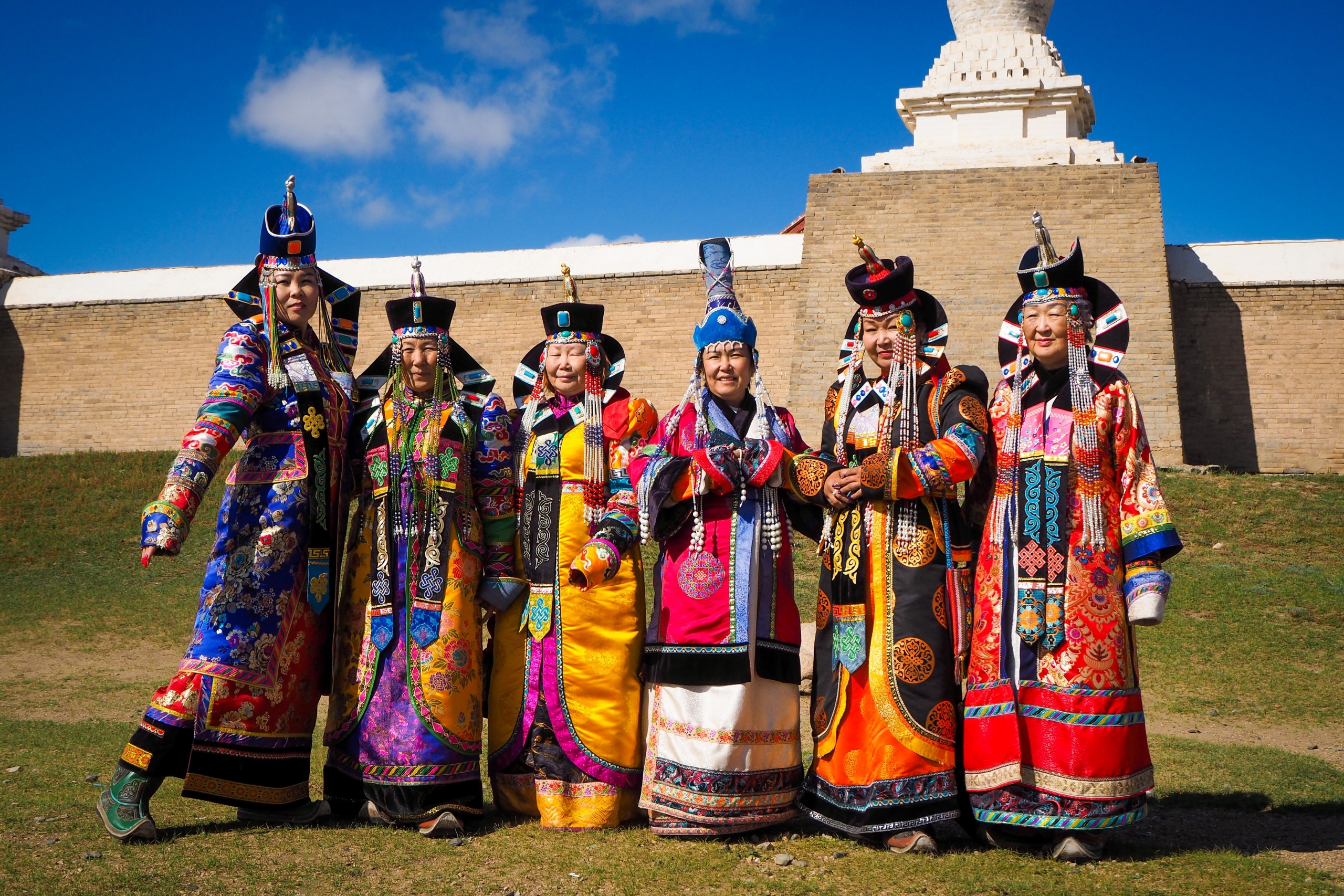
Erdene Zuu: A monastery built on memory
Erdene Zuu was founded in 1585 by Abtai Sain Khan, following diplomatic and religious exchanges with the Third Dalai Lama. Construction materials were taken directly from the ruins of Karakorum, a deliberate gesture that embedded the imperial past into the new monastic complex. The monastery was laid out as a symbolic mandala, enclosed by 108 stupas—a number associated with completeness in Buddhist cosmology.
During the 17th and 18th centuries, Erdene Zuu developed into a major cultural and educational center. It housed numerous temples, supported a large monastic population, and hosted public ceremonies such as tsam masked dances that drew participants from across the region. Artistic production flourished, blending Tibetan iconography, Chinese decorative elements, and Mongolian stylistic preferences.
The 20th century brought severe disruption. During the anti-religious campaigns of 1937–1939, thousands of monks across Mongolia were executed and most monasteries destroyed. Erdene Zuu was largely dismantled; only three temples and the surrounding wall survived. The remaining structures were preserved as a state-controlled “religious museum,” a status that allowed the site to endure, albeit stripped of its original function. Following Mongolia’s political changes in 1990, Erdene Zuu was returned to religious use while retaining its museum role.
What to see today: Architecture, art, and use
Erdene Zuu now functions simultaneously as an active monastery and a heritage site. A small monastic community resides within the complex, while visitors are free to explore its grounds and interiors.
The three surviving temples
- Zuun Zuu (East Temple) – Associated with the early life of the Buddha, this structure contains finely modeled sculptures and restored wall paintings.
- Baruun Zuu (West Temple) – Linked to youth and learning, it features protective deities and strong color contrasts.
- Central Buddha Temple – Focused on the mature Buddha Shakyamuni, this building anchors the complex both spatially and symbolically.
Together, these temples offer a concentrated view of artistic synthesis across regions and periods. Murals, thangkas, carved woodwork, and ritual objects reveal how visual culture adapted to local materials and aesthetics.
Additional structures and surroundings
The Temple of the Dalai Lama, built in 1675, houses a prominent statue of Zanabazar, an important historical figure in Mongolian Buddhism, alongside representations of successive Dalai Lamas. Circling the monastery along the line of the 108 stupas remains a common practice for both pilgrims and visitors, serving as a contemplative walk rather than a formal ritual requirement.
Several smaller pavilions display masks used in tsam dances, musical instruments, and liturgical objects. Modern utility buildings accommodate current residents and administrative needs. A short walk from the complex leads to the so-called Kharkhorin Rock, a carved stone associated with local folklore and monastic discipline narratives.
Practical information for travelers
Erdene Zuu is located in Kharkhorin, approximately 360 km southwest of Ulaanbaatar. Road travel takes five to six hours, and daily buses operate from the Dragon Bus Terminal in the capital. From May to September, the site is generally open from 09:00 to 18:00; winter access is limited due to extreme cold.
Entry to the grounds is free, while interior temples require a modest ticket. Photography usually incurs an additional fee. Basic guided tours are available in Mongolian and English. Facilities include restrooms, a small souvenir shop, and guesthouses in the surrounding town. Late spring through early autumn offers the most favorable conditions, when the steppe is accessible and the Orkhon Valley landscape is at its most vivid.
A landscape of continuity and change
A visit to Erdene Zuu situates travelers within a landscape shaped by successive layers of use and meaning. The site allows for quiet observation: of monastic routines continuing after decades of interruption, of ruins marking the former center of a global empire, and of an open valley that has absorbed both without spectacle. Erdene Zuu stands as a record of Mongolia’s capacity to adapt inherited structures—political, architectural, and cultural—into new forms suited to changing historical circumstances.
AI Transparency Notice
PilgriMaps uses artificial intelligence tools to assist in the research, drafting and translation of editorial content. All AI-assisted content is reviewed, edited and verified by our editorial team before publication. We contrast information against primary sources, specialist literature and on-the-ground knowledge to ensure accuracy, cultural sensitivity and editorial integrity.
AI is one tool among many in our workflow. The judgement, curation and responsibility for everything published on this platform remain entirely human.
Viator Media S.L. — in compliance with the EU Artificial Intelligence Act (Regulation EU 2024/1689).
This post is also available in: