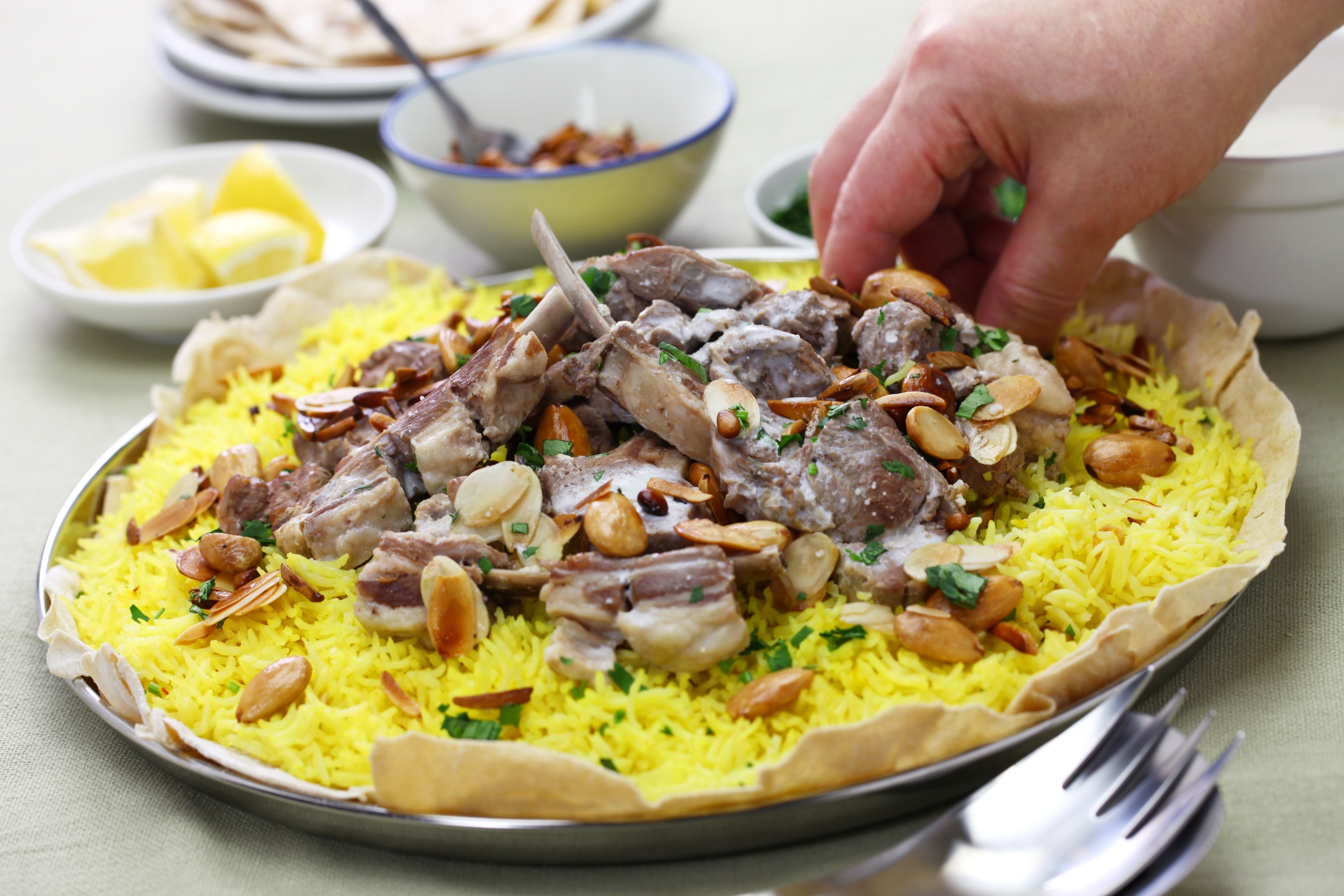
The first encounter with mansaf does not begin on the palate, but in the setting. A large round platter is placed at the center of the room. Several hands reach toward the same point, with a restraint that feels almost ceremonial. There is a brief pause before the first bite. In Jordan, mansaf is not ordered; it is shared. In that simple, ancient gesture lies a dense concentration of history, identity, and social meaning.
More than a national dish, mansaf functions as a cultural language. It communicates hospitality, belonging, social hierarchy, reconciliation, and memory. To understand mansaf is one of the most direct ways to understand Jordan.
Bedouin origins
Any explanation of mansaf begins in the desert. In traditional Bedouin life, food was less about pleasure than survival and cohesion. Nomadic tribes relied on pastoralism and ingredients that could be preserved and transported: lamb or camel meat, flatbread, and animal fats such as clarified butter. Dried yogurt—jameed—existed, but not yet as a sauce. It was a hardened, dehydrated product, reconstituted only when needed.
Early mansaf was austere. Boiled meat, bread to absorb juices, fat for calories. No rice. No elaborate preparation. It was a meal designed to feed many people efficiently while reinforcing group bonds.
Later narratives sometimes place its origins in ancient periods, even linking it to the biblical kingdom of Moab and to symbolic acts of cultural defiance, such as cooking meat with dairy products. These stories function best as retrospective identity myths rather than historical evidence. Mansaf’s real roots lie in Bedouin social organization and collective ways of inhabiting territory.
From tribal meal to national dish
The mansaf known today is not a static survival of the past, but a tradition shaped by change. Its most significant transformation occurred in the 20th century, as Jordan began to take form as a modern state. Processes of sedentarization, exposure to other cuisines, and especially the introduction of rice—widely adopted from the 1920s onward—altered the dish’s structure. Rice replaced wheat or bulgur, and jameed shifted from a supplementary food to the defining element of mansaf, reimagined as a tangy, creamy sauce in which the meat is cooked.
This culinary evolution mirrored broader political and cultural developments. Following independence, and particularly after 1967, Jordan faced internal tensions that made the articulation of a shared national identity increasingly urgent. Bedouin heritage, framed as an authentic foundational culture, became central to that narrative. Mansaf, strongly associated with that heritage, rose to symbolic prominence.
Its consolidation as the “national dish” is inseparable from this historical moment.
Eating to say “We are Jordan”
From then on, mansaf ceased to be merely celebratory food and became a marker of belonging. Serving mansaf is a statement—of hospitality, status, and identification. Urban families, non-Bedouin communities, and Jordanians of Palestinian origin adopted mansaf for weddings and major gatherings as a way of signaling integration into Jordanian society. Eating from the same platter expresses a shared position: we are on the same side of the table.
Mansaf also operates as a social and political instrument. In tribal contexts, sharing it can formalize reconciliation after conflict. At funerals, it embodies collective solidarity. During national celebrations, it reinforces communal identity. The dish does not merely nourish; it structures relationships.
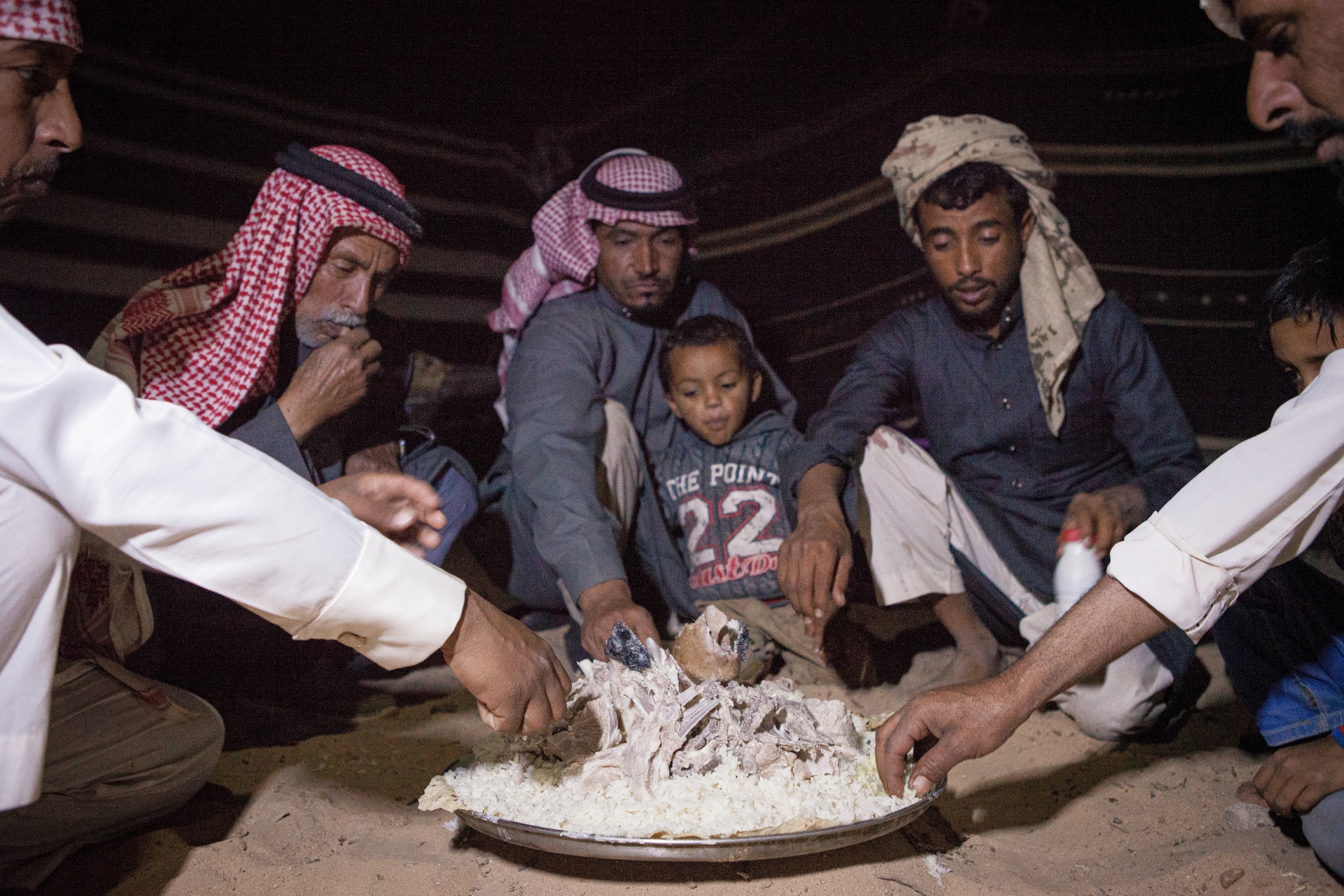
The liturgy of the platter
The ritual surrounding mansaf is as significant as its ingredients. Traditionally, it is served on a large round tray. At the base lies shrak bread, followed by white rice tinted yellow with turmeric. On top rest large pieces of lamb, slow-cooked in jameed sauce. More hot sauce is poured over everything, then finished with toasted almonds and pine nuts.
It is eaten with the right hand. One does not cross into another’s space. One does not blow on the food. Small portions of rice and meat are shaped with three fingers. These rules are rarely verbalized; they are learned through observation. Mansaf is a meal that prioritizes awareness of the group over individual preference.
Today, for convenience or to accommodate visitors, mansaf is often served in individual plates with cutlery. Yet when eaten according to custom, the message is unambiguous: there are no isolated diners here, only a collective.
Food for life’s thresholds
Mansaf accompanies major moments across the life cycle. It appears at weddings, births, and graduations, as well as at funerals and during periods of mourning. In every case, its function is consistent: to gather, to support, to accompany.
In tribal society, mansaf has long served as a tool of mediation. Sharing the platter after a dispute symbolizes the end of hostility and the restoration of honor. Few dishes globally illustrate so clearly how food can operate as a social and political act.
Who does mansaf belong to?
Although strongly identified with Jordan today, mansaf belongs to a wider Bedouin tradition. Related dishes exist in Palestine, Syria, Saudi Arabia, and southern Iraq. Some versions use wheat or bulgur; others rely on fresh yogurt instead of jameed. Modern borders do not align with historical tribal routes.
This has generated identity debates, particularly between Jordan and Palestine. Yet mansaf itself offers a response: it is a dish created to be shared. More than the property of any single nation, it forms part of the broader cultural heritage of the Levant.
In 2022, mansaf was inscribed on the Intangible Cultural Heritage list of UNESCO, recognizing its value as a living social practice rather than simply a recipe.
Modernity, however, brings challenges. Urban restaurants, fast adaptations, and even attempts to serve mansaf in individual cups have sparked controversy. How far can the dish adapt without losing its meaning? The debate reflects a broader tension familiar to many traditions: how to preserve significance without freezing culture in place.
Mansaf as a travel experience
For travelers to Jordan, trying mansaf is often considered essential. Yet not all mansaf experiences are equal. Restaurant versions are accessible and satisfying; a home-prepared mansaf is transformative. If invited to share one in a family setting, it is worth accepting without hesitation. This is not simply a meal, but a cultural immersion.
Arriving without haste, observing attentively, asking respectfully, and following the lead of others all matter. Mansaf is best appreciated when the dynamics around the platter are understood.
It cannot be fully grasped by reading a recipe or listing ingredients. Mansaf reveals itself when it is shared. In Jordan, history is not always written in books; sometimes it is served hot, on a large tray, placed at the center of the room.
Some cultures explain themselves with words. Others—like this one—are better understood by eating together.
AI Transparency Notice
PilgriMaps uses artificial intelligence tools to assist in the research, drafting and translation of editorial content. All AI-assisted content is reviewed, edited and verified by our editorial team before publication. We contrast information against primary sources, specialist literature and on-the-ground knowledge to ensure accuracy, cultural sensitivity and editorial integrity.
AI is one tool among many in our workflow. The judgement, curation and responsibility for everything published on this platform remain entirely human.
Viator Media S.L. — in compliance with the EU Artificial Intelligence Act (Regulation EU 2024/1689).
This post is also available in: