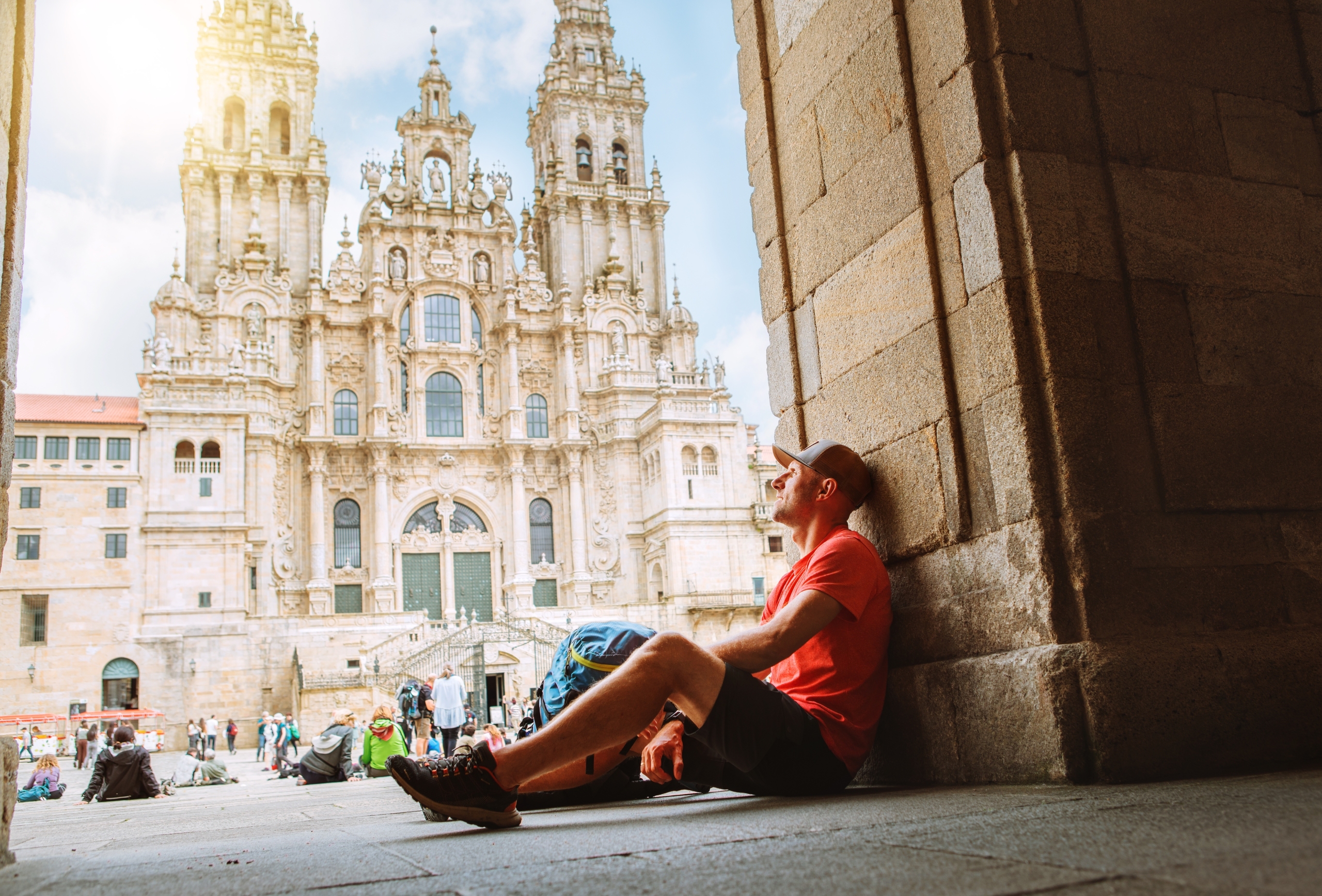
At the Holy Door of the Cathedral of Santiago de Compostela, there are people who have not cried in years and who, at that precise moment, cannot stop. No one told them to. It simply happens.
In 1909, the French anthropologist Arnold van Gennep published a study that researchers around the world are still building on more than a century later. The title was Les Rites de Passage — the rites of passage — and the central argument was, as with all great insights, simultaneously simple and revolutionary: every significant moment of transformation in a person’s life — birth, puberty, marriage, death, change of social status — is structured, in every culture on earth without exception, in the same way. There is a phase of separation from the old state. There is a threshold phase — the limen in Latin, the term that gives us the word “liminal” — a space of ambiguity and uncertainty, of “no longer what I was and not yet what I will be.” And then there is aggregation: entry into the new state. The middle phase — the uncomfortable one, the one without defined identity, the one without clear instructions — is, according to van Gennep, the most important. It is there that real transformation occurs.
What van Gennep had observed — and what is so relevant for those who walk — is that nearly every rite of passage in every culture includes a physical crossing of a threshold: a door, an arch, a bridge, a gate, a ford. Not as decoration or as a mere architectural accident. As an active, functional device. As though the body required a physical, spatial signal — in concrete space — to truly register that something has changed. That the change is not only in the mind or in intention. It is in the crossing of a boundary.
This explains, at least in part, why sacred architecture across every religious tradition, in every era and every part of the world, has always devoted disproportionate attention to entrances over any other element of the building. The Shinto torii — that red wooden arch marking the entrance to Japanese shrines, often placed in the middle of a forest or over water, sometimes kilometers before the main structure — is not there for structural or directional reasons. It is there to tell the body, before the mind has caught up: ordinary space ends here. Something different begins. Conduct yourself accordingly. The Romanesque portals of medieval European cathedrals, with their elaborate carvings of saints, demons, apocalyptic figures, and scenes of daily life covering every centimeter of the jambs and archways, served exactly the same function: before you had even stepped inside, they already told you that this was a different kind of space, requiring a different kind of presence.
The Holy Door of Compostela opens only during Holy Years — those years when the feast of Saint James, July 25th, falls on a Sunday. In these years, thousands of pilgrims add a specific element to their preparation: arriving in time to pass through that door. Not the side entrance, not the main portal of the baroque façade. That particular door, on the right side of the cathedral, normally bricked up and hidden behind wood, which opens only in these rare years. The fact that it leads to the same nave as any other entrance is entirely beside the point. What matters is the ritual of crossing, the deliberate act of passing through that specific threshold at that specific moment. The physical boundary becomes an interior one. The body that passes through becomes a body that changes.
Psychological research has documented something analogous in far more ordinary contexts. Cognitive neuroscientist Gabriel Radvansky studied what has become known as the “doorway effect”: people carrying objects through a doorway — even in a virtual environment — forget significantly more often what they were doing or what they were carrying compared to people who cover the same distance without crossing any threshold. The brain, it appears, uses spatial boundaries as boundaries between episodes: when a door is crossed, the “previous chapter” is archived and a new one opens. Memories and intentions associated with the previous chapter become less accessible. A door is not simply an opening in a wall. It is an interrupt in the continuity of experience.
Bridges deserve separate attention. In nearly every culture in the world, “crossing a bridge” is a metaphor for transition, for passage from one state to another. The bridge on the pilgrimage route — the Puente la Reina on the Via Francigena, the Romanesque bridges that punctuate the Camino Francés, the medieval bridges crossing the Tuscan rivers on the Via Romea — was traditionally a place of pause, offering, and prayer. Medieval pilgrims stopped on bridges, watched the water moving beneath their feet — that universal symbol of time passing and not returning — and some left something behind: a coin, a piece of bread, a prayer spoken into the air. It was not superstition. It was the recognition that this place — this boundary between two banks, this point suspended above moving water — had something to say to the traveler.
Those who have crossed the Cruz de Ferro on the Camino Francés — that iron pole topped with a cross, planted in a mound of stones deposited by millions of pilgrims over the centuries — know that the act of laying down the stone carried from home produces something impossible to explain rationally and equally impossible to deny. The stone represents something one wishes to leave behind — a grief, a regret, a relationship that has ended, a loss not yet fully mourned. And the physical gesture of setting it down, of leaving it there and walking away without picking it up again, does something that mental intention alone does not. The body needs gestures in space to close the chapters the mind struggles to close on its own.
To cross a threshold is to say, with the body before the words arrive: from here, something is different. And sometimes it is enough to tell that to the body for it to become true.
References:
Van Gennep, A. (1909). Les Rites de Passage. Émile Nourry. Turner, V. (1969). The Ritual Process: Structure and Anti-Structure. Aldine.
AI Transparency Notice
PilgriMaps uses artificial intelligence tools to assist in the research, drafting and translation of editorial content. All AI-assisted content is reviewed, edited and verified by our editorial team before publication. We contrast information against primary sources, specialist literature and on-the-ground knowledge to ensure accuracy, cultural sensitivity and editorial integrity.
AI is one tool among many in our workflow. The judgement, curation and responsibility for everything published on this platform remain entirely human.
Viator Media S.L. — in compliance with the EU Artificial Intelligence Act (Regulation EU 2024/1689).
This post is also available in: