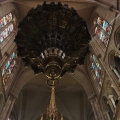
The church of San Miguel in Arévalo, built between the 12th and 16th centuries, is an outstanding example of Mudejar style, the result of the artistic fusion of Christian and Muslim influences. This church was founded by the Montalvo family, whose coats of arms can be seen on several tombs and in the family archives of the temple. Declared an Asset of Cultural Interest, it is located next to the medieval wall in the northwest of the city. Its masonry structure with brick walls preserves original parts such as the choir, the enclosure walls and its tower, once one of the highest in the city.
Inside, the main altarpiece stands out, a work of art from the XVI century painted by Marcos Pinilla, composed of thirteen tables distributed in five aisles and three bodies. This altarpiece depicts scenes from the Passion and Death of Christ, as well as one of the apparitions of the Archangel St. Michael. The paintings, in Hispano-Flemish style, represent an artistic transition to the Renaissance. The church also has a reformed 18th century choir stalls and the exterior of an organ in a raised tribune. Closed for worship since 1911, the church is occasionally used for cultural events, maintaining its importance as an important architectural and artistic heritage of the region.
- Address
C. San Miguel, 15, Arévalo, Ávila - Web
None - Visiting Hours
Opened only for cultural events - What to see
Altarpiece dedicated to St Michael
AI Transparency Notice
PilgriMaps uses artificial intelligence tools to assist in the research, drafting and translation of editorial content. All AI-assisted content is reviewed, edited and verified by our editorial team before publication. We contrast information against primary sources, specialist literature and on-the-ground knowledge to ensure accuracy, cultural sensitivity and editorial integrity.
AI is one tool among many in our workflow. The judgement, curation and responsibility for everything published on this platform remain entirely human.
Viator Media S.L. — in compliance with the EU Artificial Intelligence Act (Regulation EU 2024/1689).
This post is also available in: