In 1344, the North African traveler Ibn Battuta crossed the mist-covered forests of Sri Lanka’s interior in search of a legendary mountain. Guided by local devotees, he eventually reached a towering summit that, to his eyes, resembled an anvil, rising alone from the jungle. At its peak, he found what he was looking for: a large footprint carved into the rock, measuring approximately eleven handspans. For Ibn Battuta, it was unmistakable—“the blessed footprint of our father Adam, the first human, who descended to Earth upon this mountain.”
What Ibn Battuta may not have known—or perhaps did—is that the mountain had been considered sacred long before the emergence of Islam. And the footprint he observed is claimed by multiple religious traditions, each assigning it a different origin.
A Sacred Mountain since Antiquity
Today known as Adam’s Peak in English and Sri Pada in Sinhala (“Sacred Footprint”), the mountain has drawn reverence since antiquity. With its distinct pyramidal silhouette and gemstone-laden slopes, the site has long been regarded as a place of otherworldly significance.
In pre-Buddhist belief systems of the island, the summit was associated with Saman, a guardian deity of the forests and skies. Later absorbed into the Buddhist pantheon as a protective deva, Saman remains venerated today. The earliest Buddhist texts refer to the peak as Samantakuta, meaning “Summit of Saman.”
Buddhist Interpretations: The Footprint of the Buddha

According to Sri Lankan Theravāda tradition, the Buddha visited the island on three occasions. On his final journey, he is said to have left the footprint at the request of Prince Sumana, who would later be deified as Saman.
In the 1st century BCE, the exiled King Valagambahu is believed to have encountered the footprint during a time of political refuge and declared it sacred. Over subsequent centuries, rulers such as Vijayabahu I and Parakramabahu II formalized pilgrimage routes, commissioned stone stairways, and endowed mountain temples with land and resources. The footprint was enclosed with a protective slab and a shrine was built around it.
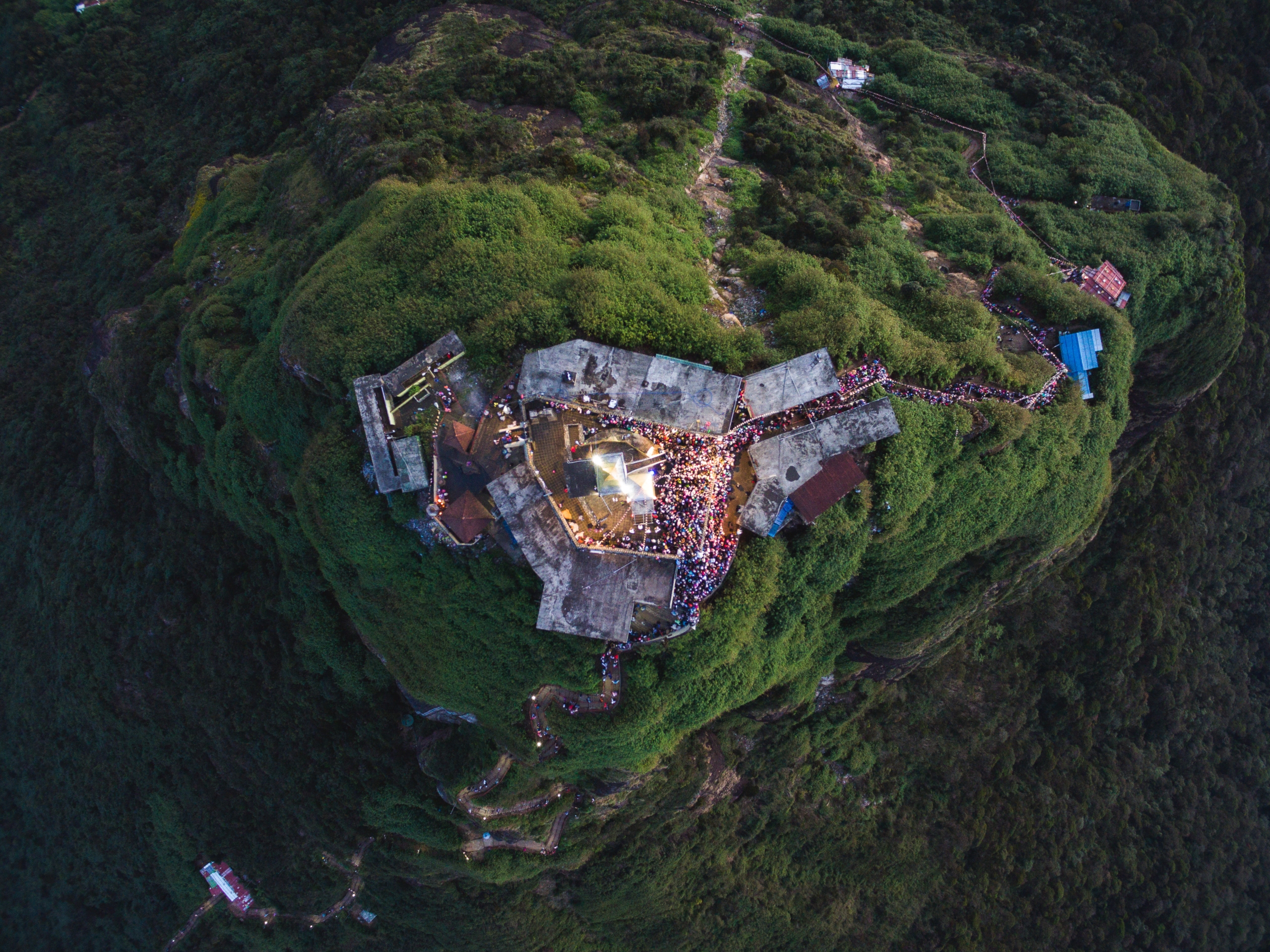
To this day, thousands of Buddhist pilgrims ascend the mountain—many overnight—to witness the sunrise from the summit. At dawn, the shadow of the peak casts a near-perfect triangular projection into the sky, a phenomenon that adds to the mountain’s symbolic power.
Tamil Hindu Perspectives: The Footprint of Shiva
Among Tamil Hindus, the same footprint is attributed to Shiva, the supreme ascetic and mountain-dwelling deity. In Tamil, the site is known as Sivanolipatha Malai, “Mountain of Shiva’s Lighted Foot,” and is also associated with Trikuta, the legendary stronghold of the demon king Ravana in the Ramayana.
Hindu pilgrims ascend the peak alongside Buddhists, often on the same paths and during the same season. Along the route, small devalayas (Hindu shrines) coexist with vihāras (Buddhist temples), reflecting a long history of shared space and plural devotional practices.
Islamic Narratives: The Mountain of the First Human
In Islamic tradition, Adam descended from Paradise to the island of Sarandīb—an early Arabic name for Sri Lanka—and landed on the mountain, leaving a footprint as he touched the earth. According to some accounts, Adam stood in penitence on one leg for years atop the summit, praying for forgiveness.
By the 10th century, Arab merchants had begun incorporating the mountain into their spiritual geography. Arabic inscriptions near the summit attest to these early visits, and through travelers like Ibn Battuta, the name Adam’s Peak entered Western cartographic and literary records. Islamic lore also links the island’s gemstones to the crystallized tears of Adam and Eve.
Medieval Christian Encounters
Though Christianity never developed a sustained devotional tradition around the mountain, several medieval European visitors left accounts of its significance. One was Giovanni de Marignolli, a Franciscan envoy of the papacy, who visited Sri Lanka around 1348. He described the footprint as “two and a half palms long” and debated whether it might belong to Adam, Saint Thomas the Apostle, or even the legendary King Josaphat – a Christianized version of the Buddha.
Other notable accounts include those of Marco Polo, who described the site as a major pilgrimage destination in the late 13th century, and Robert Knox, an Englishman held captive in Sri Lanka in the 17th century, who recounted folk beliefs linked to the peak. In the 19th century, John Davy, a British physician, described the footprint as crude in form yet undeniably surrounded by an atmosphere of sincere veneration.
A Shared Summit
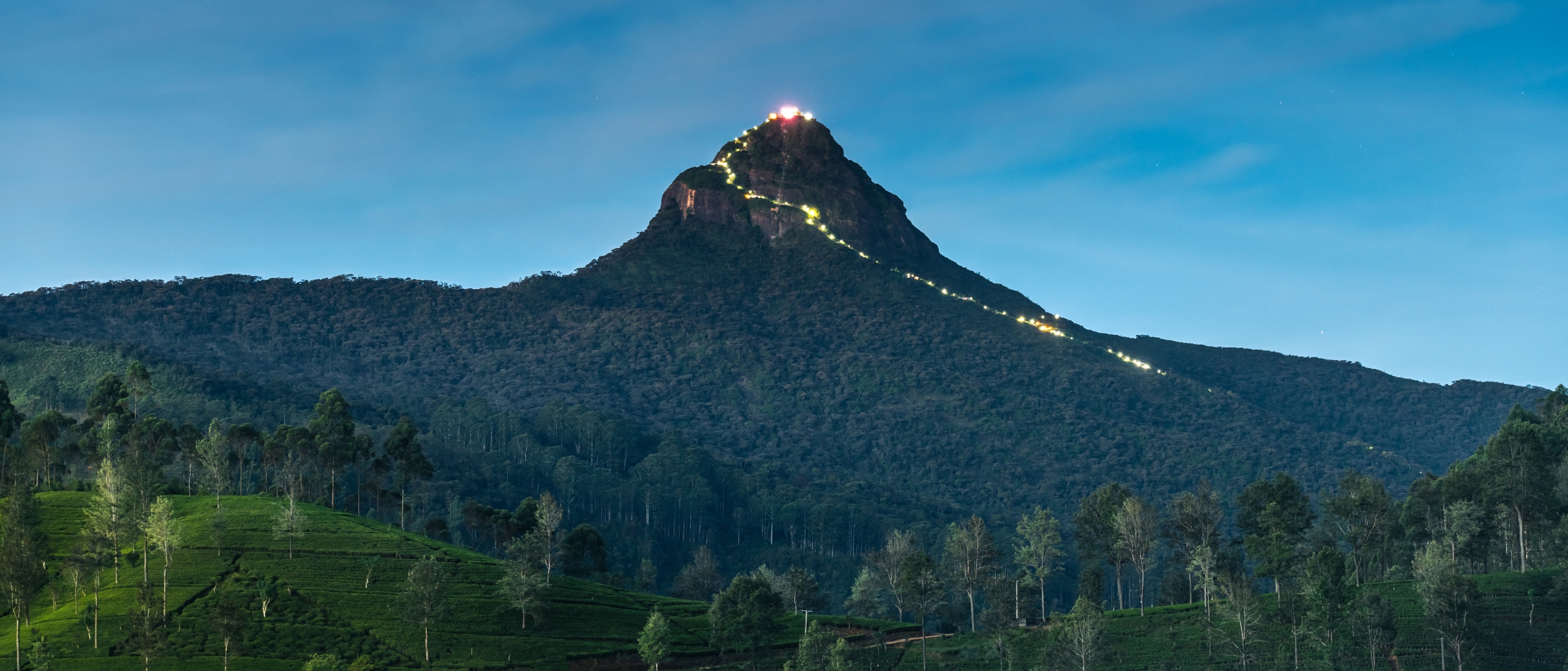
For over a thousand years, Adam’s Peak has been a site of multireligious pilgrimage. Its pathways are lined with inscriptions in Arabic, donations from Buddhist kings, and shrines reflecting multiple faiths. Pilgrims climb not in opposition, but often in parallel—each community interpreting the mountain through its own worldview, yet coexisting in practice.
The main pilgrimage season runs from December to May, with most pilgrims taking the route from Hatton, which includes over 5,000 stone steps. Many ascend at night to reach the summit by sunrise, when the conical shadow of the mountain appears suspended in the sky.
At the top, a bell is rung by each person who has completed the ascent—once for every successful visit. Some ring it once. Others, fifteen times. A few, a hundred.
An estimated 100,000 people climb the mountain each year. At the summit, individuals pray, chant, or sit in silence—each in their own way. Some recite mantras. Others say Allāhu Akbar. Others simply watch the sky shift with the rising sun.
A Footprint in the Human Imagination
Few mountains in the world carry the symbolic density of Adam’s Peak. Whether seen as the footprint of Buddha, Shiva, Adam, or another figure entirely, the depression in the rock reflects less a singular origin than a shared human impulse to ascribe meaning to place.
Ultimately, the source of the footprint may remain uncertain. What is certain is the legacy it has left in those who have encountered it. For centuries, people of differing beliefs have climbed to the same summit, following different paths yet converging in reverence—a rare example of spiritual coexistence embedded in landscape.
AI Transparency Notice
PilgriMaps uses artificial intelligence tools to assist in the research, drafting and translation of editorial content. All AI-assisted content is reviewed, edited and verified by our editorial team before publication. We contrast information against primary sources, specialist literature and on-the-ground knowledge to ensure accuracy, cultural sensitivity and editorial integrity.
AI is one tool among many in our workflow. The judgement, curation and responsibility for everything published on this platform remain entirely human.
Viator Media S.L. — in compliance with the EU Artificial Intelligence Act (Regulation EU 2024/1689).
This post is also available in: