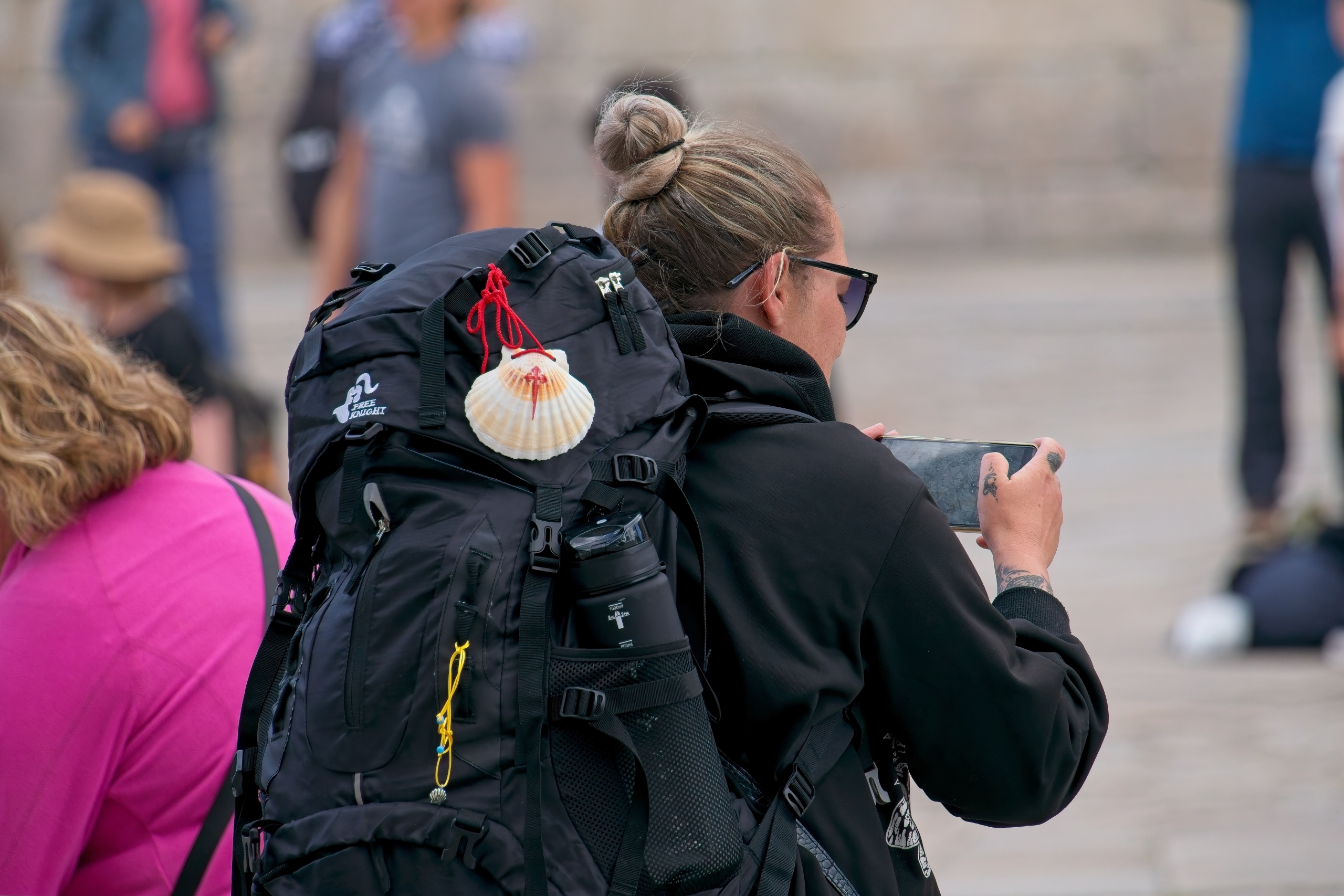
You’ve stepped away from daily routines to walk hundreds of kilometers in search of clarity. Unfortunately, that clarity is often buried beneath dozens of messages, work chats, and social media updates from people you barely follow.
Let’s be honest: the idea of setting out on a long-distance route without constant access to a smartphone can trigger real anxiety. What if something happens? What if I get lost? What if I miss something important?
And yet, here you are, reading an article about digital restraint. Which suggests that part of you—the part still capable of sustained attention between notifications—suspects that carrying an entire digital ecosystem on a route like the Camino de Santiago may not be especially helpful.
That instinct is worth listening to.
Walking needs mental space
When you walk—truly walk, without stopping every few minutes to check a screen—the brain responds in measurable ways. Stress levels decrease. Attention improves. Cognitive processes slow into a more sustainable rhythm. Studies consistently show that extended walking supports memory, emotional regulation, and decision-making.
All of this, however, depends on mental space. Constantly checking notifications keeps the mind in a loop of anticipation and interruption. The body moves forward, but attention stays fragmented. The result is familiar: restlessness, mental fatigue, and the sense of being perpetually behind.
In practical terms, this means walking long distances only to reproduce the same patterns of distraction found at home—just with better scenery.
Why it’s difficult to disconnect
Smartphones are engineered to capture attention. Notifications, likes, and updates trigger small but frequent neurological rewards. Over time, the habit becomes automatic. Expecting to override this system through willpower alone is unrealistic.
On long-distance routes, this dependency appears in predictable ways: photographing every landmark and spending rest breaks editing images; posting daily updates out of obligation; checking dating apps or messages instead of engaging with people sharing the same space.
The result is partial presence. The body completes the route, but attention is directed elsewhere.
A digital detox: Pilgrimages can help you reclaim your natural rhythm
Two weeks before departure: reducing reliance
Moving directly from frequent phone use to extended disconnection is challenging. A gradual approach works better.
Two weeks before departure
Disable all non-essential notifications. Keep only calls and direct messages if necessary. Set specific times—once in the morning and once in the evening—to check email or social platforms. Outside those windows, the phone remains silent.
Inform people who matter that you will be less reachable. This sets expectations and reduces anxiety on both sides.
One week before departure
Remove applications that encourage habitual checking. If the idea feels uncomfortable, that discomfort is a useful indicator. Replace digital navigation with a paper map. Physical orientation fosters attentiveness and reduces dependence on screens.
Departure day: creating distance
Use airplane mode—not silent mode, not “do not disturb.” Place the phone deep in your backpack, somewhere that requires effort to access. Physical inconvenience can be an effective deterrent.
During the first days:
- If you sense a vibration that isn’t there—a common phenomenon—pause and notice the impulse rather than reacting to it.
- When encountering a striking landscape, look at it directly. Stay slightly longer than necessary. Observe details no image would capture.
- When boredom arises, allow it. Boredom often precedes reflection and creativity.
Evenings without screens
Evenings are the most vulnerable moment: fatigue, shared spaces, and widespread phone use make distraction tempting.
Consider alternatives:
- Writing. A notebook allows the day to settle. A few lines are enough.
- Conversation. Without screens as intermediaries, exchanges tend to become more direct and memorable.
- Sleep. Reduced screen exposure improves rest. Early sleep supports recovery and attention the following day.
When you reconnect—briefly
At some point, most people reconnect longer than intended. This does not undo the experience. It simply reflects established habits.
Return the phone to airplane mode and continue. The goal is not perfection but awareness. Each moment of noticing matters.
Returning home: preserving what changed
After weeks of walking, many people feel calmer and more attentive. That state can disappear quickly if everything is reactivated at once.
A simple guideline helps:
The first 48 hours
Limit communication to close contacts. Gradually reintroduce work-related messages. Social platforms can wait.
New routines
Daily walks without a phone
Fixed times for social media
Keeping phones out of the bedroom
Habits stabilize over time. If sustained for several weeks, the adjustment often feels natural rather than forced.
A final observation
No long-distance route is strictly necessary to reduce smartphone use. The same experiment could be done at home. But daily life provides endless justifications to remain connected. A long walk removes many of those excuses. Disconnection becomes practical, even logical.
That is why it works—not because the route is exceptional, but because it creates conditions that allow attention to return.
The landscapes, towns, and landmarks matter. But they are context. The central experience is learning to be present without constant interruption.
Buen Camino – offline.
AI Transparency Notice
PilgriMaps uses artificial intelligence tools to assist in the research, drafting and translation of editorial content. All AI-assisted content is reviewed, edited and verified by our editorial team before publication. We contrast information against primary sources, specialist literature and on-the-ground knowledge to ensure accuracy, cultural sensitivity and editorial integrity.
AI is one tool among many in our workflow. The judgement, curation and responsibility for everything published on this platform remain entirely human.
Viator Media S.L. — in compliance with the EU Artificial Intelligence Act (Regulation EU 2024/1689).
This post is also available in: