There is a precise moment, on certain trails in Tibet or the Andes, when the legs stop complaining and the brain simply yields to the present. This is not mysticism. It is oxygen – more precisely, the lack of it.
Call it the moment of surrender. It usually arrives between 4,000 and 4,500 meters, at a point in the journey where the landscape has already become so extreme in its scale that it ceases to feel entirely real. A few steps, then a pause. A few more steps. Breath that does not come as it should. Legs that feel twice as heavy as usual. And something, amid all this, that begins to slow in an unfamiliar way – not the body, but thought.
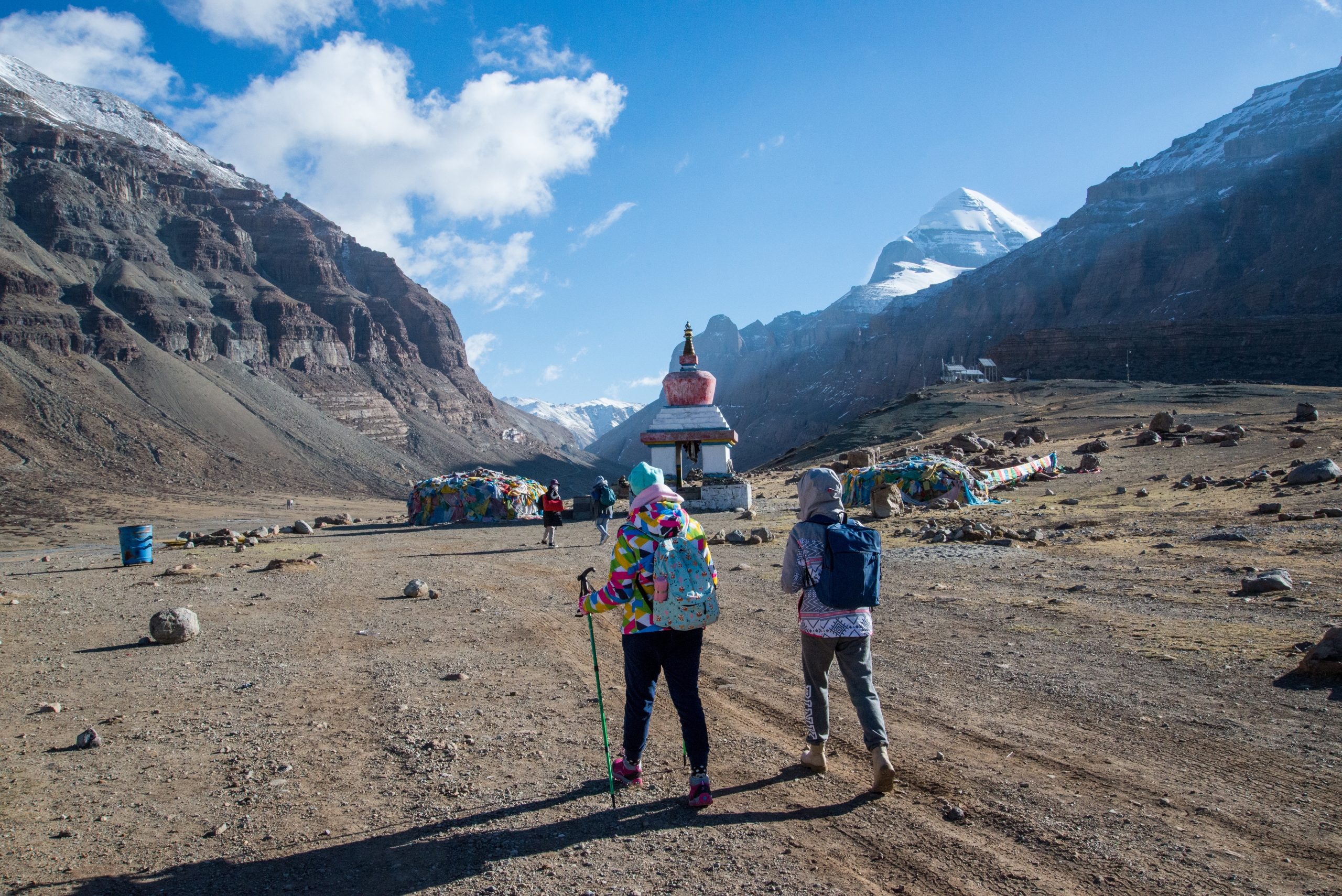
Those who have walked the kora of Mount Kailash – the 52-kilometer circuit around a mountain held as sacred across Tibetan, Hindu, Jain, and Buddhist traditions, with its highest point at the Dolma La pass (5,636 meters) – tend to describe a similar progression. In the first days, walking becomes a technical problem to solve: rhythm, breathing, pauses every twenty minutes, water, trekking poles. Steps are counted, shoes are watched, prayer flags mark the path like a code in an unfamiliar language. Then something shifts. The circle tightens. The mind stops managing and simply remains. The only thing that exists is the step being taken now. This step. And it is, at root, physiology.
At 5,000 meters, the air contains roughly half the oxygen molecules available at sea level. The body – pragmatic and indifferent to metaphor – responds by increasing breathing rate, accelerating the heart, compensating with volume for what it cannot achieve in concentration. Yet the brain, the organ with the highest oxygen demand, still receives less than it is accustomed to. The effects are concrete and measurable – and, for those willing to observe them with curiosity rather than alarm, remarkably revealing.
The frontal lobe, the region responsible for planning, judgment, and projection into the future, functions differently under mild hypoxemia. Abstract thinking becomes more effortful. Long-term concerns lose clarity. What remains sharply defined is the immediate present: the trail beneath one’s feet, the cold on the face, the sound of wind. Zen practitioners have described such a state for centuries as a goal. High altitude delivers it – without preparation and without request – to anyone with suitable boots.

Researchers studying high-altitude populations—Tibetans, Quechua communities in the Andes, Sherpas in Nepal—have identified genetic adaptations that allow these bodies to function where others struggle. Variants in specific genes, shaped by millennia of selection at altitude, regulate red blood cell production and oxygen transport differently. Yet the more revealing point may not be that they fare better, but that those unaccustomed to altitude, under pressure, encounter something that in lowland contexts might require years of contemplative practice to recognize: the present moment is not an abstraction. It is a physical sensation, and altitude makes it difficult to ignore.
Quechua guides in the Andes use the word despacio, which translates as “slowly,” yet carries a distinct nuance in the mountains. It is not merely a safety instruction. It operates as a working philosophy: to slow down, because haste at altitude reads as a form of disregard—for the mountain, for the terrain, for the conditions themselves. Those who arrive with the accelerated cadence of urban life—back-to-back meetings, constant messaging, overlapping notifications—often learn this principle abruptly. A headache that does not respond to analgesics, a sleepless night in a refuge at 4,200 meters, the unsettling sense that the body has chosen to stop cooperating in the least convenient place possible.
Acclimatization requires a capacity that contemporary life has largely set aside: waiting. It cannot be forced. It cannot be purchased or expedited through an application. The body proceeds at its own pace—producing more red blood cells, adjusting oxygen transport, recalibrating respiration—and the most effective response is to follow: walk slowly, drink consistently, and observe. Observe the landscape, certainly, but also observe oneself in a way that rarely occurs at lower elevations.

High altitude, in this sense, operates with a kind of clarity. It reveals, with little mediation, how a person responds when control is no longer assumed. Fatigue is real and not negotiable. Slowness is imposed and cannot be argued with. Within that slowness, within the inability to distract oneself from a body working to breathe, many people encounter—unexpectedly—a form of quiet.
Some pilgrims return from the Kailash circuit or from the Inca Trail and describe having resolved questions that had remained open for years. Complicated relationships that seemed to settle during an ascent. Decisions long deferred that became evident. Concerns once sustained by routine that surfaced and then appeared less substantial than remembered. These accounts are not framed in the language of retreats or instruction. They are stated with the same directness used to describe a striking sunset. As if they were entirely ordinary—which, in context, they may be.
Science provides partial explanations for these phenomena: changes in cerebral blood flow, altered time perception, hormonal shifts associated with prolonged exertion, the effects of isolation and sustained quiet on the nervous system. Each explanation is plausible and useful. None fully accounts for the individual who returns from high altitude with a discernible change—slower, steadier, as though a tacit agreement had been made during the ascent and maintained afterward.
Thin air tends to remove what is unnecessary. Concerns that feel urgent at lower elevations often dissipate before the body reaches higher ground. As the background noise of the mind recedes—through hypoxemia, fatigue, or the scale of the surrounding landscape—something else may emerge, something that ordinary conditions rarely allow space to appear.
In Tibetan contexts, the term lung refers to a current of wind moving through the body’s internal channels. Across mountain cultures, different vocabularies describe related sensations. Even those without a contemplative framework often recognize, by the end of the circuit, what is being indicated.
AI Transparency Notice
PilgriMaps uses artificial intelligence tools to assist in the research, drafting and translation of editorial content. All AI-assisted content is reviewed, edited and verified by our editorial team before publication. We contrast information against primary sources, specialist literature and on-the-ground knowledge to ensure accuracy, cultural sensitivity and editorial integrity.
AI is one tool among many in our workflow. The judgement, curation and responsibility for everything published on this platform remain entirely human.
Viator Media S.L. — in compliance with the EU Artificial Intelligence Act (Regulation EU 2024/1689).
This post is also available in: