On Gozo’s western plateau, where wind-carved limestone ridges meet terraced fields, a stone path ascends across Ta’ Għammar Hill. This is the Via Crucis—a life-sized, open-air Way of the Cross that guides pilgrims toward the Sanctuary of Our Lady of Ta’ Pinu, a Mediterranean centerpiece of Maltese Marian devotion. Though the path itself is a recent addition to Gozo’s sacred landscape, completed in the early 21st century, it feels ancient in spirit—an extension of centuries of movement toward a place shaped as much by memory as by stone.
A landscape shaped by faith and geography
Unlike the narrow alleyways of Valletta or the stepped streets of Mdina, the approach to Ta’ Pinu unfolds in open space. Here, the Via Crucis is not enclosed by architecture but framed by low hills, sea breezes, and expansive Mediterranean light. The path begins at the base of Ta’ Għammar, a hill directly facing the basilica, and winds upward in a slow, reflective arc. Along its route, fourteen sculptural tableaux depict the Stations of the Cross—from Jesus’ condemnation to his entombment—culminating in a fifteenth station: the Resurrection.
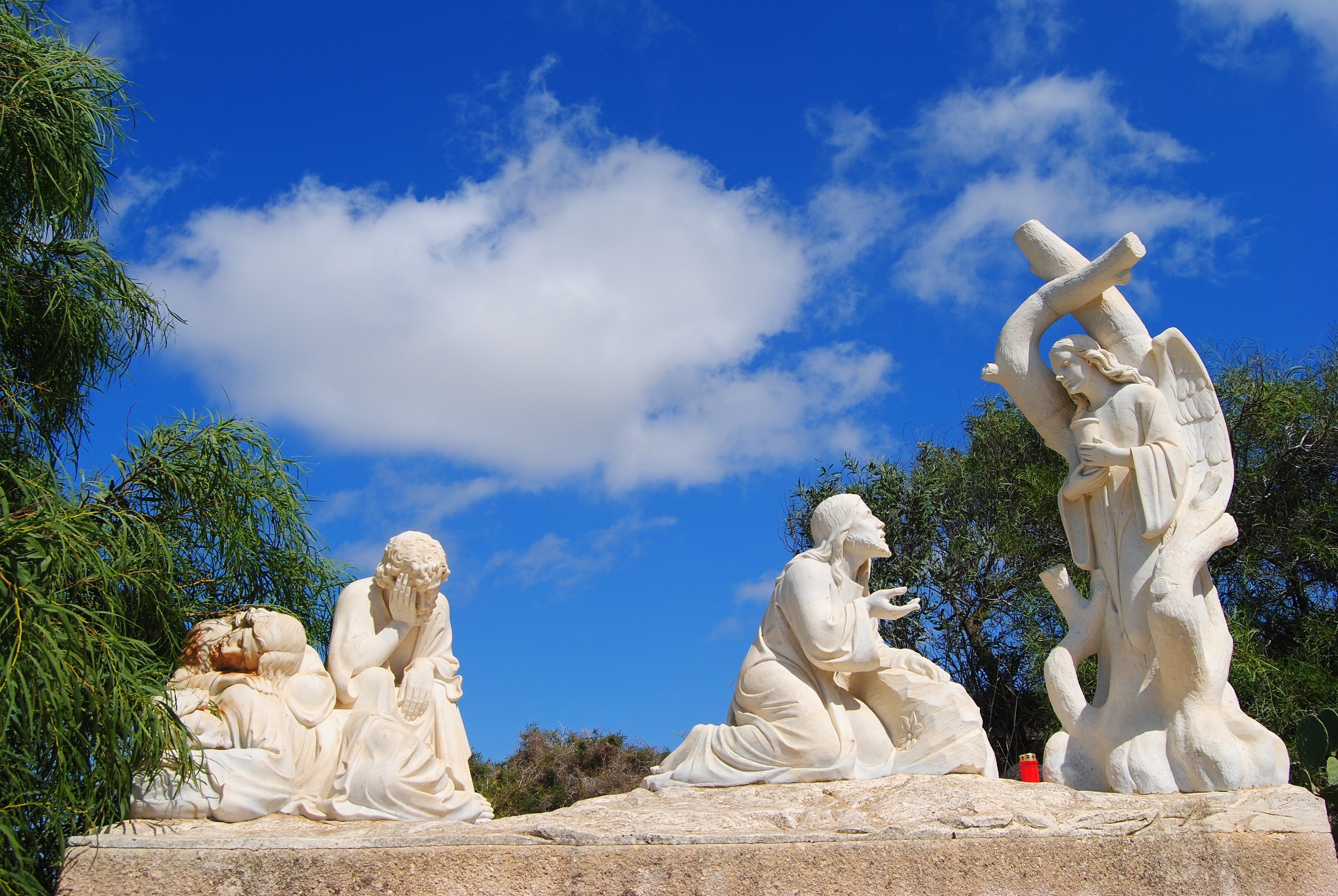
Each station is hewn from local limestone and rendered with quiet intensity. The figures are not overly ornate, but they carry expressive weight, rooted in gesture and posture rather than ornament. For pilgrims, walking the Via Crucis here is a devotional act and an embodied engagement with a sacred story—one reinterpreted through Gozo’s geological and cultural language.
At the summit, the hill offers a commanding view of the sanctuary below, framed by golden fields and, beyond them, the Mediterranean horizon. The movement from valley to hilltop mirrors the spiritual arc of the Passion itself: from descent into suffering to the promise of elevation.
The Sanctuary of Our Lady of Ta’ Pinu
The origin of the Ta’ Pinu shrine lies not in royal or ecclesiastical decree, but in an enigmatic voice heard by a local woman. In June 1883, Karmni Grima, a peasant from the nearby village of Għarb, passed a small country chapel and heard a voice instructing her to recite three Hail Marys. The voice, believed to come from the image of the Virgin Mary inside the chapel, was followed by a series of healings and answered prayers, soon attributed to Mary’s intercession.
The chapel—already centuries old—was preserved and expanded into a basilica, completed in 1931 and later designated a national shrine. The original 16th-century structure, with its modest proportions and intimate icon, remains intact inside the sanctuary’s larger nave. The revered image depicts Mary’s Assumption to heaven, embodying the Byzantine iconographic tradition that deeply shaped Mediterranean Marian imagery.
Ta’ Pinu’s rise to national prominence consolidated Gozo’s religious distinctiveness. Its reach extended to the Maltese diaspora, especially in Australia, the United States, and Canada, where emigrant communities often commissioned replica statues and chapels. Pilgrims continue to visit Ta’ Pinu seeking healing, offering thanks, or making petitions—many leaving ex-voto offerings in a dedicated gallery, where photos, crutches, and letters quietly attest to private experiences of suffering and gratitude.
Pilgrimage in modern form
Though lacking the ancient trails of Compostela or the arduous terrain of Sinai, the Via Crucis to Ta’ Pinu offers a different kind of pilgrimage. It is short in distance but layered in symbolism. The sculpted stations invite contemplation not through grandeur but through the slow passage and effort of feet, breath, and time.
In this way, Ta’ Pinu represents a form of contemporary pilgrimage rooted in repetition and accessibility. Local families walk the hill on Marian feast days. Elderly pilgrims take their time between stations, resting on stone benches built into the hillside. Schoolchildren come in groups to learn, reflect, and remember.
Yet it is not only a Catholic space. Its artistic and architectural presence, combined with the open landscape of Gozo itself, make it accessible to travelers interested in cultural heritage, spiritual geography, or the broader phenomenon of place-based meaning. What unfolds here is doctrine and lived memory—both individual and collective.
Enduring presence
Ta’ Pinu was visited by Pope John Paul II in 1990 and by Pope Francis in 2022, further solidifying its role in Malta’s national narrative. Yet its most profound significance lies in its quiet consistency. Long before it became a shrine of national stature, it was a chapel of rural devotion. Long before the sculptures lined the hillside, people climbed it anyway—seeking something beyond themselves, or perhaps returning to what they already carried within.
In the Ta’ Pinu Via Crucis, the sacred is embedded in visibility—in the open air, in stone gestures, and in the act of walking toward an image that has, for over a century, been the center of countless personal journeys.
AI Transparency Notice
PilgriMaps uses artificial intelligence tools to assist in the research, drafting and translation of editorial content. All AI-assisted content is reviewed, edited and verified by our editorial team before publication. We contrast information against primary sources, specialist literature and on-the-ground knowledge to ensure accuracy, cultural sensitivity and editorial integrity.
AI is one tool among many in our workflow. The judgement, curation and responsibility for everything published on this platform remain entirely human.
Viator Media S.L. — in compliance with the EU Artificial Intelligence Act (Regulation EU 2024/1689).
This post is also available in: