Across history, certain weapons have evolved from battlefield tools into cultural markers. Figures such as Charlemagne, Joan of Arc, or the legendary Castilian knight Rodrigo Díaz de Vivar became associated with blades that later acquired symbolic weight. These objects encapsulated ideas of authority, resistance, faith or leadership, and many entered the collective imagination as signifiers of formative moments.
Among them stands a piece less familiar beyond the Mediterranean, yet central to the faith and heritage of Malta: the sword attributed to Jean Parisot de La Valette, head of the Hospitaller Order during the Great Siege of 1565. It was the year in which the island, strategically situated in the central Mediterranean, resisted a major Ottoman campaign. The defense preserved Christianity in the Mediterranean and Europe, shaped early modern geopolitics, contained imperial ambitions, and secured the Order’s future in Malta. Later, the island’s capital established by the Grand Master was named after him, Valletta, and two swords – rather than one – carry his legacy into the present.
A Man and Two Blades
Contemporary accounts describe La Valette as disciplined and austere, with long experience in naval and terrestrial warfare. The sword used during the siege reflected these traits. It was a 16th-century side sword: balanced, functional, minimally decorated. Subtle engravings appear along the blade, including a rosary motif and a small crescent element. The latter has been interpreted variously by scholars, sometimes as a reference to adversaries in the Mediterranean conflict, though its precise meaning remains debated.
The Great Siege of Malta: A collective pilgrimage of Faith and Resistance
After the Great Siege of 1565, La Valette placed the weapon in a chapel in Birgu before the icon of Our Lady of Damascus. Throughout the siege, the Maltese and the Knights constantly turned to prayer, entrusting their cause to the Blessed Virgin Mary. Grand Master Jean Parisot de la Valette prayed fervently before the Damaskinì icon, seeking her intercession. The defenders knew that their survival depended not on human effort alone but on divine aid.
Their prayers were answered. On September 8, the Feast of the Nativity of Mary, the Ottoman forces unexpectedly abandoned the siege. The Maltese and their allies had prevailed. Grand Master de la Valette, overwhelmed with gratitude, laid his sword and hat at the altar steps of the Church of Our Lady of Damascus, dedicating the victory to the Blessed Virgin. This act initiated the object’s symbolic trajectory and anchored it within the town’s and nation’s memory.
Yet the narrative involves another blade. Spain’s monarch Philip II presented a ceremonial sword and matching dagger to La Valette in recognition of his military leadership. These ornate pieces later followed a separate historical path, eventually entering the French national collections after the Napoleonic occupation of Malta in 1798.
Thus, two distinct swords—one forged for combat, the other for ceremony—became linked to a single figure.
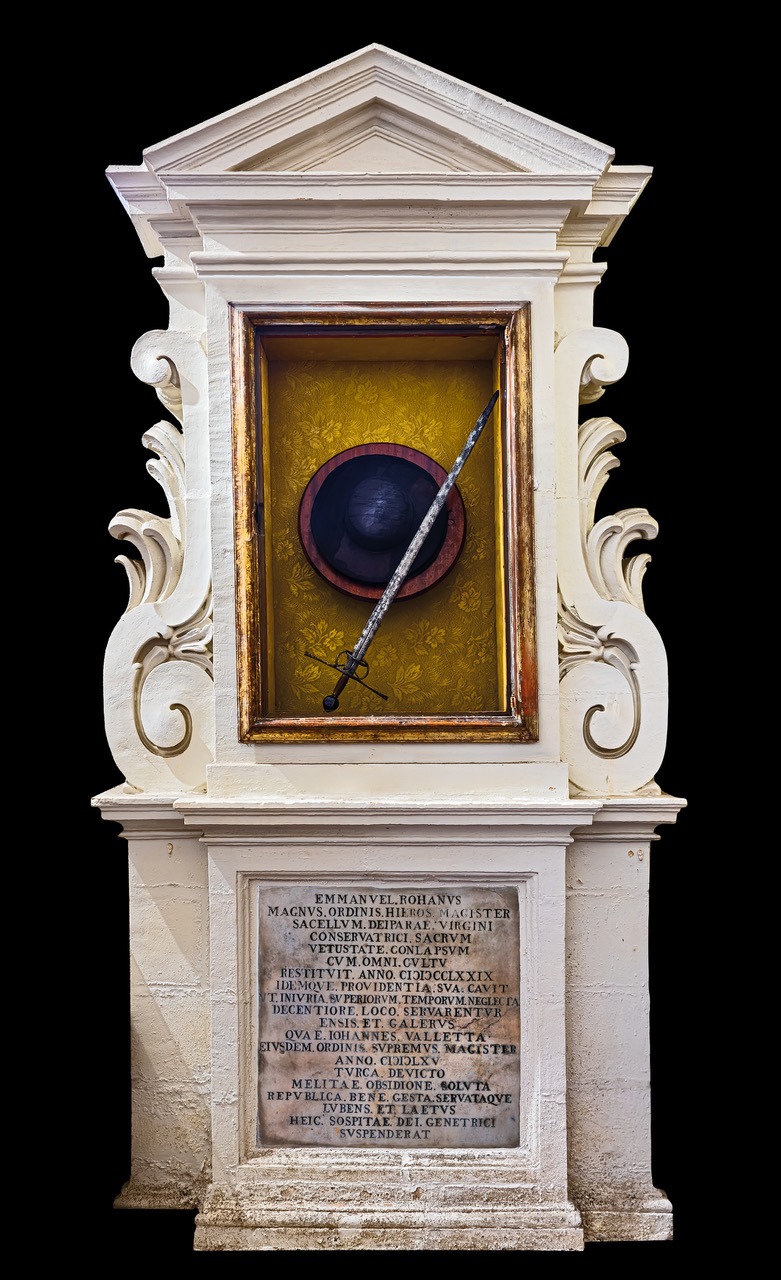
The Birgu Sword: Material Witness of the Siege
For centuries, the combat sword has remained in Birgu. It is kept today within the parish museum of San Lorenzo (one of the oldest parishes in Malta), near the site of the original chapel where it once hung. The object has served as a local point of reference and a tangible reminder of the siege era.
Its story has resurfaced in recent years thanks to renewed research. A key contributor is Maltese historian Franco A. Davies, who has examined the piece since 2012 in collaboration with the Malta Historical Fencing Association. Publications, exhibitions, and public programming have helped reposition the sword within academic and popular consciousness. Earlier assumptions—fueled partly by limited archival evidence – had sometimes classified it as a legendary relic rather than a documented historical item.
This view shifted decisively in 2024. George Agius, secretary of the Vittoriosa Historical & Cultural Society, uncovered an overlooked pastoral visitation report written in 1646 by Bishop Miguel Juan Balaguer de Camarasa. The document explicitly notes the presence of “a sword of the illustrious Grand Master Valletta” in the chapel of Our Lady of Damascus. The record dates only eight decades after the siege, offering a strong chronological link between La Valette and the object.
Another reference appears in a marble plaque installed in 1779 by Grand Master Emmanuel de Rohan, which recounts how La Valette placed his sword and hat in the chapel following the defense of Malta. Travel literature of the 19th and early 20th centuries – by authors such as William Bartlett and Elizabeth Schermerhorn – further attests to the sword’s position in local memory.
Recent initiatives have broadened public engagement with the artifact. Accurate replicas created by craftspeople, including Danelli Armouries (2013) and Balefire Blades (2024), allow visitors to handle facsimile versions, assessing weight and balance directly. These experiences situate the sword within the practical realities of 16th-century combat and reinforce its status as a historical object rather than an abstract symbol.
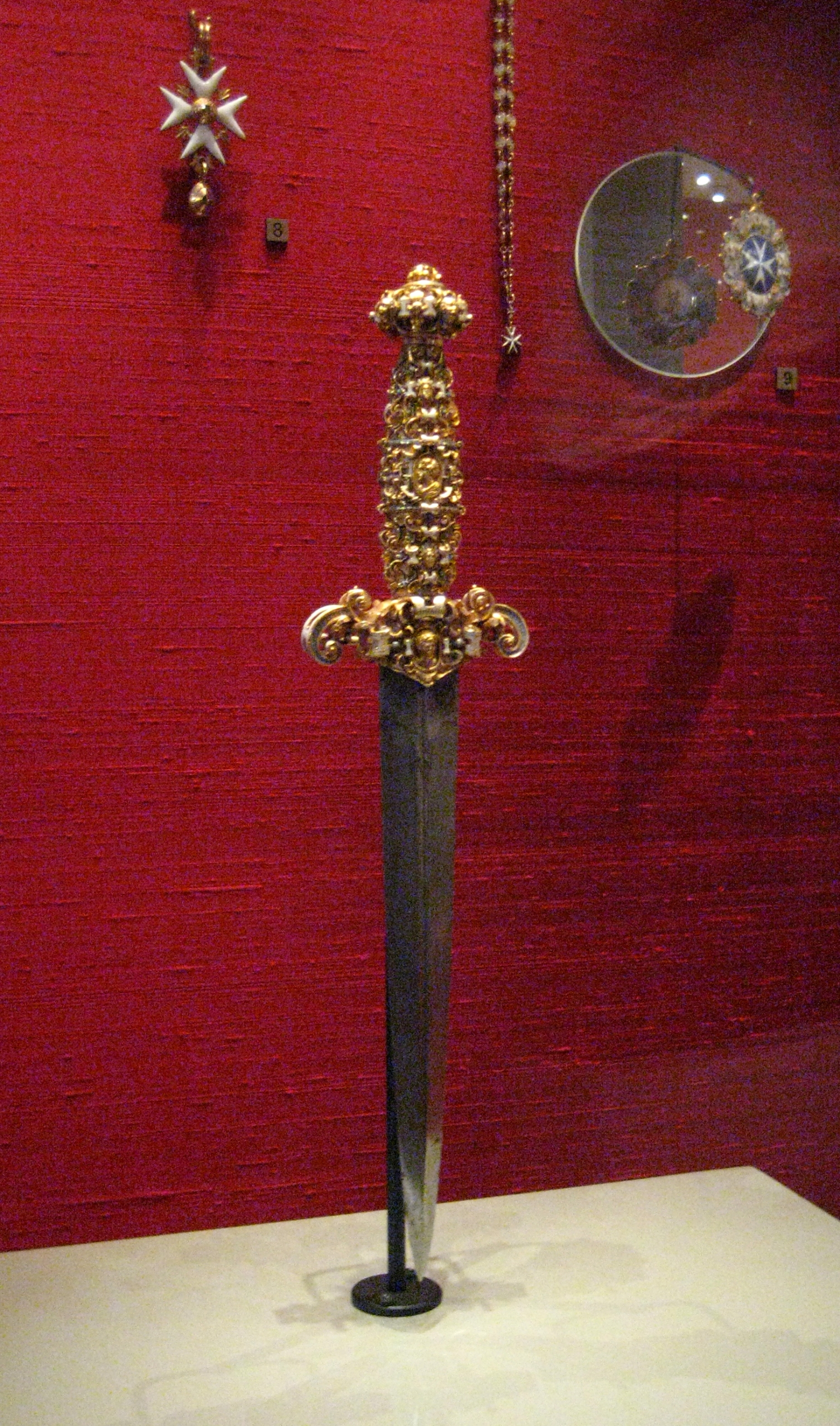
The Ceremonial Sword: Diplomacy Cast in Gold
In contrast, the ceremonial sword given by Philip II occupies a more opulent register. Crafted in the Renaissance style, it features a gold hilt with chiselled foliage, coloured enamels, and miniature ornamental figures. The original blade carried a Latin inscription praising La Valette’s courage. This sword, together with the matching dagger, served as prominent state regalia within the Order for generations.
After Napoleon’s forces seized Malta, the dagger reportedly became the general’s personal possession, while the sword travelled to France as part of the vast collection of objects appropriated during the 1798 campaign. Both items ultimately entered French national collections and are now held by the Louvre Museum. They are displayed in the Richelieu wing, often only partially unsheathed due to conservation requirements.
For many in Malta, the ceremonial set retains cultural significance that extends beyond its craftsmanship. Debates surrounding potential repatriation—whether temporary or long-term—continue to surface, especially following the dagger’s short loan to Malta for an exhibition in 2017. The sword, however, has remained in Paris for conservation reasons.
A Divided Legacy
Today, the two swords occupy different spheres. The combat sword remains in Malta, embedded within a local museum that preserves objects associated with the island’s early modern history. The ceremonial sword and dagger remain in France, part of an international museum context that highlights global exchanges, diplomacy, and the art of Renaissance metallurgy.
Together, they outline a story that moves from battlefield necessity to political recognition. One carries the wear of conflict; the other, the refinement of a diplomatic gift. Both objects navigate questions of heritage, identity, and custodianship. Their journeys illustrate how material culture can connect communities across centuries and borders, while also provoking discussions about stewardship and historical context.
Visitors encountering either sword engage with this layered narrative. The experience demonstrates how a single figure’s legacy can fragment across space yet remain coherent through collective memory. The swords of La Valette endure not because of mythologizing, but because they reveal how history is preserved, interpreted, and occasionally contested.
This content comes to you in collaboration with VisitMalta
AI Transparency Notice
PilgriMaps uses artificial intelligence tools to assist in the research, drafting and translation of editorial content. All AI-assisted content is reviewed, edited and verified by our editorial team before publication. We contrast information against primary sources, specialist literature and on-the-ground knowledge to ensure accuracy, cultural sensitivity and editorial integrity.
AI is one tool among many in our workflow. The judgement, curation and responsibility for everything published on this platform remain entirely human.
Viator Media S.L. — in compliance with the EU Artificial Intelligence Act (Regulation EU 2024/1689).
This post is also available in: