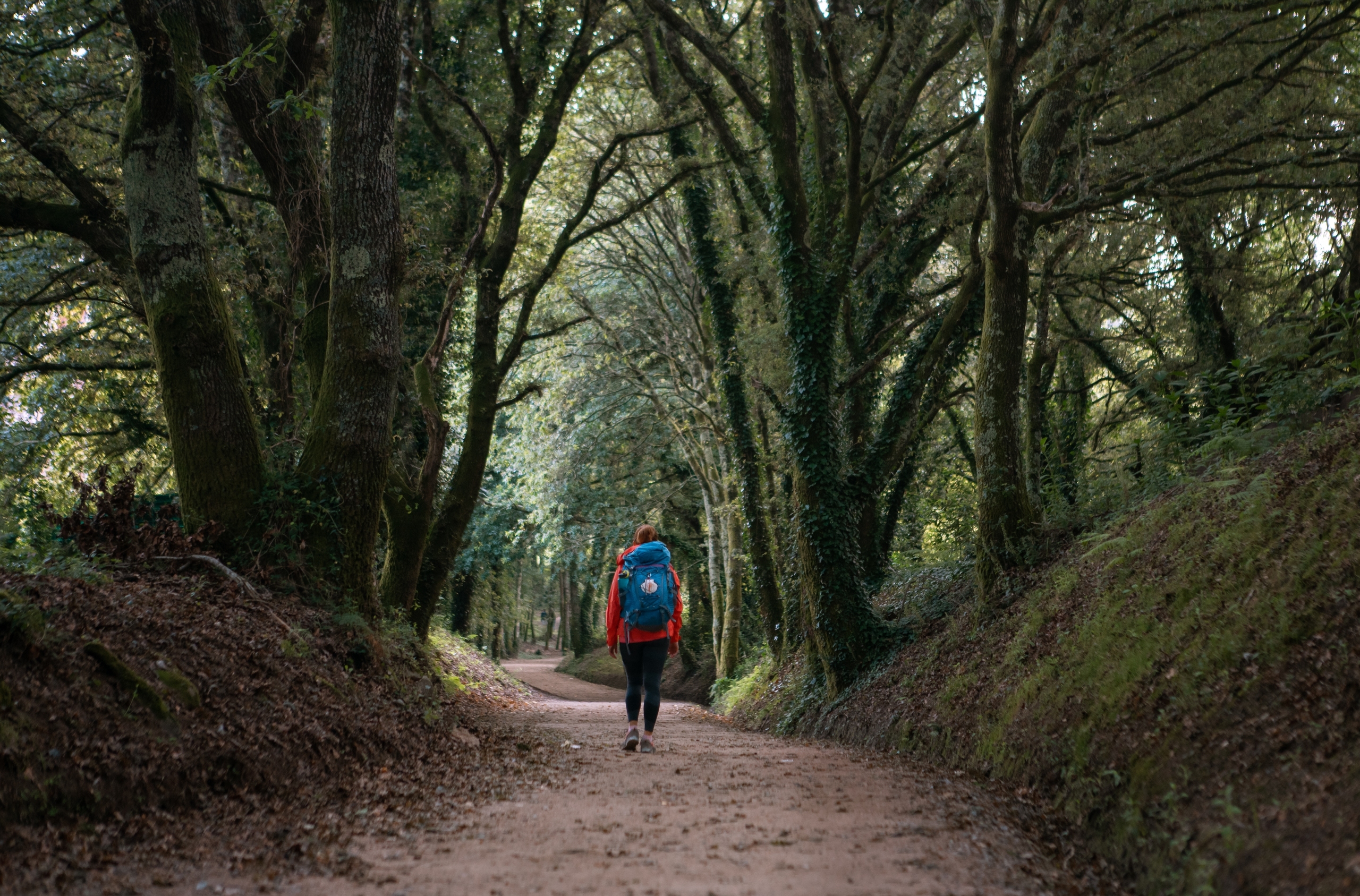
At dawn, on the forested trails of Japan’s Kumano Kodo, walkers of all backgrounds begin their day. Sarah, a software engineer from Seattle, left her job after burnout. Marco, a teacher from Italy, walks to process grief. Yuki, a designer from Tokyo, has never entered a temple but seeks something she cannot name.
None of them would call themselves religious. Yet, all are on pilgrimage.
This scene repeats across the world’s ancient routes—on paths once defined by faith, now walked by those searching for meaning in other forms. The motivation has shifted: the destination remains.
The Invisible Malaise of Modern Life
In the 1950s, Austrian psychiatrist Viktor Frankl, survivor of the Nazi camps, described what he called the existential vacuum: the persistent sense that, despite material comfort, life lacks deeper purpose.
Frankl identified three recurring symptoms—rising aggression, widespread addiction, and chronic depression. Decades later, his diagnosis seems prophetic. The World Health Organization estimates that depression now affects over 280 million people worldwide. Addictions—from drugs to smartphones—continue to grow, and public anger has become commonplace.
“We no longer have instincts or traditions to guide us,” wrote Frankl. “So we imitate others or do what we are told.”
In this cultural void, thousands each year choose to walk—literally leaving behind the routines that confine them.
When Walking Becomes Transformation
Emma, 34, works in marketing in London. Three years ago, she walked 200 kilometers along the Via Francigena, the medieval route from Canterbury to Rome. “I’m not religious,” she says, “but I needed to reset my life. I just wanted to walk.”
The first days were difficult—aching feet, heavy pack, restless thoughts. Around the fifth day, something shifted: “I realized I hadn’t checked my phone in hours. I wasn’t planning or worrying. I was simply walking.”
Scientific studies are beginning to confirm what walkers describe. Researchers at Stanford University found that 90 minutes of walking in nature reduces neural activity in areas linked to mental rumination—those repetitive cycles of negative thought associated with anxiety and depression.
A 2023 study of 142 contemporary pilgrims revealed that 74% were motivated by what researchers called psycho-existential reasons. They were not seeking divine revelation but a clearer sense of self—an attempt to rediscover who they were beneath roles, expectations, and daily noise.
New Rituals for a Secular World
Along the Kumano Kodo, small stone statues of Jizo, protectors of travelers, line the path. Walkers often pause to leave a coin, a pebble, or a moment of stillness. It is not prayer in the traditional sense—it is acknowledgment: I am here. This moment matters.
Such gestures form a quiet language of modern pilgrimage. Some write reflections on leaves and let them drift away. Others carry home a single stone as a reminder of the journey. Many simply sit at sunrise, watching mist rise from the valleys.
Thomas, a programmer from Germany who walked the Portuguese route, recalls a moment of clarity: “I was sitting on a rock, staring at the ocean. For the first time in months, I wasn’t trying to be anyone—just present.”
Science and the Ancient Intuition
Extended walking offers measurable benefits beyond introspection. In Japan, shinrin-yoku—forest bathing—is recognized as a preventive health practice. Studies show that time spent walking among trees lowers cortisol levels, reduces blood pressure, and strengthens immunity.
In Switzerland, some therapists now offer walk and talk sessions, combining psychotherapy with outdoor walking. “Side-by-side movement lowers defenses,” explains Zurich-based psychotherapist Anna Müller. “Patients open up more easily. The act of walking seems to unlock something.”
Researchers also describe the flow state—a condition of full immersion where time dissolves and self-consciousness fades. After several days on the trail, many walkers report entering this state naturally: steps, breath, and scenery aligning in a rhythm that feels both intimate and universal.
Beyond Religion, Not Against It
Modern secular pilgrimage often coexists peacefully with its religious origins. On the Camino de Santiago, only about 47% of walkers now cite explicitly religious motives. The rest walk for culture, sport, or renewal.
María, a 67-year-old Spaniard who has completed the Camino five times, observes: “Twenty years ago, it was mostly religious. Now I meet newlyweds, people in crisis, young travelers. Some pray in churches; others meditate in forests. But at night, everyone shares the same feeling—that they’ve done something that matters.”
In Denmark, researchers studying the Camøno, a deliberately inclusive pilgrimage route, asked whether a journey could serve believers, skeptics, and non-believers alike. The conclusion: yes. The essence of pilgrimage need not be erased but redefined. For some, the sacred lies in nature; for others, in human connection, endurance, or silence.
The Cost of Change
Transformation rarely comes easily. Pilgrimage, even in its secular form, is not a vacation. It demands endurance. Blisters are inevitable; exhaustion and solitude, frequent. Rain, pain, and doubt accompany progress.
David, an American lawyer who walked 300 km in Japan, recalls: “Three times I wanted to quit. My body hurt, my mind told me I was crazy. But every time I was about to stop, I met someone who said exactly what I needed to hear—or saw something so beautiful it kept me going.”
In these thresholds of difficulty, transformation often begins. Frankl’s insight remains relevant: while we cannot control events, we can always choose our response. Pilgrimage reproduces this dynamic voluntarily—by confronting challenge, we rediscover agency.
An Ancient Response to a Modern Condition
Away from screens and expectations, many walkers describe a simple realization: for the first time in years, they can just be—not perform, not produce, not impress.
In an age of curated identities and constant comparison, this return to presence feels radical. “On the Camino, I understood I didn’t need to be special,” says Claire, a young French walker. “It was enough to be myself—step by step.”
Psychologists might call this authenticity restoration; walkers call it feeling alive.
Perhaps that is the essence of secular pilgrimage: not the search for God, but for a more genuine way of inhabiting one’s life. It is not escape from the world but a new way of walking within it.
The ancients had a saying: solvitur ambulando—it is solved by walking. They did not promise that the path would provide all answers, only that certain questions can be faced only in motion.
Today, thousands rediscover this quiet wisdom. They are not seeking miracles or revelation, but something simpler—and perhaps more enduring: a sense of meaning in a world that often feels adrift.
And they find it, as countless walkers before them did—in the effort of the steps, in the beauty of the landscape, in the kindness of strangers, and in the silence that is not empty, but profoundly full.
AI Transparency Notice
PilgriMaps uses artificial intelligence tools to assist in the research, drafting and translation of editorial content. All AI-assisted content is reviewed, edited and verified by our editorial team before publication. We contrast information against primary sources, specialist literature and on-the-ground knowledge to ensure accuracy, cultural sensitivity and editorial integrity.
AI is one tool among many in our workflow. The judgement, curation and responsibility for everything published on this platform remain entirely human.
Viator Media S.L. — in compliance with the EU Artificial Intelligence Act (Regulation EU 2024/1689).
This post is also available in: