In the early thirteenth century, two men met in Rome who between them would change the face of Western Christianity. They arrived by different roads, they left by different roads, and the distance between those roads turned out to be one of the most generative tensions in the history of the Church.
The meeting almost certainly happened more than once, though historians disagree on the exact occasions. The sources — Jordanus of Saxony’s Libellus, Jacques de Vitry’s letters, Thomas of Celano’s early life of Francis — converge on at least one encounter in Rome, probably around 1215, during the period of the Fourth Lateran Council. Two men, both seeking papal approval for their nascent communities, both drawn to the same city at the same historical moment, both committed to a form of life radically unlike anything the Church had institutionalized before.
What is remarkable about the meeting, given what came after, is how natural the accounts make it seem. Jordanus of Saxony, who was not present but received his information from Dominic’s closest companions, describes a mutual recognition that was immediate and warm. Dominic reportedly told Francis that he wished their communities could be one. Francis, in the accounts, responded with equal warmth. Both men left the encounter carrying, it seems, something of the other.
And yet they built different things. Profoundly, permanently different things. Understanding why requires going back to where each of them came from — not just geographically, but in the deeper sense of what had formed them.
Two formations, two urgencies
Dominic de Guzmán arrived in Rome already a canon — trained, disciplined, formed by years in the cathedral chapter at Osma under Bishop Diego de Acebes. His urgency had been sharpened by a specific experience: traveling through the Languedoc in 1203 and encountering the Cathar movement at close range. What he found there was not simply heresy in the abstract but a rival church — organized, ascetic, intellectually credible, capable of winning the allegiance of educated laypeople and minor nobility. The Cathars had preachers who lived simply and argued well. The Catholic missionaries sent against them arrived in episcopal splendor and were outargued in public debate. Dominic understood the diagnosis immediately: the Church was losing the battle of persuasion because its representatives could not match the moral credibility of those they opposed.
His response was institutional from the beginning. He needed an order of educated, mobile, poor preachers who could out-argue the heretics on their own ground. The intellectual dimension was not incidental — it was the core. The mendicant life of poverty was not an end in itself but the condition of credibility: you could not preach against worldliness from a position of wealth. Study, preaching, mobility, and poverty were integrated elements of a single strategic vision.
Francis of Assisi arrived by a completely different road. The son of a prosperous cloth merchant, his conversion came not through theological formation but through a series of physical encounters: a leper embraced on the road outside Assisi, a crucifix that spoke to him in the half-ruined church of San Damiano, the gradual stripping away of everything his father’s world had given him — money, status, clothing, finally the name itself. His early companions were not trained clerics but laypeople drawn to something they could not quite name: the sheer radicality of a man who seemed to have taken the Gospel at its word.
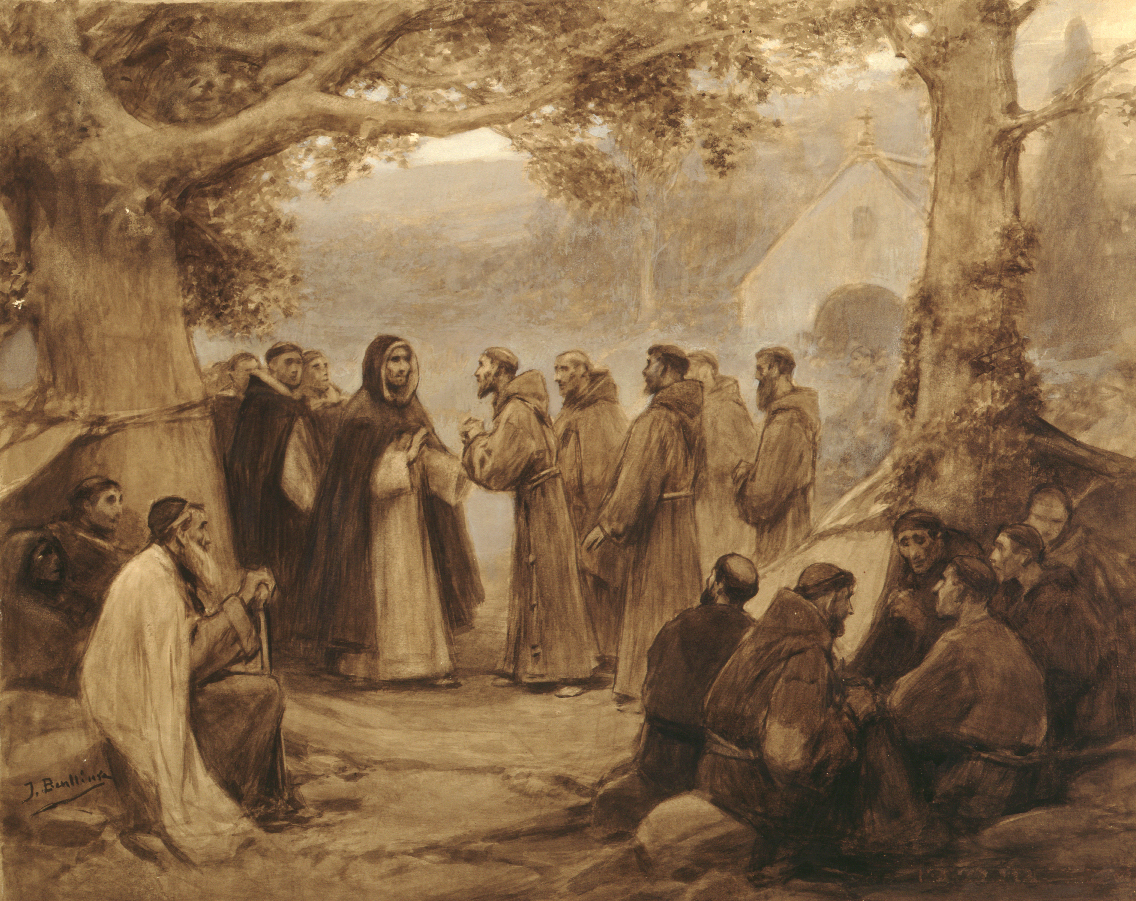
For Francis, poverty was not a strategy. It was a mystical identification. To own nothing was to be like Christ in his kenotic self-emptying, to be like the birds of the air and the lilies of the field, to be vulnerable in the way that God in the Incarnation had chosen to be vulnerable. The famous episode of the Portiuncula indulgence, the chapters held in open fields with thousands of brothers sleeping under the stars — these are not organizational moments. They are moments of deliberate exposure to the same precariousness that Francis understood as the condition of authentic discipleship.
The same city, the same moment, the same problem
What brought both men to Rome in the years around 1215 was the same crisis, seen from different angles. The Church of the high medieval period was wealthy, hierarchical, and in many regions pastorally distant from the populations it claimed to serve. The new urban economies of northern Italy and southern France had produced a literate merchant class that read the Gospels and found a troubling gap between the poverty of Christ and the splendor of his institutional representatives. Into that gap had moved the Cathars in the south, the Waldensians in the Alpine regions, and various other movements that the Church categorized as heretical but that drew their energy from genuine spiritual hunger.
Innocent III was the most acute ecclesiastical mind of the period, and he recognized the problem. The two men he authorized — Francis in 1209, Dominic formally in 1216 with the bull Religiosam vitam — represented his attempt to channel that same spiritual energy back within the Church rather than against it. He was, in effect, licensing a controlled radicalism. The alternative was losing the radicals entirely.
Both authorizations were acts of considerable institutional courage. What Francis was proposing was, by any canonical standard, irregular — a group of laypeople living without rule, property, or fixed location, wandering and preaching on the authority of nothing but their example. Innocent’s reported dream of Francis holding up the Lateran basilica — the mother church of Rome, beginning to collapse — captures the paradox with unusual precision: the man who seems to have nothing is the one holding the institution up.
The separation that became generative
After the meeting — or meetings — in Rome, the two movements diverged in ways that were partly temperamental, partly theological, and partly determined by the very different social worlds each was embedded in.
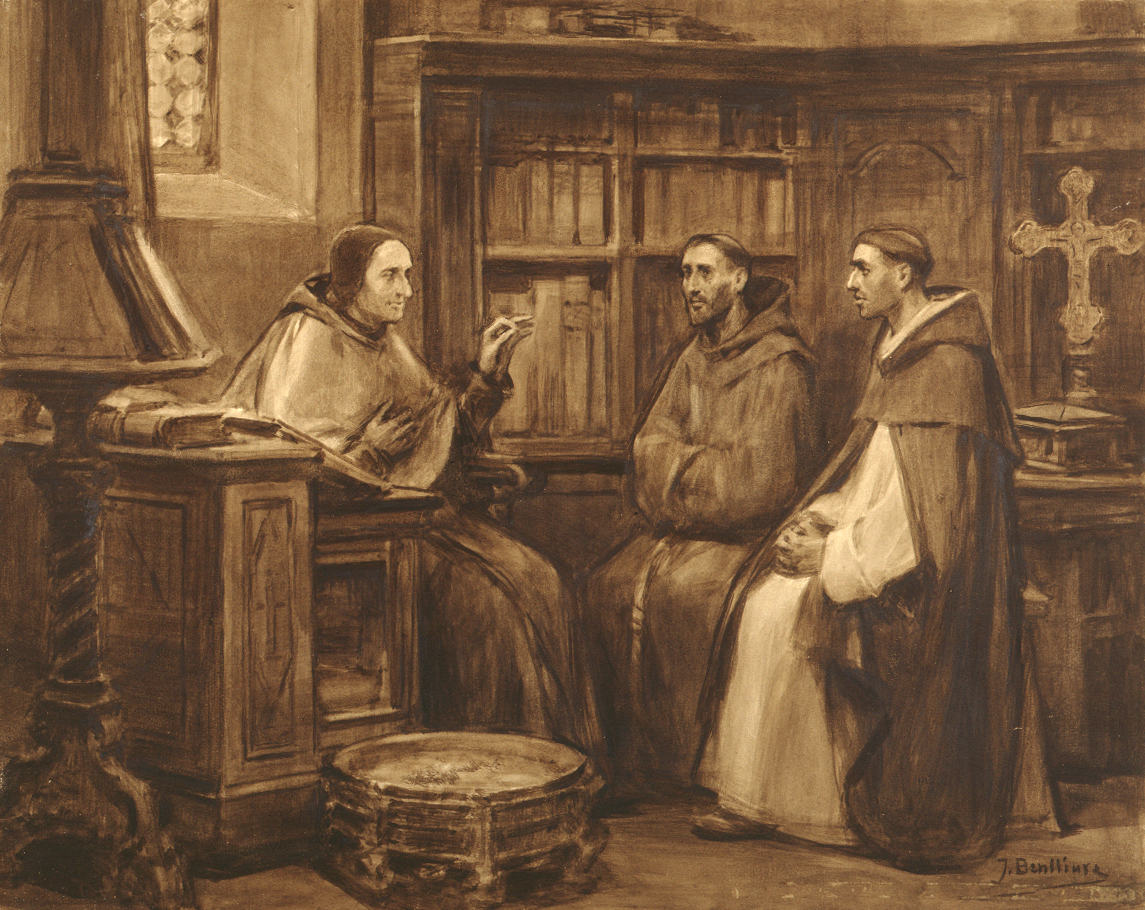
The Dominicans became the order of the university. Within a generation of Dominic’s death in 1221, his friars were established at Paris, Bologna, and Oxford — the three great intellectual centers of medieval Europe. Albert the Great was a Dominican. Thomas Aquinas was a Dominican. The order Dominic built was, almost by design, the greatest theological intelligence-gathering and argument-generating machine the medieval Church possessed. It was also, by extension, the order of the Inquisition — the institution created to carry forward in juridical form the same project of combating heterodoxy that had begun in the Languedoc fields.
The Franciscans became something more complicated and more contested. Francis himself resisted institutionalization with a stubbornness that bordered on the intractable, and the order he left behind fell almost immediately into a crisis over the question of poverty that would occupy it for the better part of a century. The Franciscan spirituals — those who insisted on absolute poverty as the founder had understood it — were eventually condemned as heretics, the supreme institutional irony of a movement born from the refusal of institutional compromise. Yet the Franciscans also produced Bonaventure, Roger Bacon, and Duns Scotus — an intellectual tradition not inferior to the Dominican, though oriented differently: more mystical, more attentive to the particular and the experiential, less drawn to the great synthetic structures of Thomism.
The road between them
What the meeting of Francis and Dominic illuminates, more than anything, is the extraordinary generative power of proximity between genuinely different visions. They agreed on the fundamentals: poverty, preaching, mobility, the refusal of the older monastic model of enclosure and stability. They disagreed, in ways neither could fully articulate, on what poverty was for and what the relationship between intellect and spirit ultimately demanded.
Dominic’s poverty was instrumental — a condition of effective witness. Francis’s poverty was terminal — the destination itself, the state of radical dispossession in which God could be encountered without the interference of ownership. These are not simply different emphases. They are different anthropologies, different readings of the Gospel, different intuitions about what the human person most fundamentally is and what it most fundamentally needs.
The Western Church, in its wisdom or its luck, kept both. The tension between them — between argument and witness, between institutional intelligence and prophetic simplicity, between the university lecture hall and the open road — turned out to be one of the most creative tensions in Christian history. Scholasticism and Franciscan mysticism are not the same thing, and the distance between the Summa Theologiae and the Canticle of the Sun is not a distance that synthesis easily bridges.
What met in Rome around 1215 was not just two men seeking papal approval for their respective projects. It was two ways of being Christian in a world that had become too complex for any single form to contain. The crossroads held them together for a moment. Then the roads diverged, as roads do, and what grew from that divergence has not yet finished growing.
The pilgrimage connection
Both movements left traces on the pilgrimage landscape of Europe that are still visible. The Dominicans built their houses near university towns and along the great preaching circuits — Bologna, Paris, Cologne, the road south through the Languedoc. The Franciscans spread along the pilgrimage routes themselves, establishing communities in the towns where pilgrims rested: Assisi itself became one of the great secondary pilgrimage destinations of the medieval world, and the Porziuncola indulgence Innocent III granted to Francis created what was effectively a portable Jubilee, available to anyone who visited the little church on August 2nd.
The pilgrim walking the Camino de Santiago in the thirteenth century would have encountered both orders within a single day’s walk: the Dominicans in the university towns, preaching and disputing in the cathedral squares; the Franciscans in the smaller roadside convents, offering hospitality and the comfort of a simpler message. They were, in a sense, the two faces of the same pastoral urgency — one turning toward the mind, the other toward the road, both recognizing that the Church’s future lay not in its buildings but in its willingness to keep moving.
Sources: Jordanus of Saxony, Libellus de principiis Ordinis Praedicatorum (c. 1234); Thomas of Celano, Vita Prima Sancti Francisci (1228); Jacques de Vitry, Historia Occidentalis; M.-H. Vicaire, Saint Dominic and His Times (1964); André Vauchez, Francis of Assisi: The Life and Afterlife of a Medieval Saint (2012); C. H. Lawrence, The Friars: The Impact of the Early Mendicant Movement on Western Society (1994).
AI Transparency Notice
PilgriMaps uses artificial intelligence tools to assist in the research, drafting and translation of editorial content. All AI-assisted content is reviewed, edited and verified by our editorial team before publication. We contrast information against primary sources, specialist literature and on-the-ground knowledge to ensure accuracy, cultural sensitivity and editorial integrity.
AI is one tool among many in our workflow. The judgement, curation and responsibility for everything published on this platform remain entirely human.
Viator Media S.L. — in compliance with the EU Artificial Intelligence Act (Regulation EU 2024/1689).
This post is also available in: