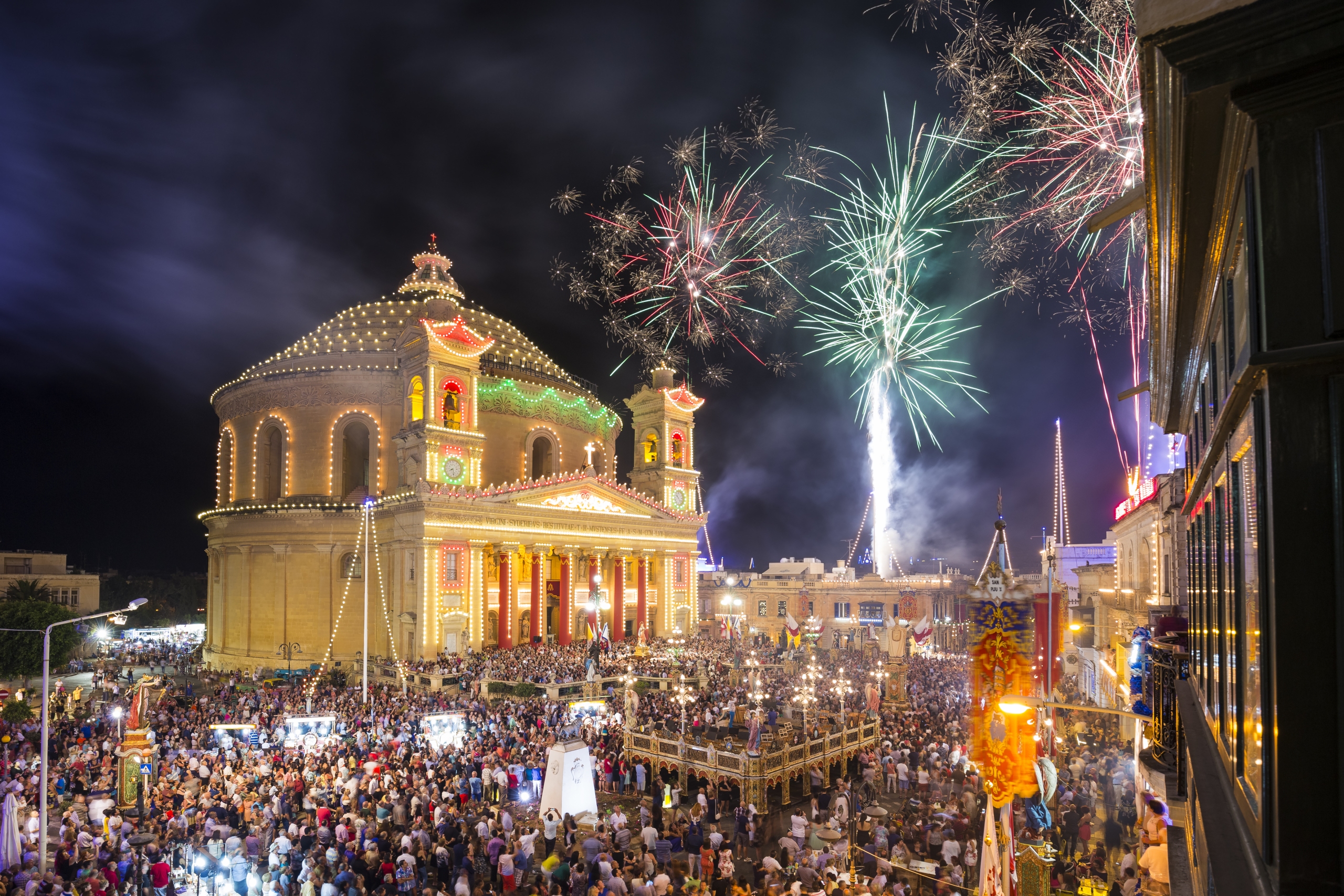
In the limestone archipelago of Malta, where the Mediterranean once ferried Phoenician merchants, Roman legions, and Crusader fleets, August 15 marks a moment of enduring resonance. It is the Feast of the Assumption of Mary – commemorated not only as a liturgical solemnity but as a cultural and historical axis in the Maltese spirit.
Though rooted in Catholic doctrine – the belief that Mary, mother of Jesus, was assumed bodily into heaven – the devotion surrounding the Assumption in Malta transcends ecclesiastical borders, inviting inquiry into how landscapes of belief shape, and are shaped by, the human passage through time.
This is not merely a feast. It is a constellation of memory, architecture, and pilgrimage, tied intimately to Malta’s evolving identity from antiquity to the present. And it finds some of its clearest expressions in two intertwined elements: the island’s historical veneration of Mary and the contemporary Melita Mariana pilgrimage.
A Geography of Devotion
The Marian devotion in Malta predates any formal proclamation of the Assumption as dogma. Archaeological and textual evidence reveals a thriving Christian presence in Malta by the 4th century CE. According to the Book of Acts, the Apostle Paul, shipwrecked on the island en route to Rome around 60 CE, was accompanied by Luke – the Gospel writer often associated with early Marian theology. Their presence in the archipelago make it clear that Malta’s Christian story begins in the apostolic age.
By the 15th century, the Assumption was firmly entrenched in local religious life. Churches, many dedicated to Santa Marija, became focal points for communal expression and life. The 19th century saw a proliferation of Marian altars and shrines across the islands – 92 churches and 22 altars bearing her name by 1800. Nine parishes still recognize the Assumption as their principal feast day. Today, the celebration takes the form of processions, pyrotechnics, and liturgical ceremonies, anchoring Maltese Catholicism in ritual and spectacle.
But beyond the festivities lies a geography of belief—churches perched on ancient hilltops, altars standing where pagan temples once rose, and routes worn by the footsteps of centuries.
Ta’ Pinu and the Iconography of Elevation
On the sister island of Gozo stands the National Shrine of the Blessed Virgin of Ta’ Pinu, one of Malta’s most frequented pilgrimage destinations. Rising from the rural landscape like a fortress of devotion, the sanctuary centers on an image of Mary crowned in heavenly glory, surrounded by angles and apostles. This iconographic language—deeply Byzantine in its visual theology—invokes the motifs of the Dormition and Assumption that developed in the early centuries of Christianity, portraying Mary as a pivotal participant in the arc of salvation history.
The site is associated with miraculous events, drawing pilgrims not only from Malta but from the broader Mediterranean and diaspora communities. As a shrine, Ta’ Pinu represents more than intercession. It reflects how sacred space is constructed through both belief and political continuity. Even the architectural decision to erect the basilica over earlier chapels mirrors
Malta’s broader history: ancient fertility cults yielding to Marian imagery, stone upon stone, belief upon belief.
Nearby, in the fortified town of Victoria, the Cathedral of the Assumption was built over what is believed to be a Roman temple dedicated to Juno. The layers of this site—from imperial deity to Christian Virgin—offer a living palimpsest of religious transformation. It is not only theology that is assumed into new form here, but the landscape itself.
The Melita Mariana Route: A Modern Pilgrimage
In recent years, some of these sacred sites have been connected through the Melita Mariana Project, a 60-kilometer pilgrimage route across Malta and Gozo. It is not a traditional camino in the sense of distance or difficulty; rather, it is a curated journey through centuries of Marian devotion.
Pilgrims and travelers who undertake this route encounter chapels carved into cliffs, Renaissance altarpieces, and village festivals timed to the liturgical calendar. But they also encounter silence—the kind found only in coastal valleys at dawn or inside stone churches dimly lit by vigil candles. Here, pilgrimage is not defined by hardship, but by accumulation: of steps, of memory, of thresholds crossed.
While grounded in Catholic tradition, the Melita Mariana route offers cultural resonance for a broader audience. It engages questions of how place becomes sacred, how stories endure through architecture, and how collective memory is embedded in ritual. The route invites contemplation on continuity—on what it means to carry forward belief in bodily, tangible ways.
A Feast of Transcendence and Territory
The Assumption, formally declared dogma by the Catholic Church only in 1950, is often understood theologically as a declaration of bodily resurrection and the human full participation in divine promise. But in Malta, it also serves as a narrative fulcrum—a feast that organizes communal rhythms, rural economies, and national memory. It brings together the metaphysical and the material, the eternal and the historical.
This layered reality aligns the Assumption with pilgrimage not only as devotion but as anthropology. It reveals how sacred time folds into sacred space, how belief is negotiated through the contours of an island shaped by siege, trade, migration, and faith. The Assumption, in this sense, is a mirror of Malta itself: elevated and enduring.
This content has been brought to you in partnership with VisitMalta
AI Transparency Notice
PilgriMaps uses artificial intelligence tools to assist in the research, drafting and translation of editorial content. All AI-assisted content is reviewed, edited and verified by our editorial team before publication. We contrast information against primary sources, specialist literature and on-the-ground knowledge to ensure accuracy, cultural sensitivity and editorial integrity.
AI is one tool among many in our workflow. The judgement, curation and responsibility for everything published on this platform remain entirely human.
Viator Media S.L. — in compliance with the EU Artificial Intelligence Act (Regulation EU 2024/1689).
This post is also available in: