Each year on 1 December, millions of people open the first little door of an Advent calendar. Behind it there may be a piece of chocolate, a miniature object, a short phrase, or simply a seasonal illustration. The gesture feels familiar and playful, yet it sits on top of a historical practice that emerged in 19th-century Protestant Germany and later spread far beyond its original setting.
This article traces that story: from domestic rituals in Lutheran homes to the global reinvention of the Advent calendar as a cultural and, for some, spiritual itinerary toward Christmas.
Advent: Framing the season
To understand the Advent calendar, it helps to consider Advent itself. In Western Christian traditions, Advent marks the beginning of the liturgical year. The term comes from the Latin adventus, “coming,” and refers to the expected arrival of Christ. Spanning the four weeks before Christmas, it has historically been associated with expectation, preparation, and attentive waiting.
For many historic churches, Advent was not merely a prelude to Christmas celebrations. It was a period linking the commemoration of Jesus’ birth with theological reflections on a future, final coming. In 19th-century Protestantism, especially within Lutheran contexts, Advent retained a restrained tone of prayer and watchfulness. Families began to translate these themes into concrete domestic rituals that children could see, touch, and follow day by day.
Protestant Germany in the 19th century: Faith practiced at home
In 19th-century Germany, shaped by pietist pedagogy and a strong emphasis on religion in the home, families developed practices to structure the weeks of Advent. These customs pursued two aims: reinforcing everyday religious life and offering children a visible and engaging way of experiencing the passage of time toward Christmas.
The methods were simple. Some families drew 24 chalk marks on a door and erased one each evening. Others hung small images related to the Nativity, or lit a candle for each day starting from the first Sunday of Advent. In certain households, a piece of straw was added daily to the crib, symbolically preparing a place for the Christ Child.
The educational intention was clear. Each day became a step along a path, a small observance that kept the sense of expectation alive. Often, these actions were accompanied by household readings, songs, or short prayers, integrating the counting of days into a wider rhythm of family devotion.
Gerhard Lang and the first visual calendar
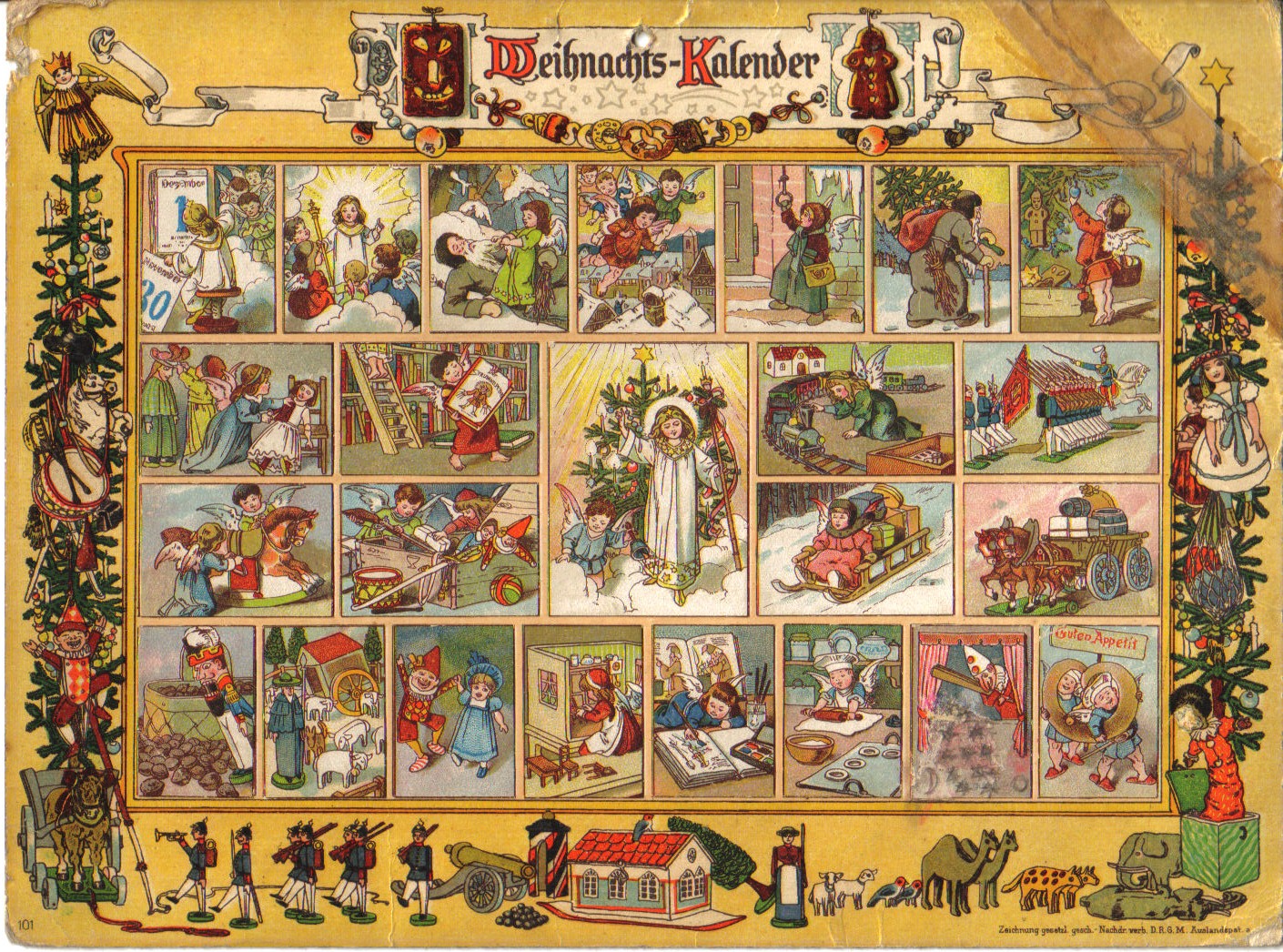
The decisive shift toward the Advent calendar as we know it came at the turn of the 20th century through the work of Gerhard Lang. Born in Maulbronn in southwest Germany, Lang remembered how his mother had once sewn 24 small biscuits onto a piece of cardboard so that he could eat one each day of December.
Drawing on that memory, and working as a printer associated with the firm Reichhold & Lang in Munich, he produced in 1908 what is often considered the first commercial Advent calendar: Im Lande des Christkinds (“In the Land of the Christ Child”). It was composed of two sheets: one with 24 biblical verses, and another with 24 festive images that children cut out and glued over the corresponding texts.
This model spread quickly and became the direct ancestor of modern calendars. A few years later, Lang introduced small doors that could be opened daily, each hiding an image or message. The element of surprise made the experience more playful. In 1926, in partnership with the chocolate company Stollwerck, he released calendars that incorporated sweets, although the chocolate-filled format would take several decades to become dominant.
A resilient symbol in turbulent times
During the 1920s and 1930s, the Advent calendar grew increasingly popular in Germany. Designs ranged from explicitly religious to winter landscapes and educational themes. Publishers produced affordable editions so that many households could participate. There were even calendars adapted for blind children, with Braille text and raised images.
The rise of National Socialism and the outbreak of the Second World War, however, brought attempts to control and reshape the tradition. The regime banned calendars with religious imagery and promoted ideologically reworked “pre-Christmas calendars” marked by nationalist or so-called “pagan” symbols. Material shortages also reduced printing. Lang, who had created more than thirty models, eventually had to close his company.
Yet the calendar did not disappear. In 1945, Richard Sellmer founded a publishing house in Stuttgart which, with the approval of Allied authorities, resumed production of Advent calendars and helped restore the practice’s earlier meanings and motifs.
From spiritual symbol to global cultural object
In the second half of the 20th century, the Advent calendar began to move beyond its original German and Protestant context. A widely circulated photograph of U.S. President Dwight D. Eisenhower opening a calendar with his grandchildren in 1953 contributed to raising its profile in North America. Over time, it became a common feature of the winter season in many countries.
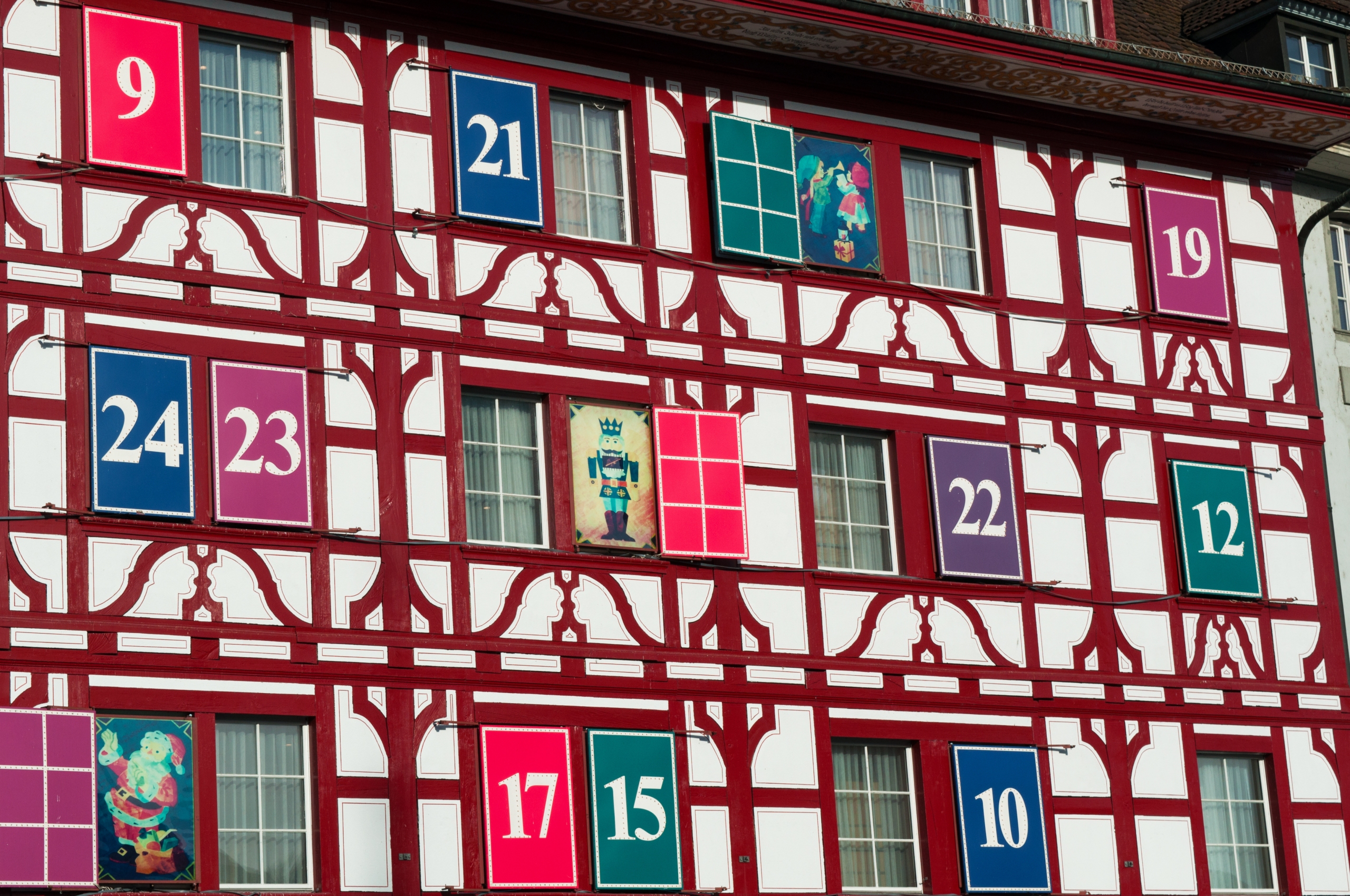
As it globalized, the calendar diversified. New versions appeared containing sweets, toys, cosmetics, miniature spirits, specialty teas, or luxury items. Large brands recognized the format’s potential and created physical and digital calendars for marketing campaigns. Behind each daily window or click, users might find a small product sample, a discount code, or exclusive content.
Despite these changes, the underlying structure remained: a repeated daily gesture that traces a progression through time. This continuity suggests that the calendar’s symbolic logic—anticipation expressed through numbered stages—persists even when the content becomes fully commercial. The calendar still organizes expectation, marks days with intention, and frames the approach to an awaited date or event.
The Calendar as interior itinerary
In recent years, as a response to the intensifying commercial tone of the season, various groups have sought to reclaim the Advent calendar as a tool for more deliberate living. This contemporary reinterpretation does not necessarily reject new formats, but it invites users to reconnect with the idea of preparation and attentive waiting.
Families, communities, and institutions have begun designing their own calendars with reflective or educational content. Some draw on biblical texts, short meditations, or inspirational phrases that encourage a daily pause for reading, silence, or conversation. Others experiment with what are sometimes called “reverse calendars”: each day, participants place a food item, warm clothing, or other donation into a box, to be given to a charity at the end of the period.
Across these variations, the Advent calendar retains a strong symbolic charge. Each small door or envelope becomes more than a container for a surprise; it offers a moment to stop, to recognize that something is unfolding gradually. In a culture often driven by speed and immediacy, this modest practice suggests an alternative rhythm: some things arrive step by step, and the process of waiting, when marked consciously, can itself acquire meaning.
AI Transparency Notice
PilgriMaps uses artificial intelligence tools to assist in the research, drafting and translation of editorial content. All AI-assisted content is reviewed, edited and verified by our editorial team before publication. We contrast information against primary sources, specialist literature and on-the-ground knowledge to ensure accuracy, cultural sensitivity and editorial integrity.
AI is one tool among many in our workflow. The judgement, curation and responsibility for everything published on this platform remain entirely human.
Viator Media S.L. — in compliance with the EU Artificial Intelligence Act (Regulation EU 2024/1689).
This post is also available in: