The passengers later remembered as the Pilgrim Fathers—though they never called themselves that—were mostly Separatist Puritans, dissenting Protestants who had broken with the Church of England. Unlike other Puritans, they did not aim to reform the national church but to leave it entirely, convinced that official worship had become entangled with royal authority and devoid of spiritual integrity.
After enduring censorship and persecution, many fled to the Dutch Republic, settling in Leiden, where they lived in relative freedom for over a decade. But exile carried its costs: economic hardship, loss of language and cultural identity, and fear that their children would assimilate into what they saw as a morally lax society. Seeking a life guided by conscience, they decided to start anew across the ocean—with the Bible as compass and the promise of autonomy as destination.
William Bradford, their future governor and chronicler, later wrote that “they knew they were pilgrims,” echoing a biblical verse that described people as “strangers and pilgrims on the earth.” For them, the new land represented both an economic promise and a moral experiment: an American Canaan where they could live according to their own covenant.
Of the 102 passengers, only 37 belonged to that separatist congregation. The rest were sailors, craftsmen, servants, or adventurers recruited by the investors who financed the voyage. Yet all would share the same cramped quarters and uncertain fate—and from that enforced coexistence, a new political idea would emerge.
The Voyage and the Compact
Two ships were initially planned for the crossing: the Mayflower and the Speedwell. The latter, true to the irony of its name, proved unseaworthy and was abandoned after repeated leaks. Everyone crowded into the Mayflower, a small cargo ship never designed for long ocean passages.
They sailed on 6 September 1620. For 66 days, they endured storms, seasickness, poor ventilation, damp food, and illness. The North Atlantic showed no mercy. At last, on 9 November, they sighted land—but not where they had intended. Winds and currents had driven them north to Cape Cod, in present-day Massachusetts.
That detour proved decisive. They had arrived outside the legal bounds of the Virginia Company’s charter. Some passengers—those not of the Separatist group—argued that without royal authority they owed obedience to no one. To prevent disorder, the leaders proposed a written agreement defining the rules of their community.
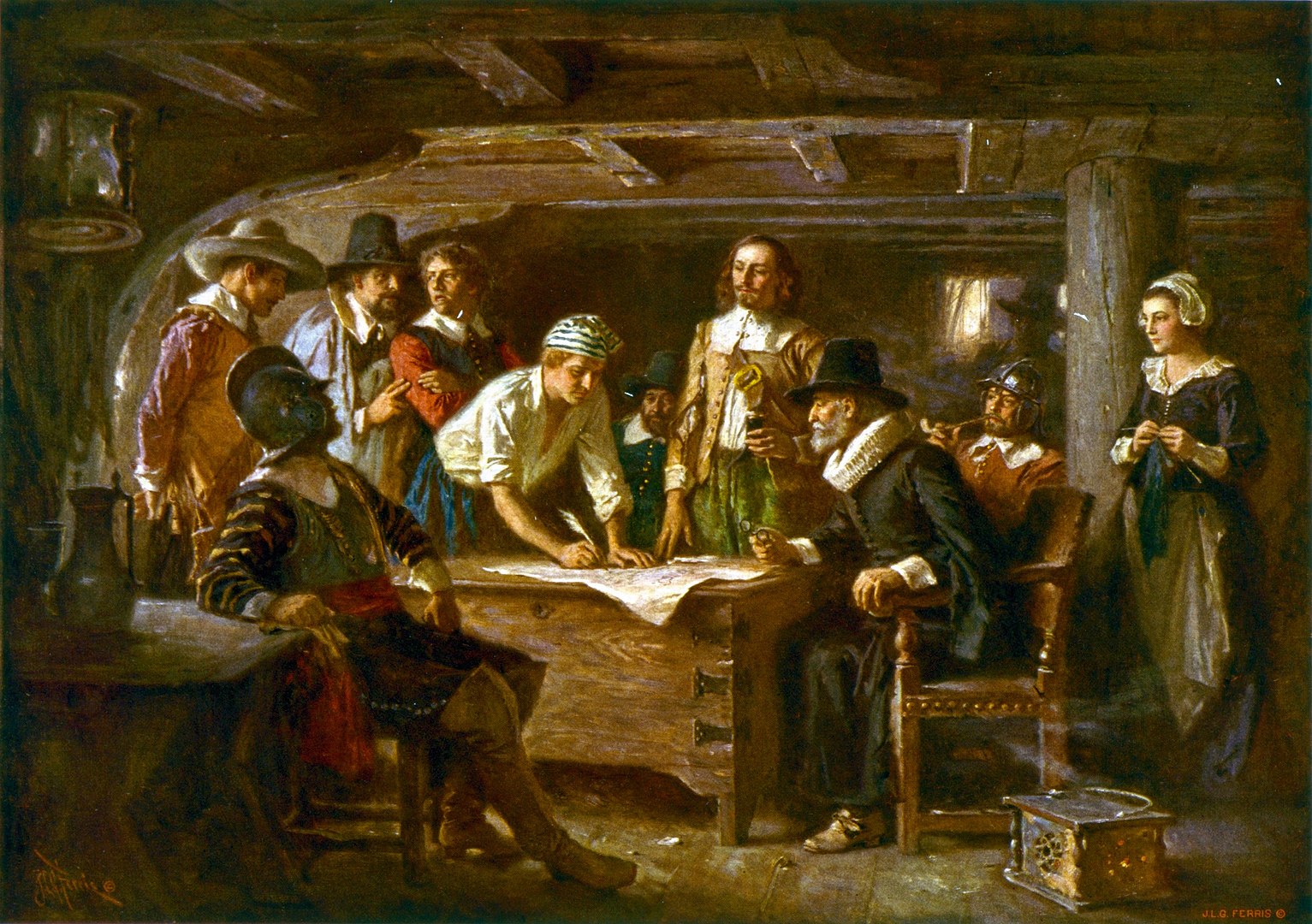
On 11 November 1620, forty-one men signed the Mayflower Compact. It established a “civil body politic” for the common good, governed by laws and leaders chosen by mutual consent. Though civil in nature, its structure reflected their congregational habits: just as each church elected its minister and made collective decisions, so too would the colony govern itself.
Without intending it, they had inaugurated a new political tradition—one based on consent and community self-rule. In that small ship anchored off the American coast lay the seed of modern democratic thought.
Winter of Trial and the First Thanksgiving
They disembarked in late December, just as the New England winter set in. The forest was dense, the cold biting, and the land unwelcoming. There were no shelters or roads. By spring, half of them had died. Disease, hunger, and exhaustion took their toll; at times, there were not enough healthy people left to bury the dead.
Then, in March 1621, an unexpected encounter changed their fate. An Indigenous man named Samoset entered the settlement, greeting them in halting English learned from coastal fishermen. Days later he returned with Squanto, a member of the Wampanoag people who had lived in Europe and spoke fluent English. Squanto taught the settlers how to plant corn, fertilize the soil with fish, and fish with nets. He also brokered an alliance with the Wampanoag leader, Massasoit.
With their help, the colony endured. That autumn, after their first harvest, the settlers organized a feast of gratitude and invited Massasoit and about ninety of his people. For three days, they shared food and celebration. It was not yet the modern Thanksgiving, but its symbolic ancestor—a gesture of survival, mutual aid, and renewal.
For the colonists, this cooperation had providential meaning; yet beyond belief, it was also a testament to human interdependence. Gratitude became their way of interpreting the world.

From Pilgrimage to Myth
In time, Plymouth remained a modest colony, overshadowed by larger settlements such as Massachusetts Bay. But its story grew in significance. By the eighteenth century, American revolutionaries had reclaimed the Mayflower narrative as a national symbol. In the Pilgrim Fathers they saw early citizens who defied monarchy and established religion to form a community grounded in conscience and self-government.
In 1820, at the bicentennial of their landing, orator Daniel Webster declared that the Pilgrims had carried “the eternal principles of American civilization.” From then on, their memory was enshrined in civic mythology. Plymouth Rock—where they supposedly stepped ashore—became a national shrine. During the Civil War, President Abraham Lincoln invoked their example when he proclaimed Thanksgiving a national holiday, evoking 1621 as a symbol of unity and endurance.
The Mayflower thus ceased to be merely a ship; it became a founding ark, carrying in miniature the ideals that would shape a nation: faith, covenant, community, and liberty.
The Pilgrim Legacy
Four centuries later, the Mayflower story remains central to the American imagination. It reminds us that the search for moral and spiritual freedom can also be a political act—and that every community begins not with conquest, but with a shared commitment.
In the United States, the pilgrim endures as a moral archetype: one who crossed the ocean not for wealth, but for conviction; who sought not domination, but integrity.
Perhaps that is why the symbol transcends borders.
To undertake a pilgrimage—then as now—is to move toward the unknown, guided by belief, purpose, or vision. Few journeys capture that impulse more vividly than the Mayflower crossing of 1620, when a small group of men and women signed a compact at sea, trusted an unseen horizon, and discovered that liberty, in all its forms, begins with a single step.
AI Transparency Notice
PilgriMaps uses artificial intelligence tools to assist in the research, drafting and translation of editorial content. All AI-assisted content is reviewed, edited and verified by our editorial team before publication. We contrast information against primary sources, specialist literature and on-the-ground knowledge to ensure accuracy, cultural sensitivity and editorial integrity.
AI is one tool among many in our workflow. The judgement, curation and responsibility for everything published on this platform remain entirely human.
Viator Media S.L. — in compliance with the EU Artificial Intelligence Act (Regulation EU 2024/1689).
This post is also available in: