Jerusalem has long stood at the center of the religious imagination of Jews, Christians, and Muslims. For centuries, it has also been a destination shaped by movement: caravans, liturgical processions, imperial travelers, merchants, monks, soldiers, and pilgrims. Among the many customs associated with arrival in the city, one of the most distinctive is the practice of receiving a tattoo. Small in scale and intimate in execution, these marks became durable records of a journey that was often difficult, costly, and life-defining.
The tradition of pilgrimage tattoos in Jerusalem reaches back several centuries. Written accounts from the seventeenth century describe the practice as already established, pointing to older roots that likely extend into the late medieval period. For travelers returning from the Holy Land, a tattoo could serve as proof of having completed the journey, a visible sign carried on the body rather than stored among documents or devotional objects. In an age when travel was slow and often dangerous, that mattered. Reaching Jerusalem was an achievement of endurance, resources, and commitment.
These tattoos also belonged to a wider culture of pilgrimage memory. Travelers brought home flasks, ampullae, rosaries, icons, and palm branches. A tattoo differed from all of them in one decisive way: it could not be lost, sold, or broken. It fixed the experience of travel onto the skin, turning memory into something permanent. For many pilgrims, that permanence carried emotional force. The mark recalled the places visited, the rites observed, the companions met along the road, and the intensity of arrival in a city layered with sacred associations.
Within Christian communities, pilgrimage tattoos also developed a social function. They could communicate that the wearer had visited Jerusalem and participated in a recognized devotional journey. In some contexts, they may have strengthened communal identity, especially among Eastern Christian groups for whom tattooing had a longstanding place in local custom. Attitudes toward tattoos have varied across Christian traditions, and some churches have regarded them with reserve. Even so, in Jerusalem the practice endured, sustained by families of artisans and by generations of pilgrims who wanted their journey recorded in a form both personal and public.
Ver esta publicación en Instagram
No name is more closely associated with this tradition than Razzouk Tattoo in Jerusalem’s Old City. The Razzouk family has preserved the craft across generations, becoming custodians of one of the city’s most unusual continuities. Their workshop connects the contemporary visitor with a practice shaped by Ottoman-era travelers, clergy, local Christians, and foreign pilgrims who passed through Jerusalem long before modern tourism. Today, Waseem Razzouk continues that lineage, working at the intersection of family inheritance, local history, and living craftsmanship.
Part of what makes the Razzouk workshop so compelling is its archive of old wooden stamps, some based on historic designs used to transfer images onto the skin before tattooing. These designs draw on a rich Christian visual vocabulary: Jerusalem crosses, depictions of the Virgin Mary, angels, saints, and scenes from the life of Christ. The “Seal of Jerusalem” remains among the most recognizable motifs, linking the individual body to the city through an image that is both emblematic and portable. For some visitors, choosing one of these designs is a way of entering a historical continuum. Others request custom work, combining inherited iconography with personal references, dates, or names.
The Immovable Ladder: A tangled history at the Holy Sepulchre
The appeal of these tattoos lies partly in their layered meaning. They are souvenirs, though the word feels too light for what many recipients intend. They are declarations of memory, signs of belonging, family heirlooms translated into skin, and sometimes acts of continuity with earlier generations. Among Christians from Egypt, Ethiopia, Armenia, Greece, or the wider diaspora, tattoo traditions have long taken different local forms. In Jerusalem, those histories meet in a city where pilgrimage has always brought cultures into close contact.
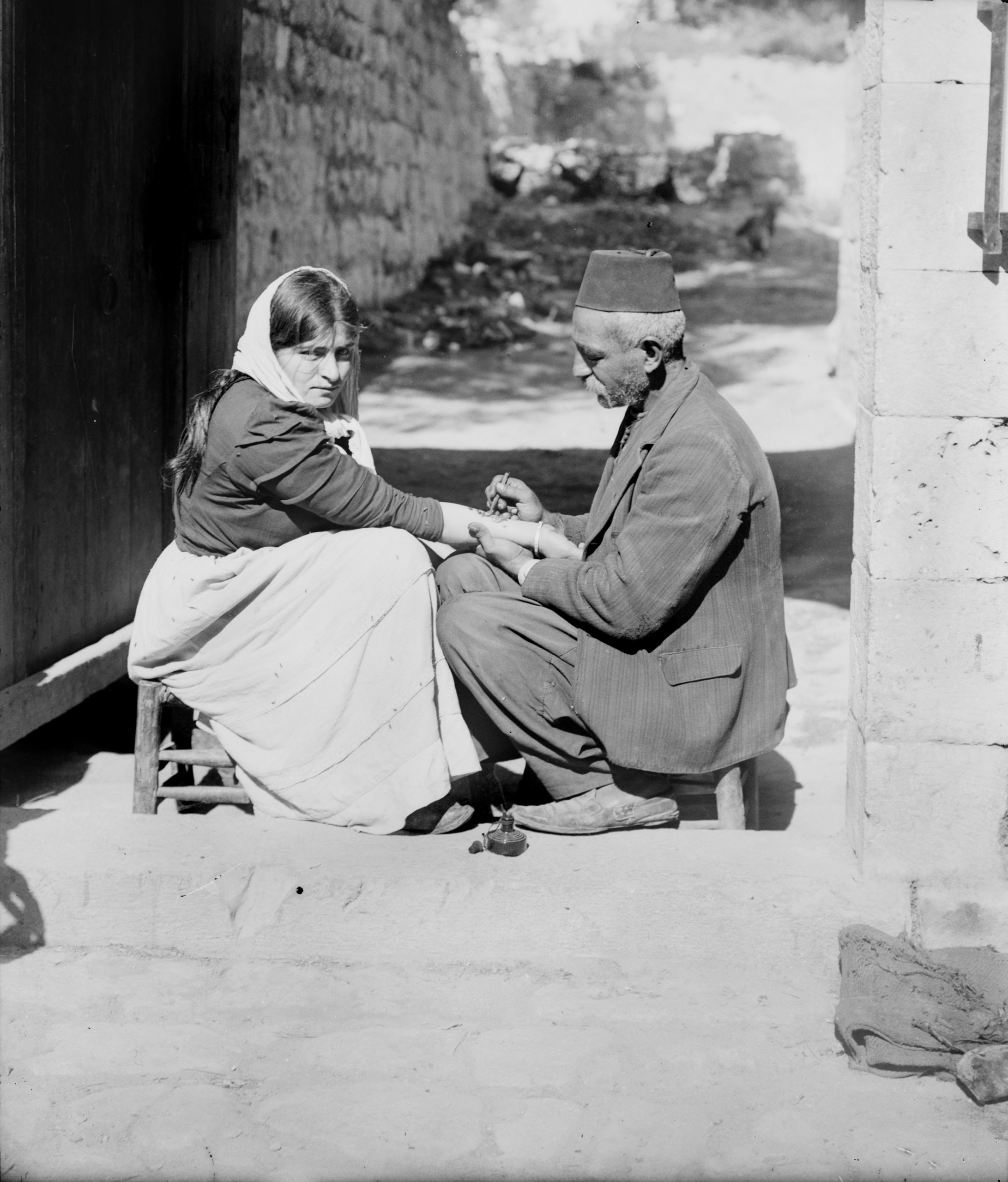
The process itself contributes to the significance of the tattoo. In a world of fast transactions and standardized travel experiences, the ritual of entering a small workshop in the Old City, selecting a design with centuries behind it, and receiving a mark associated with generations of pilgrims carries unusual weight. The act is tactile and deliberate. It asks for commitment. It leaves a trace that extends beyond the visit.
Jerusalem’s pilgrimage tattoos offer a revealing lens on the city. They show how devotion, travel, craft, and memory intersect in concrete ways. They also remind us that pilgrimage is not only a matter of routes and destinations. It is expressed through objects, gestures, and bodily practices that outlast the journey itself. In that sense, the tattoos of Jerusalem belong to the broader history of how travelers have tried to hold on to transformative experiences once they return home.
At Razzouk Tattoo, that history remains visible. What might appear at first as a specialized local custom opens onto a much larger story: the enduring human desire to inscribe movement, meaning, and remembrance into a form that time cannot easily erase.
Places of the Passion: Memory, Transformation, and Pilgrimage
AI Transparency Notice
PilgriMaps uses artificial intelligence tools to assist in the research, drafting and translation of editorial content. All AI-assisted content is reviewed, edited and verified by our editorial team before publication. We contrast information against primary sources, specialist literature and on-the-ground knowledge to ensure accuracy, cultural sensitivity and editorial integrity.
AI is one tool among many in our workflow. The judgement, curation and responsibility for everything published on this platform remain entirely human.
Viator Media S.L. — in compliance with the EU Artificial Intelligence Act (Regulation EU 2024/1689).
This post is also available in: