


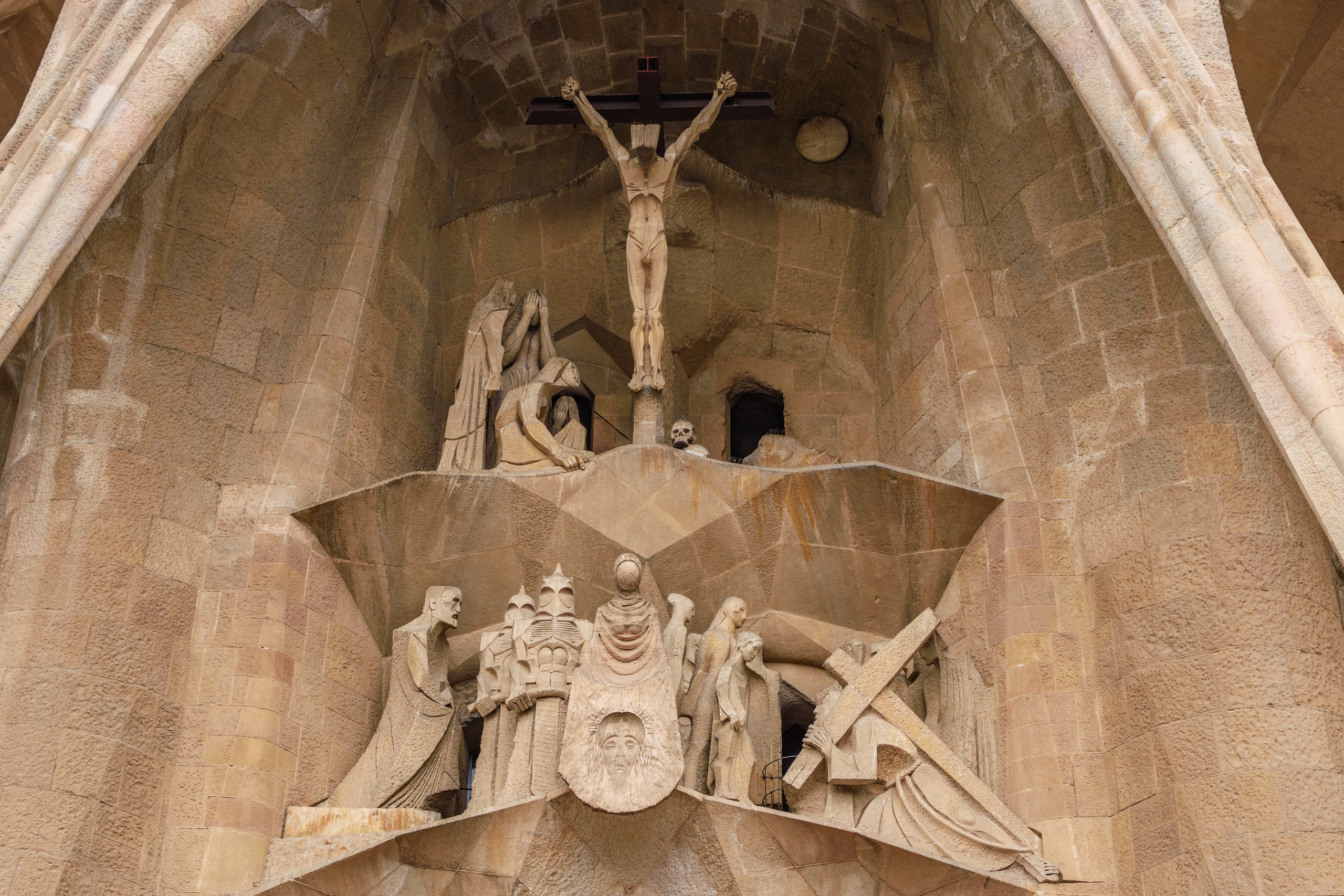
For pilgrims approaching the Sagrada Família from the west, the first encounter with Josep Maria Subirachs’ work is deliberately unsettling. The Passion Facade — completed between 1987 and 2005 under the Catalan sculptor’s zealous direction — offers none of the honeyed welcome of Gaudí’s Nativity side. It is angular, severe, stripped of ornament. It is meant to hurt.
And that, Subirachs always insisted, is precisely the point.
A deliberate contrast
When Antoni Gaudí died in 1926, he had completed only the Nativity Facade and the crypt. He left behind sketches and plaster models for the Passion Facade, but almost nothing in the way of sculptural specifics. The brief was theological: the suffering, death, and resurrection of Christ. What the figures should look like, how the stone should feel — that was left to whoever came after.
Subirachs, appointed to the task in 1987 at the age of sixty-four, made a radical choice. Rather than imitate Gaudí’s Modernista exuberance, he would create a sculptural language in total opposition to it. Where the Nativity Facade celebrates the joy of incarnation with soft, teeming, almost biological forms, the Passion Facade would render agony in hard geometry: elongated bodies, fractured planes, figures that look as though they have been cut from the same cold limestone as the wall itself.
Critics were outraged. Purists accused him of desecrating Gaudí’s vision. Subirachs was unmoved. “I am not Gaudí,” he reportedly said. “And this is not the Nativity.”
Reading the stone
For the pilgrim who takes time to read the facade as a text — and it rewards that patience — Subirachs composed the Passion as an S-shaped narrative path, beginning at the bottom left and winding upward to the Cross and beyond.
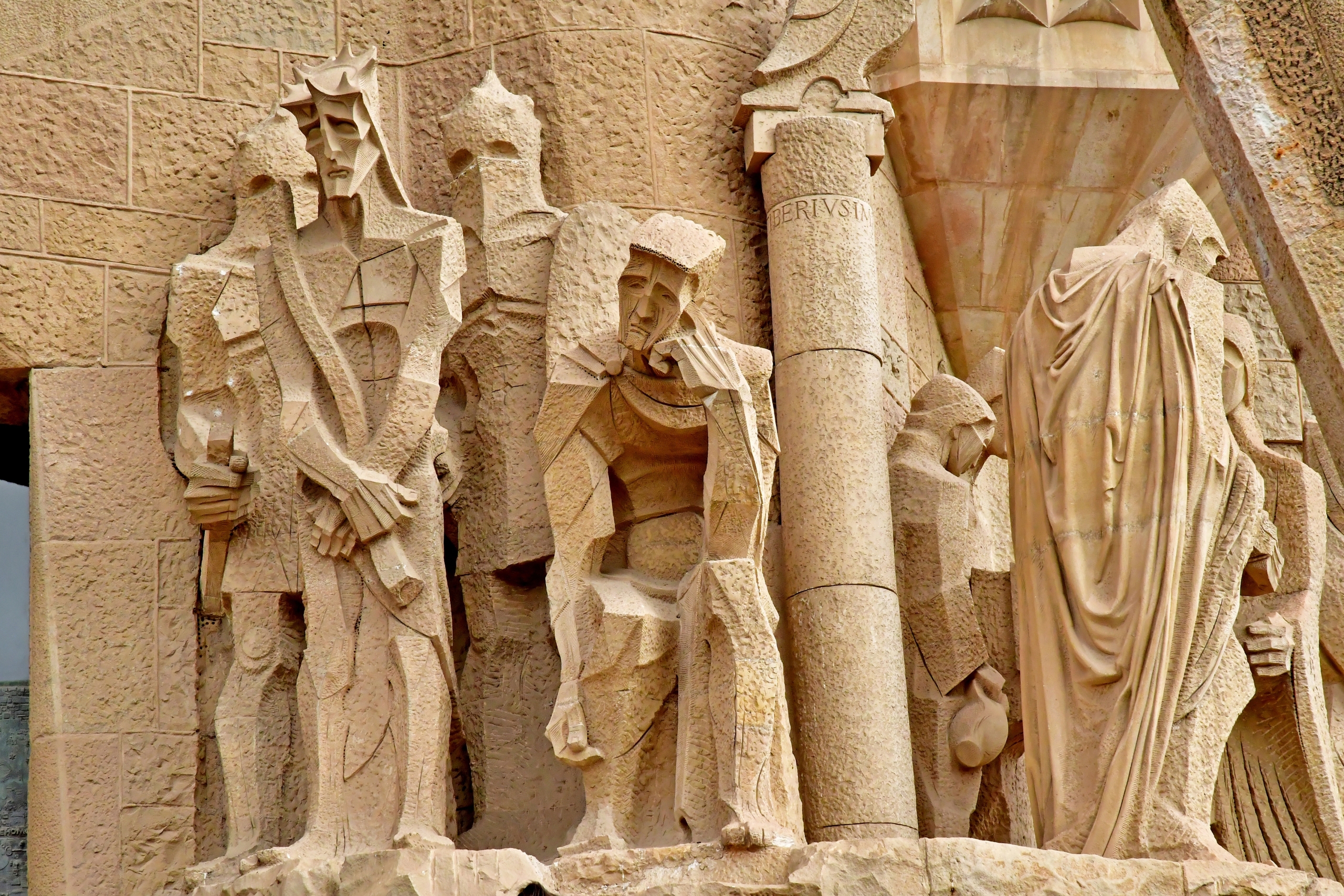
At ground level, the Last Supper anchors the story. The disciples’ faces are contorted with bewilderment and grief, their bodies abstracted into almost Cubist forms. Look closely at the figure of Judas: above his head, a serpent coils. Beneath the scene, a magic square of numbers — 33 in every direction, the age of Christ at his death — introduces a note of mathematical mysticism that Gaudí himself would have appreciated.
The Betrayal scene nearby is among the most psychologically raw moments on the entire basilica. Judas leans toward Christ with the fatal kiss; behind them, a helmeted Roman soldier fills the background like a stone shadow. The figure of Peter cutting off the ear of Malchus crackles with desperate, futile violence.
As the eye and the feet move upward, the Flagellation and the Crown of Thorns lead to the haunting Veronica scene: the woman holds her veil, upon which Subirachs — with an audacity that continues to divide opinion — imprinted his own face as the image of Christ. Whether this is hubris or humility, an act of artistic self-offering or mere vanity, each pilgrim must decide alone.
The cross and the empty tomb
The great bronze doors of the Passion Facade, also by Subirachs, are themselves a scripture in metal: covered in passages from the Gospel accounts of the Passion, the text pressed into the surface like a palimpsest. Pilgrims often press their hands to the letters, tracing words they may not be able to read in the original Catalan and Latin.
Above the portal, the composition climbs toward the crucified Christ, gaunt and stretched against the stone. The body has the quality of an abstraction pushed to its limit — not quite human, not quite symbol, hovering in that charged space between. At the very summit, the risen Christ appears, ascending in a form so spare it seems almost weightless. After the density of suffering below, it reads as pure release.
A theology in stone
What Subirachs gave the Sagrada Família — and what pilgrims sense even before they have the vocabulary to name it — is the insistence that sacred art need not be comforting to be holy. The Passion Facade refuses consolation in the easy sense. It makes you stand before darkness.
The great medieval cathedrals understood this. Their tympana showed the damned alongside the saved, the horrors of judgment flanking the hope of mercy. Subirachs, working in a century that had witnessed industrialized atrocity, reached for a similar unflinching honesty.
To walk the Passion Facade slowly, panel by panel, is to make a small Via Crucis in stone and light. You emerge, as from any real pilgrimage, changed by what you were willing to see.
AI Transparency Notice
PilgriMaps uses artificial intelligence tools to assist in the research, drafting and translation of editorial content. All AI-assisted content is reviewed, edited and verified by our editorial team before publication. We contrast information against primary sources, specialist literature and on-the-ground knowledge to ensure accuracy, cultural sensitivity and editorial integrity.
AI is one tool among many in our workflow. The judgement, curation and responsibility for everything published on this platform remain entirely human.
Viator Media S.L. — in compliance with the EU Artificial Intelligence Act (Regulation EU 2024/1689).
This post is also available in:

1 Comment
Vicki Irene
Splendid coverage and writing! I want to go!