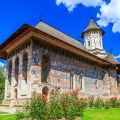
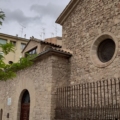
The Romanesque church of Santo Stefano, near Chiaverano, stands isolated amid dioritic rocks and chestnut woods at the edge of the Morainic Amphitheatre of Ivrea. Built in the 11th century as the parish church of the vanished village of Sessano—destroyed by a landslide in the Middle Ages—it is one of the oldest Christian sites along the Via Francigena, the historic route linking Canterbury to Rome. The name Sessano comes from saxus, Latin for “stone,” recalling the rocky ground on which it was built. When the inhabitants relocated to Chiaverano in 1251, the church survived as their last spiritual landmark.
The building, with a single nave and a rare central bell tower-porch, is an outstanding example of Canavese Romanesque architecture. Inside, a cycle of frescoes from the 11th century—inspired by Ottonian art and the illuminated manuscripts of Bishop Warmondo’s scriptorium in Ivrea—depicts the Christ Pantocrator within a mandorla, the Tetramorph, and a procession of apostles and saints, including Saint Stephen the Protomartyr at the center. Despite centuries of neglect, these paintings remain among the most significant in Piedmont’s medieval art. Restored since 1985 and surrounded by a garden of medicinal herbs and historical vineyards, Santo Stefano di Sessano offers a timeless dialogue between faith, art, and landscape in the spiritual heart of the Canavese.
- Address
Casale Brac, Chiaverano, Italy - Web
None - Visiting Hours
Unknown - What to see
Pantocrator and medieval frescoes
AI Transparency Notice
PilgriMaps uses artificial intelligence tools to assist in the research, drafting and translation of editorial content. All AI-assisted content is reviewed, edited and verified by our editorial team before publication. We contrast information against primary sources, specialist literature and on-the-ground knowledge to ensure accuracy, cultural sensitivity and editorial integrity.
AI is one tool among many in our workflow. The judgement, curation and responsibility for everything published on this platform remain entirely human.
Viator Media S.L. — in compliance with the EU Artificial Intelligence Act (Regulation EU 2024/1689).
This post is also available in: