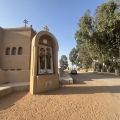
The Sanctuary of Santa Maria di Stignano, nestled in the Gargano valley, is one of the earliest Marian shrines in Capitanata and a remarkable 16th-century monument. Located along the ancient via Micaelica, a branch of the Via Francigena leading to Monte Sant’Angelo, it is wrapped in legend: tradition says St. Francis blessed the valley in 1216, and a blind man, Leonardo Di Falco, regained his sight upon discovering the Virgin’s image in an oak. Documented as early as 1231, the sanctuary was rebuilt in 1515 thanks to Cistercian friar Salvatore Scalzo and nobleman Ettore Pappacoda.
Entrusted to the Franciscan Observants in 1560, it grew as a hub of prayer, novitiate, and theological studies. Consecrated in 1679 by Archbishop Vincenzo Maria Orsini (later Pope Benedict XIII), it became famous for its hospitality to pilgrims, its “miraculous water,” and the Assumption feast drawing great crowds. After earthquakes, fires, and the 19th-century suppression of orders, the Franciscans restored it in the 20th century as a Franciscan Oasis, a place of retreats and renewal. Inside are the Renaissance cloister with a 1576 well, frescoes of St. Francis’s life, Luigi Schingo’s high altar, and an 18th-century lectern with Marian scenes.
- Address
Eremi di Stignano, 1628, San Marco in Lamis, Italy - Web
https://www.conventostignano.com/ - Visiting Hours
Unknown - What to see
Frescoes of St. Francis’s life
AI Transparency Notice
PilgriMaps uses artificial intelligence tools to assist in the research, drafting and translation of editorial content. All AI-assisted content is reviewed, edited and verified by our editorial team before publication. We contrast information against primary sources, specialist literature and on-the-ground knowledge to ensure accuracy, cultural sensitivity and editorial integrity.
AI is one tool among many in our workflow. The judgement, curation and responsibility for everything published on this platform remain entirely human.
Viator Media S.L. — in compliance with the EU Artificial Intelligence Act (Regulation EU 2024/1689).
This post is also available in: