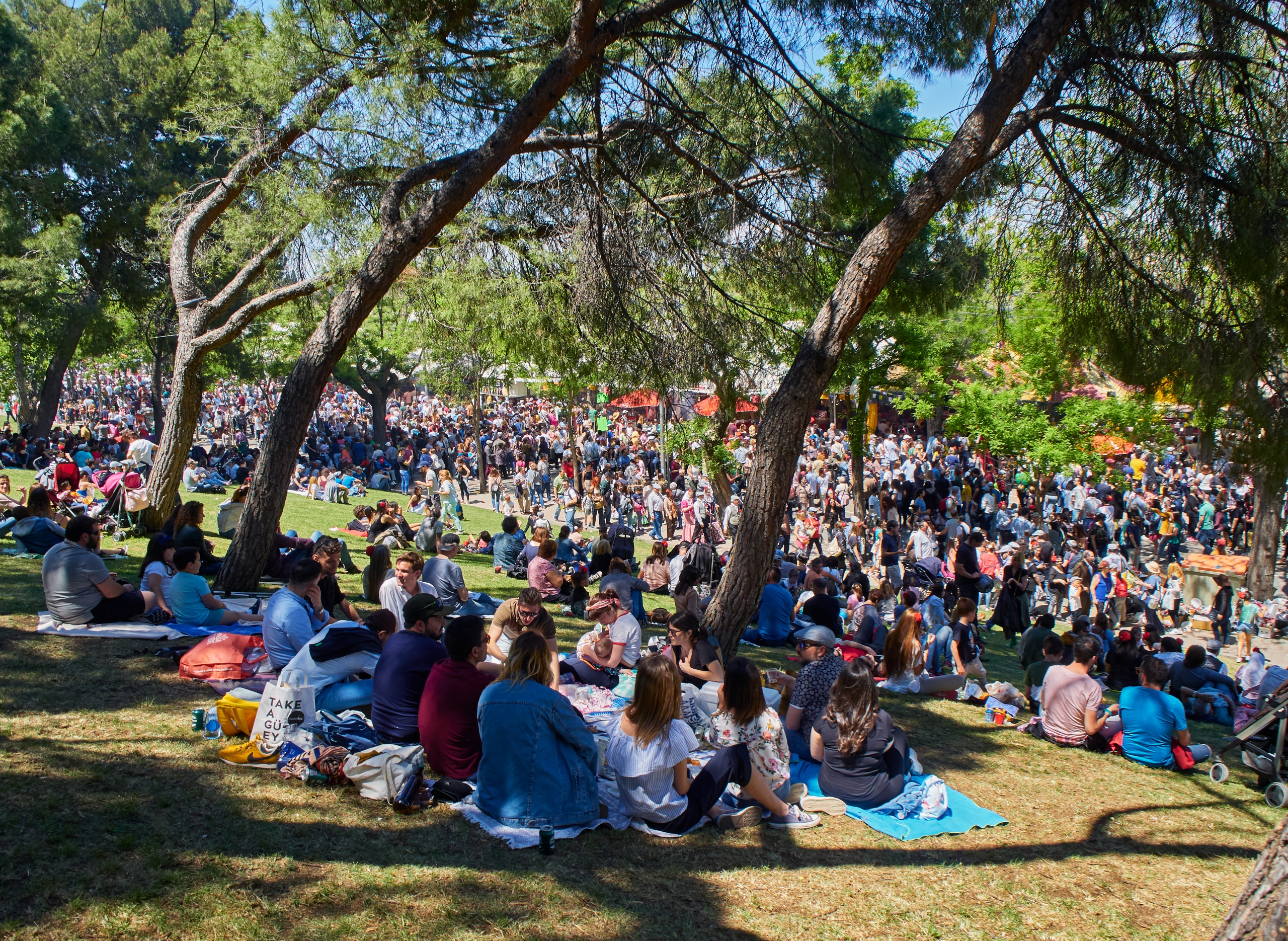
Every May, Madrid briefly changes rhythm. The city’s avenues, traffic, and business districts continue operating as usual, yet along the banks of the Manzanares River another Madrid reappears: one shaped by pilgrimage, popular devotion, music, shared food, and open-air celebration. The center of that transformation is the Pradera de San Isidro, the meadow dedicated to San Isidro Labrador, patron saint of Madrid.
For several days, the hillside overlooking the river becomes one of the most symbolic cultural landscapes in the Spanish capital. Families arrive carrying picnic baskets and folding chairs. Chulapos and chulapas — dressed in the traditional attire associated with nineteenth-century Madrid — dance chotis beneath temporary stages. Processions, concerts, religious ceremonies, food stalls, and fairground attractions coexist in a celebration that combines pilgrimage, urban festivity, and local identity.
The festival of San Isidro, celebrated around 15 May, remains one of Europe’s most distinctive examples of how a modern capital preserves a living relationship between popular spirituality and communal public space.
The saint who became Madrid’s symbol
San Isidro Labrador was born in Madrid around the late eleventh century, during a period when the city still stood near the frontier between Muslim and Christian territories of the Iberian Peninsula. Unlike many urban patron saints associated with bishops, monarchs, or martyrs, Isidro was a farmer. Tradition describes him as a laborer who worked the fields surrounding medieval Madrid while maintaining a life marked by prayer, charity, and simplicity.
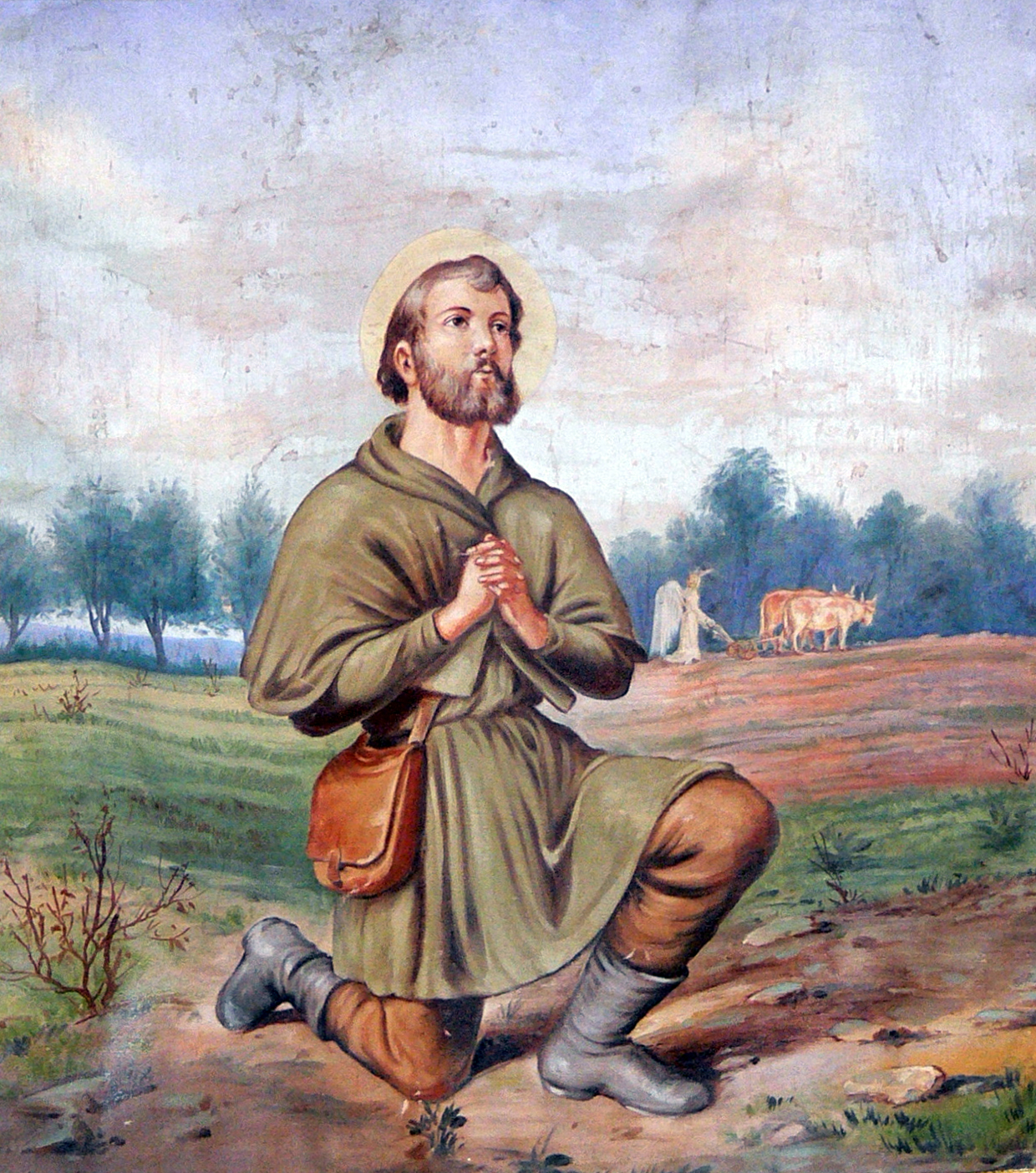
His biography belongs largely to oral tradition and later hagiographic texts, but several elements became central to Madrid’s collective imagination. Stories associated with miraculous springs, agricultural fertility, acts of generosity, and divine intervention linked the saint closely to the land itself.
That rural identity remains essential to understanding San Isidro’s importance. Madrid today is one of Europe’s largest capitals, yet its patron saint represents an agricultural world that long preceded urban expansion. The festival therefore preserves a symbolic memory of the city before industrialization and before Madrid became a political metropolis.
Canonized in 1622 alongside figures such as Teresa of Ávila and Ignatius of Loyola, San Isidro gradually evolved into a civic symbol as much as a religious one. His feast day became a collective celebration of Madrid identity itself.
The Pradera: A landscape of pilgrimage
The Pradera de San Isidro lies on the southern side of central Madrid, near the Ermita de San Isidro, a small chapel connected to one of the saint’s best-known traditions: the miraculous spring whose water pilgrims still drink during the festivities.
The meadow became associated with pilgrimage from at least the sixteenth century onward. People traveled from across Madrid and surrounding villages to visit the hermitage, participate in religious observances, and spend the day outdoors. Over time, the gathering evolved into a hybrid celebration balancing devotion, leisure, and popular festivity.
What makes the Pradera culturally significant is precisely that mixture. Unlike monumental pilgrimage destinations centered entirely on sacred architecture, San Isidro revolves around an open landscape. The meadow itself functions as the social and symbolic heart of the event.
Pilgrims traditionally climbed the hill to reach the hermitage, collect water from the spring, attend Mass, and share food in the open air. Even today, many madrileños continue the custom of spending the entire day outdoors with relatives and friends, transforming the pilgrimage into a communal occupation of public space.
The physical setting contributes strongly to the atmosphere. From the hilltop, visitors can still see parts of Madrid’s historic skyline, including church domes and older neighborhoods stretching toward the city center. The festival therefore creates an unusual dialogue between urban modernity and remembered rural tradition.
Goya and the invention of the popular festival
Much of the modern visual imagination surrounding San Isidro comes from the work of Francisco de Goya. His famous painting La pradera de San Isidro, created in the late eighteenth century, portrays crowds gathered on the hillside overlooking Madrid during the feast day.
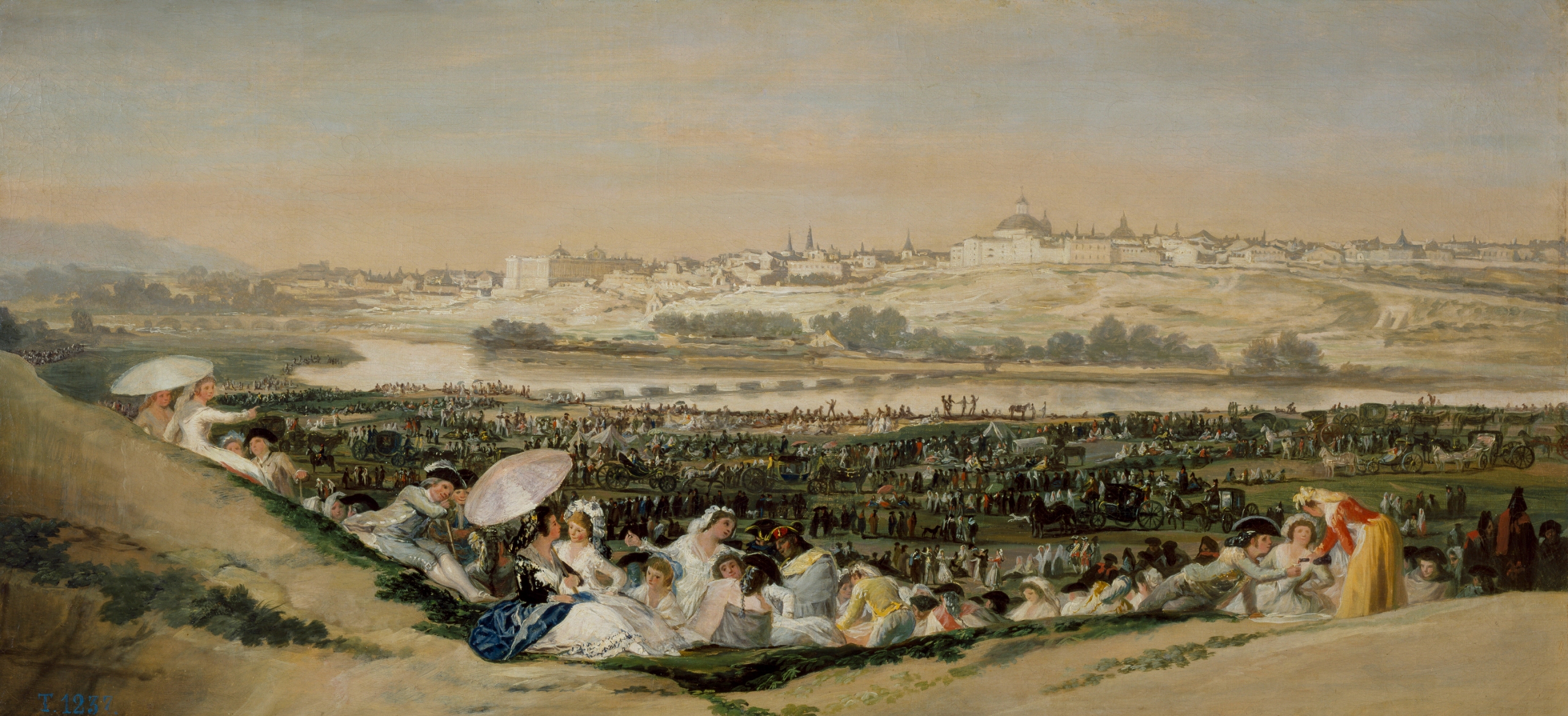
The painting remains one of the most important artistic documents of Madrid’s popular culture. Goya depicts carriages, elegant figures, ordinary citizens, vendors, musicians, and pilgrims sharing the same festive landscape. The city appears in the distance while the meadow becomes a democratic social space where different classes temporarily converge.
That image helped define the cultural mythology of San Isidro for later generations. The festival became associated not only with religious devotion but also with the idea of Madrid as a city of open-air sociability, irony, music, and collective celebration.
Even today, many aspects of the modern festival preserve that eighteenth- and nineteenth-century atmosphere. Traditional organ grinders, zarzuela performances, folk dances, and regional costumes consciously evoke historical Madrid.
Chulapos, music and the language of Madrid
One of the most recognizable aspects of San Isidro is the presence of the chulapo and chulapa costumes. The male outfit usually includes a checked cap, fitted vest, white shirt, and carnation, while women wear dresses with shawls and elaborate hairstyles decorated with flowers.
These costumes emerged from nineteenth-century Madrid working-class neighborhoods and eventually became stylized symbols of local identity. During San Isidro, they transform the city into a living theatrical space where historical memory is performed collectively.
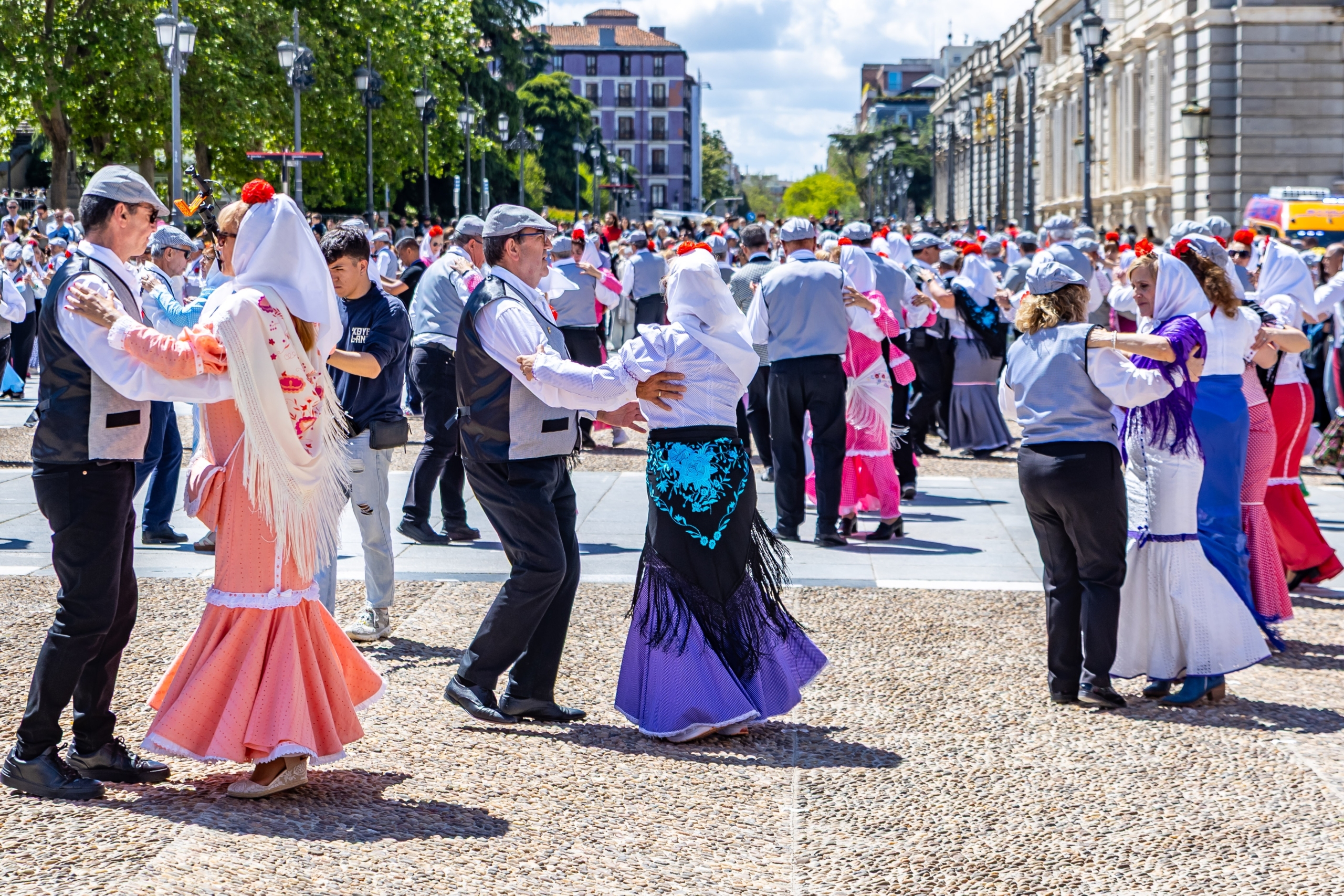
Music plays an equally important role. Chotis — the dance most associated with Madrid — fills squares and festival grounds throughout the celebrations. Although originally derived from Central European dances, it became deeply integrated into Madrid culture during the nineteenth century.
Alongside traditional music, contemporary concerts now form part of the official festival program. Pop, flamenco, indie music, brass bands, and neighborhood performances coexist across temporary stages installed throughout the city. The result is a festival balancing heritage and contemporary urban culture rather than preserving folklore as a static museum tradition.
Food, ritual and shared space
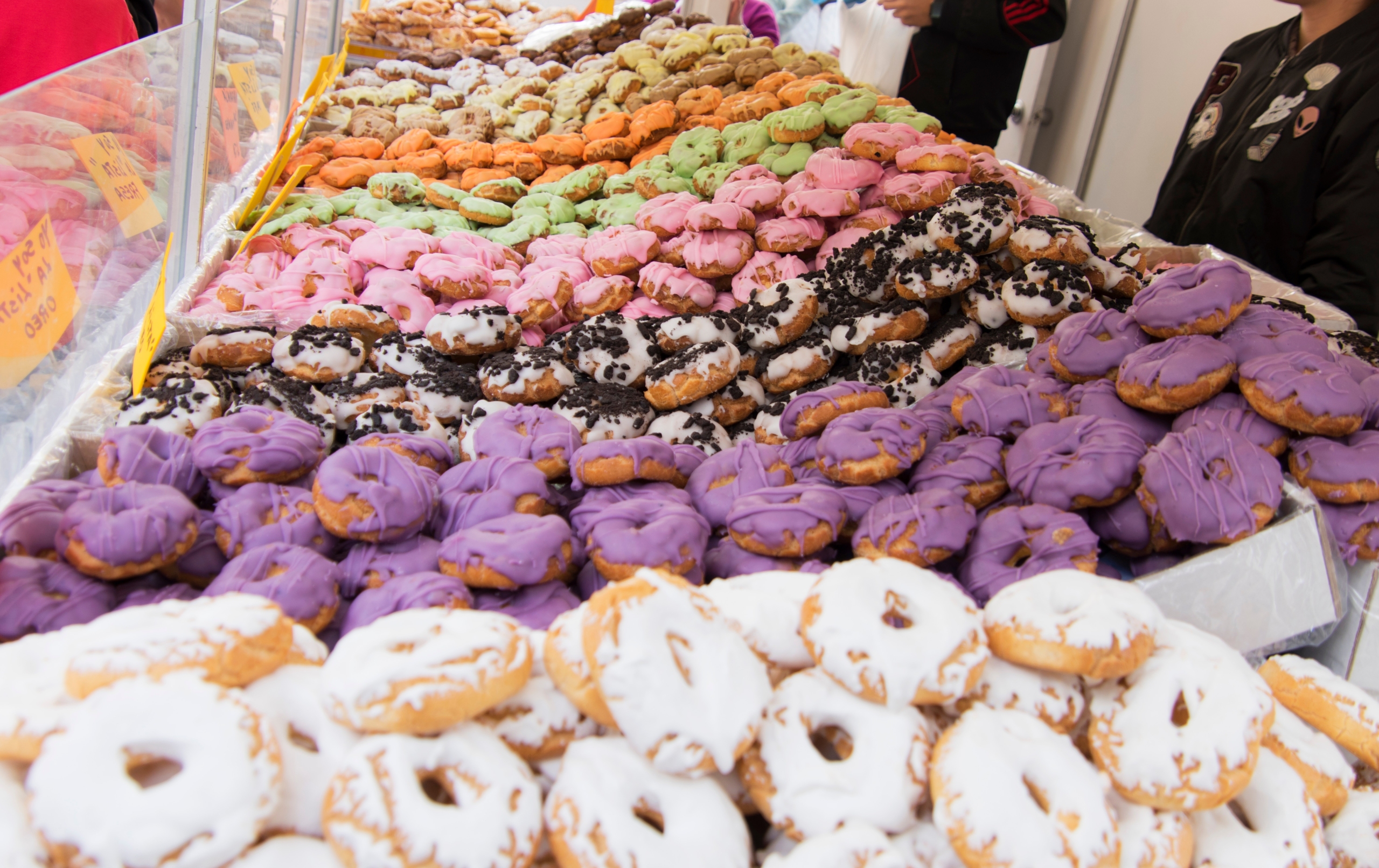
As in many Mediterranean pilgrimages, food remains central to the social experience of San Isidro. Families gather on the meadow with homemade meals, while street stalls sell traditional products associated with the festival.
Among the best-known are rosquillas de San Isidro, ring-shaped pastries prepared in several varieties: tontas, listas, de Santa Clara, and francesas. Their recipes date back centuries and remain closely linked to the feast day.
Eating outdoors forms part of the ritual itself. The pilgrimage historically marked the arrival of spring, and the meadow became a place where urban residents could reconnect with seasonal rhythms and communal life beyond the constraints of the city.
Water from the Fuente de San Isidro also continues to hold symbolic importance. Many visitors still drink from the spring while repeating the traditional saying that promises marriage prospects to unmarried women who drink its water on the saint’s feast day. Whether taken literally or humorously, the custom reveals how folklore and ritual remain intertwined within the celebration.
A pilgrimage in a modern capital
The San Isidro festivities occupy a unique position within contemporary Europe because they preserve pilgrimage traditions inside a major global capital. Unlike rural pilgrimages increasingly detached from urban life, San Isidro remains integrated into Madrid’s civic identity.
Religious processions continue through the streets, yet the festival also functions as a public cultural event open to believers, secular participants, tourists, and neighborhood communities alike. The boundaries between pilgrimage, festival, and civic celebration remain deliberately fluid.
This flexibility explains the celebration’s resilience. San Isidro survives not because Madrid has remained unchanged, but because the festival adapts continuously while preserving core symbolic elements: the meadow, the pilgrimage, the saint, the communal meal, and the occupation of public space.
In a highly urbanized society, the Pradera de San Isidro still offers something increasingly rare: a temporary collective landscape where memory, ritual, leisure, and local identity coexist in direct contact with the outdoors.
The meadow as cultural memory
The importance of the Pradera de San Isidro ultimately lies beyond folklore or tourism. The meadow preserves a long Mediterranean tradition in which pilgrimage is inseparable from landscape, seasonal cycles, and collective gathering.
For several days each May, Madrid remembers an older relationship with territory and community. The pilgrimage route to the hermitage, the shared meals on the grass, the music, the dancing, and the rituals surrounding water and springtime all connect the modern city with centuries of accumulated cultural memory.
The Pradera therefore functions simultaneously as park, sanctuary, festival ground, and symbolic archive of Madrid itself. It is one of the few places where the capital still pauses long enough to celebrate not only its patron saint, but also its historical identity as a community shaped by movement, hospitality, and public celebration.
AI Transparency Notice
PilgriMaps uses artificial intelligence tools to assist in the research, drafting and translation of editorial content. All AI-assisted content is reviewed, edited and verified by our editorial team before publication. We contrast information against primary sources, specialist literature and on-the-ground knowledge to ensure accuracy, cultural sensitivity and editorial integrity.
AI is one tool among many in our workflow. The judgement, curation and responsibility for everything published on this platform remain entirely human.
Viator Media S.L. — in compliance with the EU Artificial Intelligence Act (Regulation EU 2024/1689).
This post is also available in: