Rising 3,776 meters above central Honshu, Mount Fuji dominates Japan’s landscape both visually and symbolically. Its nearly symmetrical cone, snowcapped for much of the year, has long made it an object of reverence, inspiration, and ritual approach. Today it is climbed by thousands each summer, an act framed partly as recreation and partly as continuity with centuries of pilgrimage tradition. Yet Fuji’s role as a sacred mountain predates Buddhism’s arrival in Japan and has since been transformed by Buddhist cosmologies that reinterpreted the peak as a pathway to enlightenment.
Mountains before Buddhism: Kami and the realm of spirits
In early Japanese cosmologies, mountains were understood as abodes of kami—spirits or deities associated with natural forces, fertility, and thresholds between worlds. Fuji, towering and visible from vast distances, was regarded as a site of awe and potency.
Ancient rituals around Fuji appear to have focused on appeasement of its volcanic force and honoring it as a source of fertility. Local shrines (jinja) dedicated to Konohanasakuya-hime, a Shinto kami associated with blossoms, life, and volcanoes, framed the mountain not simply as a natural feature but as a living presence. Seasonal rites and offerings at the base of Fuji were likely meant to ensure both protection from eruption and agricultural abundance in surrounding plains.
Climbing the mountain itself was initially restricted, reflecting the belief that its summit was a realm apart, accessible only to ritual specialists. For the communities living under its shadow, Fuji was less a site of ascent than a cosmic presence shaping weather, fertility, and destiny.

The Buddhist turn: Mountains as mandalas
Buddhism entered Japan in the 6th century CE, bringing with it cosmologies that emphasized the symbolism of ascent, purification, and transcendence. In this framework, mountains were reinterpreted as mandalas in landscape form—natural sites where physical ascent mirrored spiritual progress.
By the Heian period (8th–12th centuries), practitioners of Shugendō—a syncretic tradition combining Buddhist, Shinto, and Daoist elements—began to incorporate Fuji into their ascetic practices. Shugendō emphasized rigorous mountain training: fasting, prayer, and endurance of natural extremes as means of achieving spiritual insight. For these practitioners, climbing Fuji was not recreation but ritual—a deliberate passage through stages of hardship toward transcendence.
Fuji thus shifted from a volcano revered at a distance to a pilgrimage mountain, its ascent codified as a path of purification. Each station marked progress not only physically but spiritually, mapping the pilgrim’s body onto a cosmological ascent.
Fuji as Buddhist Cosmology in Stone
Within Buddhist frameworks, Fuji came to embody cosmic order. Its summit, above the clouds, was associated with the realm of Buddhas and bodhisattvas. The act of climbing mirrored the structure of Buddhist cosmology: movement from the mundane world at the base through stages of transformation toward a sacred summit.
By the medieval period, Fuji was integrated into networks of sacred peaks such as Mount Hiei and Mount Kōya, but its volcanic power and iconic form set it apart. Temples and shrines were built along its slopes and at surrounding sites, creating an extended ritual geography. Pilgrims ascended not only for personal purification but also as representatives of their communities, carrying petitions and returning with blessings.
The mountain thus became a site where Shinto and Buddhist traditions converged: shrines at the base to kami, Buddhist rituals along the ascent, and syncretic practices at the summit. Rather than conflict, the two traditions layered upon one another, shaping a uniquely Japanese model of sacred landscape.
Popular Pilgrimage and the Fuji-kō
From the 17th century, with the relative peace of the Tokugawa shogunate, climbing Fuji spread beyond ascetics to become a widespread popular pilgrimage. Local confraternities known as Fuji-kō organized collective pilgrimages, enabling farmers, townspeople, and artisans to undertake the ascent.
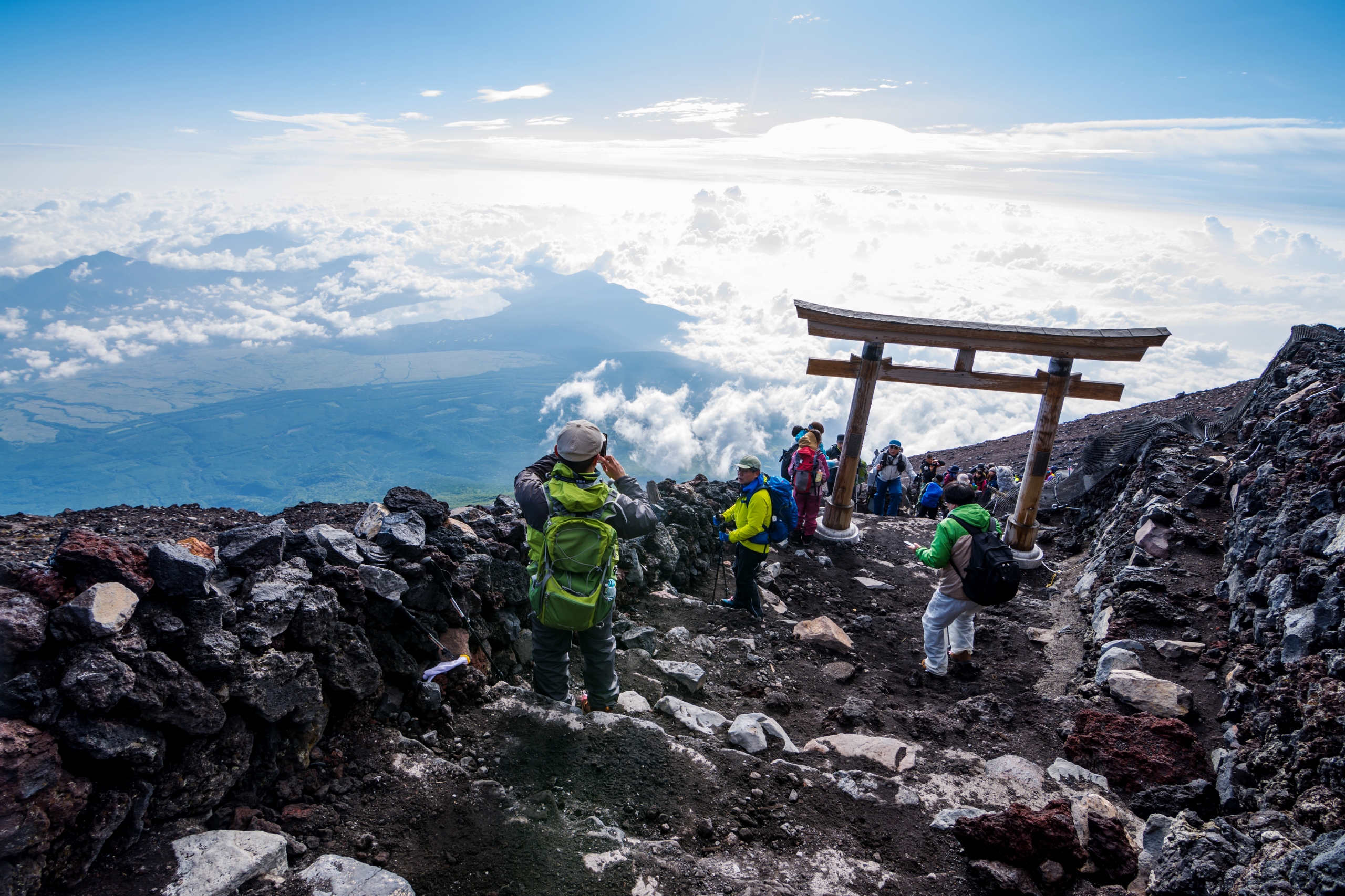
Members of Fuji-kō performed preparatory rituals at shrines such as Fujisan Hongū Sengen Taisha in Fujinomiya, then climbed in white pilgrimage garb, chanting invocations as they ascended. The summit offered not only ritual fulfillment but also a panoramic vision of the Japanese archipelago—an experience described in both sacred and aesthetic terms.
Through the Fuji-kō, the mountain became a national pilgrimage site, integrating Buddhist, Shinto, and local practices into a shared cultural rhythm.
Fuji Today: Pilgrimage, Heritage, and Continuity
Declared a UNESCO World Heritage Site in 2013, Mount Fuji is recognized for its cultural as much as its natural significance. The summer climbing season attracts hundreds of thousands, many of whom still frame their ascent in pilgrimage terms. Shinto shrines at the base and summit remain active, and Buddhist iconography continues to inform the mountain’s ritual landscape.
While modern climbers may seek fitness or scenery, they also walk a path layered with centuries of meaning. Each ascent reactivates an ancient practice: movement through hardship toward a summit that has always signified more than itself.
A Mountain of Many Traditions
Mount Fuji’s history illustrates the continuity of sacred engagement across traditions. In pre-Buddhist times, it was a volcanic kami, approached with reverence and caution. In the Buddhist era, it became a mandala in stone, a stage for ritual ascent. Later, through confraternities, it became a mass pilgrimage accessible to common people.
Today, Fuji retains its double identity—as national symbol and sacred mountain. Its slopes carry the footprints of both ancient ritual specialists and modern tourists, but the underlying impulse remains: to approach the peak as a threshold between human life and something larger, whether defined by kami, Buddhas, or the enduring awe of the mountain itself.
AI Transparency Notice
PilgriMaps uses artificial intelligence tools to assist in the research, drafting and translation of editorial content. All AI-assisted content is reviewed, edited and verified by our editorial team before publication. We contrast information against primary sources, specialist literature and on-the-ground knowledge to ensure accuracy, cultural sensitivity and editorial integrity.
AI is one tool among many in our workflow. The judgement, curation and responsibility for everything published on this platform remain entirely human.
Viator Media S.L. — in compliance with the EU Artificial Intelligence Act (Regulation EU 2024/1689).
This post is also available in: