There is a dish in Brazilian cuisine that is as simple as it is ancient: moqueca. It is a fish stew. But calling it that is like saying samba is simply dance music. Technically correct, but completely inadequate.
If Candomblé represents Brazil’s spiritual syncretism and samba its musical one, then moqueca is their culinary equivalent: a dish that brings together the food traditions of the Portuguese, the Indigenous Tupi peoples, and enslaved Africans. Three worlds meeting in a single broth. It is a story of violence, survival, and extraordinary cultural adaptation.
The earliest written reference to moqueca dates to 1554, in a letter by the Portuguese missionary Luís Grã. He described Indigenous people roasting fish on a moquém—a wooden grilling rack—wrapped in banana leaves or covered with ashes. That was the beginning of everything.
Then came the Portuguese, bringing tomatoes, onions, and olive oil. They were followed by enslaved Africans, who enriched local cooking with dendê oil and coconut milk. Salvador da Bahia became one of the principal ports of arrival for Africans forced across the Atlantic. They brought with them languages, religions, rhythms, and culinary traditions that blended with those of Europeans and Indigenous peoples. The result is one of the world’s most inclusive dishes. Every ingredient comes from somewhere different. Every flavor has a history.
Ask a Bahian and a Capixaba what the “real” moqueca is, and prepare for a long conversation.
People from Espírito Santo openly insist that their version is the original recipe. Bahians disagree with equal conviction. It is a rivalry centuries old, as serious as a family feud and, oddly enough, remarkably productive: it has given rise to two distinct masterpieces.
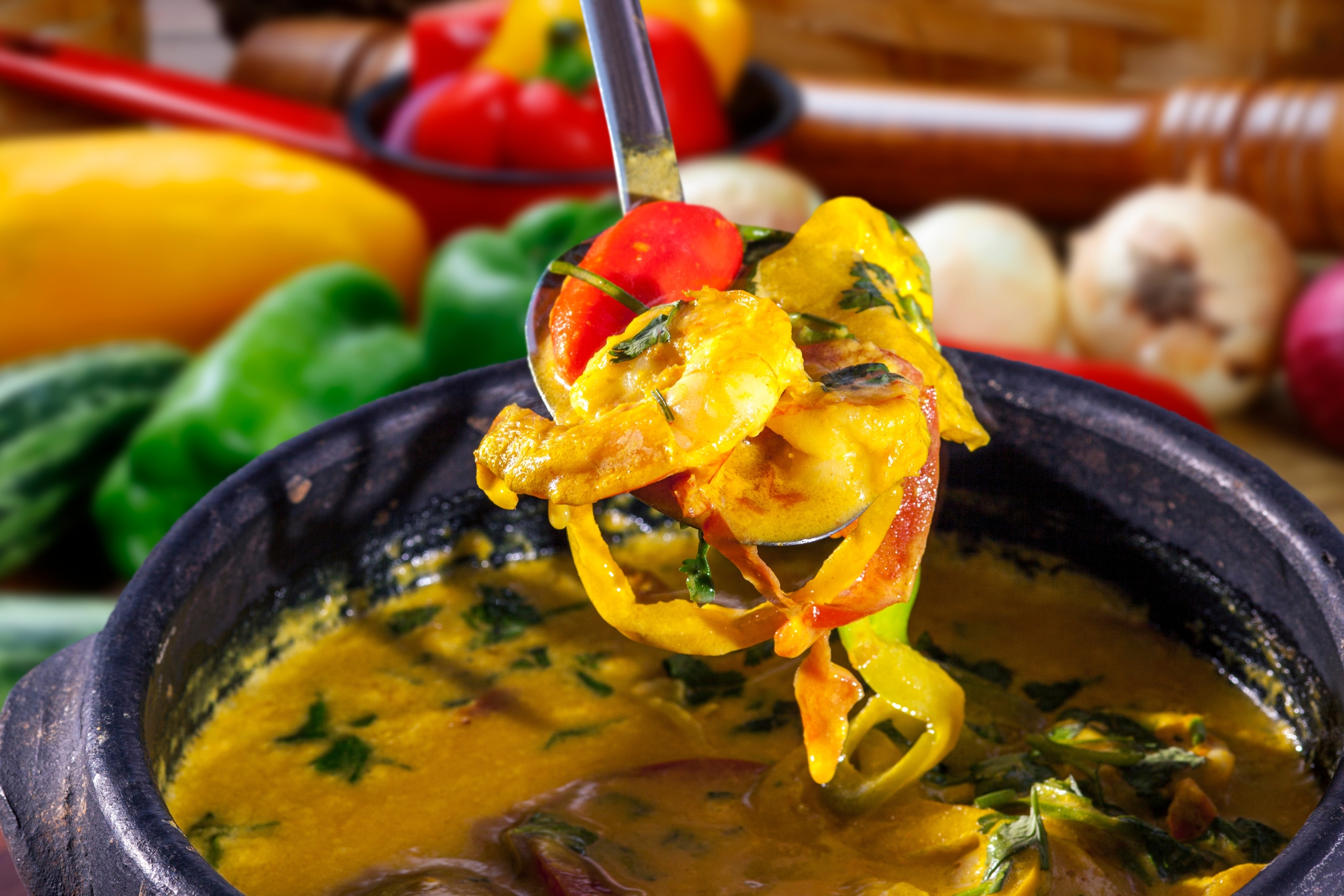
Bahian moqueca is power. Coconut milk, dendê oil, and peppers create a broth that is rich, aromatic, and unmistakable. Dendê—oil extracted from the fruit of the African oil palm—gives the dish its deep orange color and an earthy, complex flavor that is almost primal. It is Africa in a spoonful. Bahian moqueca owes its boldness and depth to the unique, musky character of dendê oil.
Capixaba moqueca is subtlety. Dendê oil is replaced with olive oil or soybean oil, and coconut milk disappears entirely. The principal ingredients are tomatoes, onions, cilantro, lime, and annatto, used both for color and flavor. The result is a lighter, cleaner dish in which the fish speaks for itself. Capixaba moqueca is more delicate, more herbaceous, and more restrained, allowing the pure flavor of fresh seafood to emerge. But before there is the broth, there is the vessel. And here the story becomes tangible.
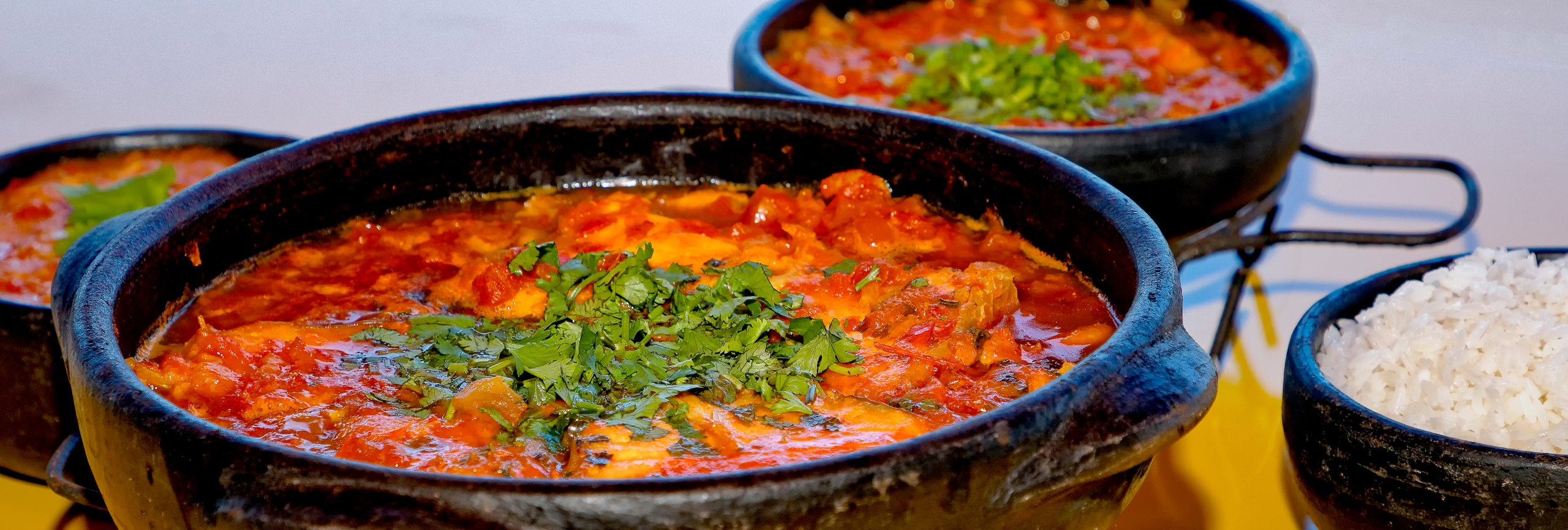
Traditionally, moqueca is cooked and served in a panela de barro, a black clay pot handcrafted in the state of Espírito Santo. This is not merely an aesthetic detail. The clay distributes heat slowly and evenly, prevents aggressive boiling, and keeps the fish intact. These pots are made by the women of Goiabeiras, a neighborhood of Vitória, the capital of Espírito Santo. Their craft is passed down from generation to generation. It is more than a profession—it is a cultural identity, a way of life. The pots are shaped entirely by hand, without machinery, and fired in open-air bonfires.
On December 20, 2002, Brazil’s National Institute of Historic and Artistic Heritage (IPHAN) registered the Ofício das Paneleiras de Goiabeiras—the Craft of the Goiabeiras Pot Makers—as Intangible Cultural Heritage of Brazil. It was the first intangible cultural asset ever entered into the institution’s registry. The Association of the Goiabeiras Pot Makers, founded in 1987, now includes more than sixty artisans.
There is something deeply moving about that. A cooking pot that prepares lunch while preserving a civilization. The name of the dish may have come from enslaved Africans speaking Kimbundu, a Bantu language originally spoken in Angola, where the term broadly meant “stew.” Other scholars trace the word to the Indigenous Tupi language, where moquém referred to the technique of slow-cooking food over a wooden rack. The two explanations do not contradict one another. They overlap, just like everything else in this dish.
So famous that it inspired the Brazilian folk song A Moqueca, the dish also found its way into literature. Moqueca appears in Jorge Amado’s novella The Two Deaths of Quincas Wateryell. Amado was a son of Bahia. He knew moqueca the way one knows a mother: with complete affection and no critical distance. Moqueca is always brought to the table in the pot it was cooked in. Always.
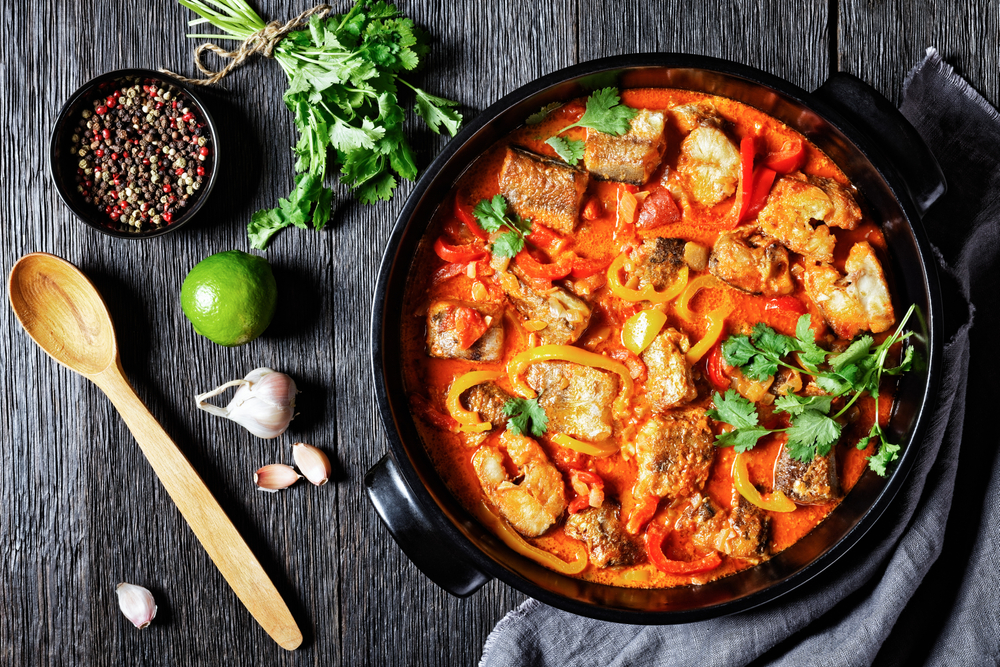
It arrives steaming hot, preceded by the aroma of fresh cilantro. It is served with white rice, pirão—a soft porridge made by thickening fish broth with cassava flour—and farofa, toasted cassava flour cooked with butter or fat.
The fish most commonly used in Capixaba moqueca are grouper, sea bass, and badejo, all firm-fleshed species that absorb flavor without falling apart. In Bahia, shrimp, shellfish, and sometimes octopus often join the pot. The orange dendê broth stains bread, fingers, and memory. This is a dish meant to be shared. Not because of some culinary convention, but because there is only one pot, placed in the center of the table. Community is built into its structure.
Moqueca survives because it is real. It was not invented by a chef searching for authenticity. It emerged from centuries of forced encounters, from the kitchens of enslaved people, from Indigenous cooking fires, and from Portuguese ships crossing the Atlantic. Every version—Bahian, Capixaba, Paraense—is a living document of a place and its history. When you eat moqueca, you eat all of that. You taste the sixteenth century and palm oil brought from Angola. You taste the black clay pots of Goiabeiras and the fresh fish from the market. You taste Jorge Amado and Brazilian folk songs. You taste Brazil itself: complex, beautiful, and impossible to reduce to a single story. Moqueca is life.
The earliest written references to moqueca date from 1554. The Ofício das Paneleiras de Goiabeiras has been recognized as Intangible Cultural Heritage of Brazil since 2002. The word “moqueca” derives either from Kimbundu, a Bantu language spoken in Angola, or from the Tupi word moquém, according to different scholarly interpretations. All historical information cited here is based on primary or institutional sources.
AI Transparency Notice
PilgriMaps uses artificial intelligence tools to assist in the research, drafting and translation of editorial content. All AI-assisted content is reviewed, edited and verified by our editorial team before publication. We contrast information against primary sources, specialist literature and on-the-ground knowledge to ensure accuracy, cultural sensitivity and editorial integrity.
AI is one tool among many in our workflow. The judgement, curation and responsibility for everything published on this platform remain entirely human.
Viator Media S.L. — in compliance with the EU Artificial Intelligence Act (Regulation EU 2024/1689).
This post is also available in: