In northern Jordan, about 50 kilometers from Amman, the archaeological site of Jerash rises from a fertile basin once threaded with caravan routes. Today it stands among the most extensive and best-preserved Greco-Roman cities in the Eastern Mediterranean. Colonnaded avenues, theaters, temples, and churches trace successive layers of Hellenistic, Roman, Byzantine, and early Islamic presence. For contemporary travelers walking the Jordan Trail, Jerash offers a compelling encounter with the plural landscapes—political, cultural, and religious—that have shaped the region.
Gerasa and the cities of the Decapolis
In antiquity, Jerash was known as Gerasa. It belonged to the Decapolis, a league of ten cities that emerged after the Roman reorganization of the Near East in the first century BCE. These urban centers—among them Philadelphia (modern Amman), Gadara, and Scythopolis—shared Hellenistic urban planning, civic institutions, and economic ties. They functioned as nodes of Greco-Roman culture within a broader Semitic and Nabataean environment.
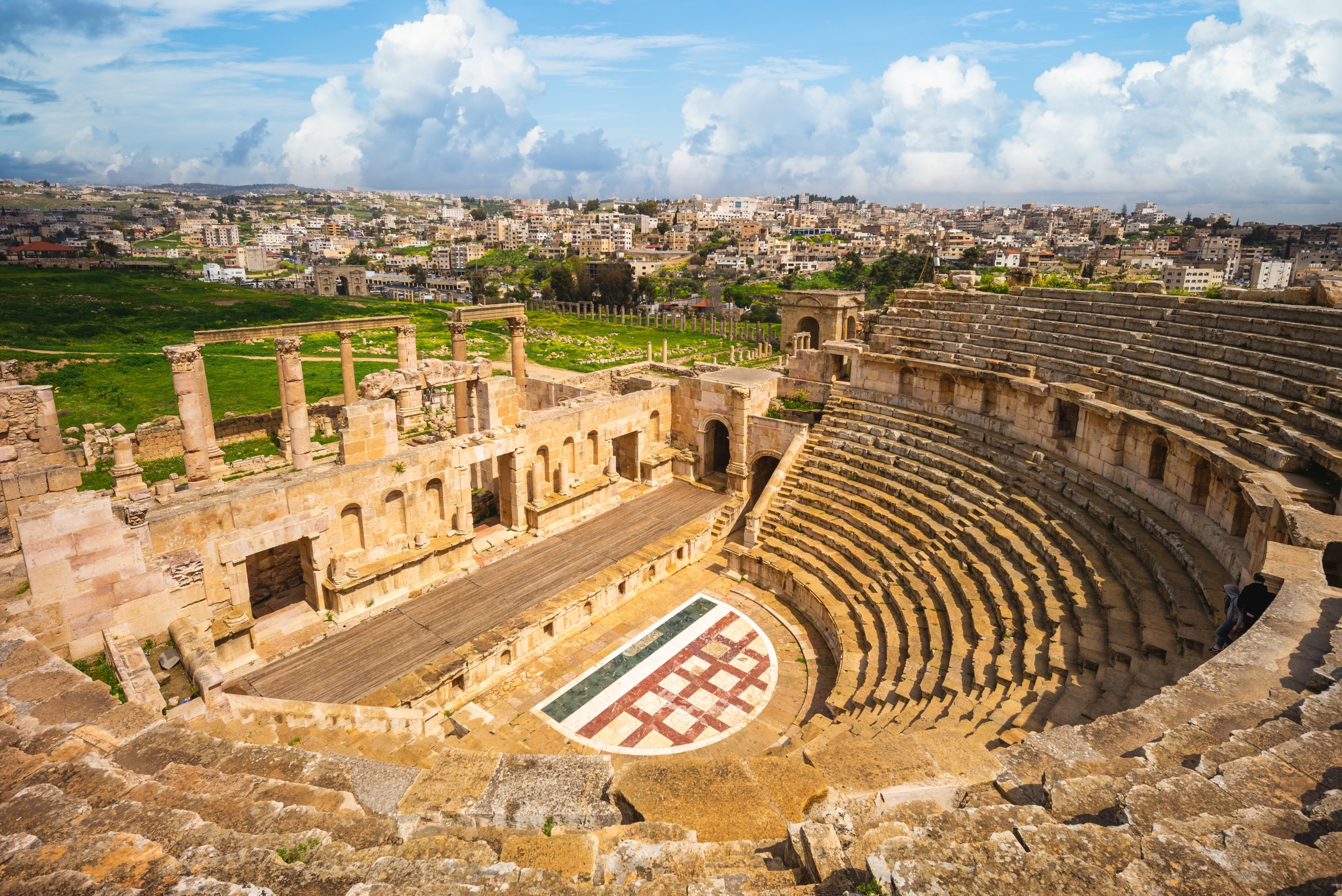
Gerasa flourished particularly in the second and third centuries CE. The Oval Plaza, framed by Ionic columns, leads into the Cardo Maximus, a long colonnaded street once lined with shops and civic buildings. The South Theater, still used for performances, reflects the city’s integration into the cultural networks of the Roman Empire. Monumental gates such as the Arch of Hadrian mark imperial visits and local aspirations.
By the fourth century, as Christianity spread through the eastern provinces, Gerasa acquired churches adorned with mosaic floors. Episcopal lists attest to its role within emerging Christian administrative structures. Earthquakes in the eighth century and shifting trade patterns contributed to its decline, though settlement never vanished entirely.
A Gospel landscape: The “miracle of the pigs”
Jerash also occupies a place in Christian textual memory. The Gospels of Mark (5:1–20) and Luke (8:26–39) recount an episode in which Jesus encounters a man described as possessed by unclean spirits in the “country of the Gerasenes” or “Gadarenes,” depending on manuscript traditions. After a brief exchange, the spirits enter a herd of pigs, which rush down a steep bank into a body of water and drown.
The narrative has generated centuries of geographical debate. Some manuscripts refer to Gerasa; others to Gadara or to Gergesa. The difficulty lies in topography: Jerash is situated inland, at a considerable distance from the Sea of Galilee, whereas the story implies proximity to water and a steep slope. Scholars have proposed that “Gerasenes” may have referred not strictly to the city itself but to a broader territorial designation under its administrative control. Others identify the setting with sites closer to the lake, such as Kursi (often associated with ancient Gergesa).
This multiplicity has led to confusion among several similarly named places—Gerasa (Jerash), Gadara (modern Umm Qais), and possible variants such as Gergesa—each embedded within the same regional matrix of the Decapolis. Ancient copyists, working with oral traditions and evolving place names, may have transmitted different toponyms reflecting overlapping jurisdictions.
For visitors to Jerash today, the episode forms part of an interpretive landscape rather than a fixed archaeological claim. The site does not offer a shoreline or cliff descending into a lake. Instead, it situates the narrative within the broader cultural and political environment of the Decapolis: predominantly non-Jewish cities characterized by Greco-Roman institutions and economic life.
A threshold toward the Gentile world
Within Christian exegesis, the story of the Gerasene demoniac has often been read as a symbolic threshold. The Decapolis represented, in first-century terms, a largely non-Jewish or “Gentile” milieu. After the man is restored, the Gospel of Mark records that he proclaims what has happened to him throughout the Decapolis. Some interpreters regard this moment as a literary foreshadowing of the later mission to non-Jewish populations—a narrative gesture toward the extension of the movement beyond its initial Jewish setting.
Such interpretations do not rest on archaeological proof linking Jerash directly to the event. Rather, they draw on the city’s documented status within a Greco-Roman league and on the symbolic geography of the Gospel text. For travelers attentive to historical context, the interest lies in how memory, text, and terrain intersect. The city’s monumental architecture speaks of imperial structures; the Gospel narrative situates a dramatic healing within that same cultural sphere.
Jerash along the Jordan Trail
The Jordan Trail stretches more than 650 kilometers from Umm Qais in the north to Aqaba in the south, linking villages, deserts, forests, and archaeological zones. Jerash lies near its northern stages, offering walkers a transition between rural highlands and urban antiquity. Olive groves and rolling hills surround the site, softening the monumental stone with agricultural continuity.
Approaching Jerash on foot alters the scale of perception. The Cardo becomes not a static ruin but a continuation of routes that have carried traders, soldiers, pilgrims, and residents for millennia. The city’s grid aligns with Roman planning principles; the surrounding paths follow older contours shaped by terrain and water sources.
Practical access is straightforward. The archaeological park is well signposted and includes interpretive panels outlining major structures. Spring and autumn provide moderate temperatures; summer heat can be intense. Combining a visit to Jerash with nearby Umm Qais—identified with ancient Gadara—allows travelers to situate the Gospel debate within a broader geographical frame.
Layers, names, and ongoing inquiry
Jerash exemplifies the complexities of historical identification in a region dense with overlapping names and jurisdictions. The recurrence of similar toponyms—Gerasa, Gadara, Gergesa—reflects linguistic shifts among Greek, Aramaic, and later Arabic usage. Textual transmission added further variation. Rather than resolving the question definitively, contemporary scholarship maps probabilities against terrain, political boundaries, and literary aims.
What remains tangible is the city itself: columns rising against the hills, mosaics bearing geometric precision, and inscriptions that anchor personal names in stone. Jerash invites visitors to read the landscape as archive. Imperial ambition, local adaptation, and early Christian storytelling converge here, not as isolated strands but as interwoven narratives.
For those tracing the Jordan Trail, Jerash stands as a threshold site. It frames the movement from rural pathways into urban antiquity and from historical record into remembered story. In its streets, the Decapolis takes architectural form; in its debated associations, early Christian expansion finds symbolic geography. The city’s enduring presence allows travelers to consider how routes—ancient and modern—shape encounters across cultures and centuries.
AI Transparency Notice
PilgriMaps uses artificial intelligence tools to assist in the research, drafting and translation of editorial content. All AI-assisted content is reviewed, edited and verified by our editorial team before publication. We contrast information against primary sources, specialist literature and on-the-ground knowledge to ensure accuracy, cultural sensitivity and editorial integrity.
AI is one tool among many in our workflow. The judgement, curation and responsibility for everything published on this platform remain entirely human.
Viator Media S.L. — in compliance with the EU Artificial Intelligence Act (Regulation EU 2024/1689).
This post is also available in: