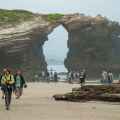
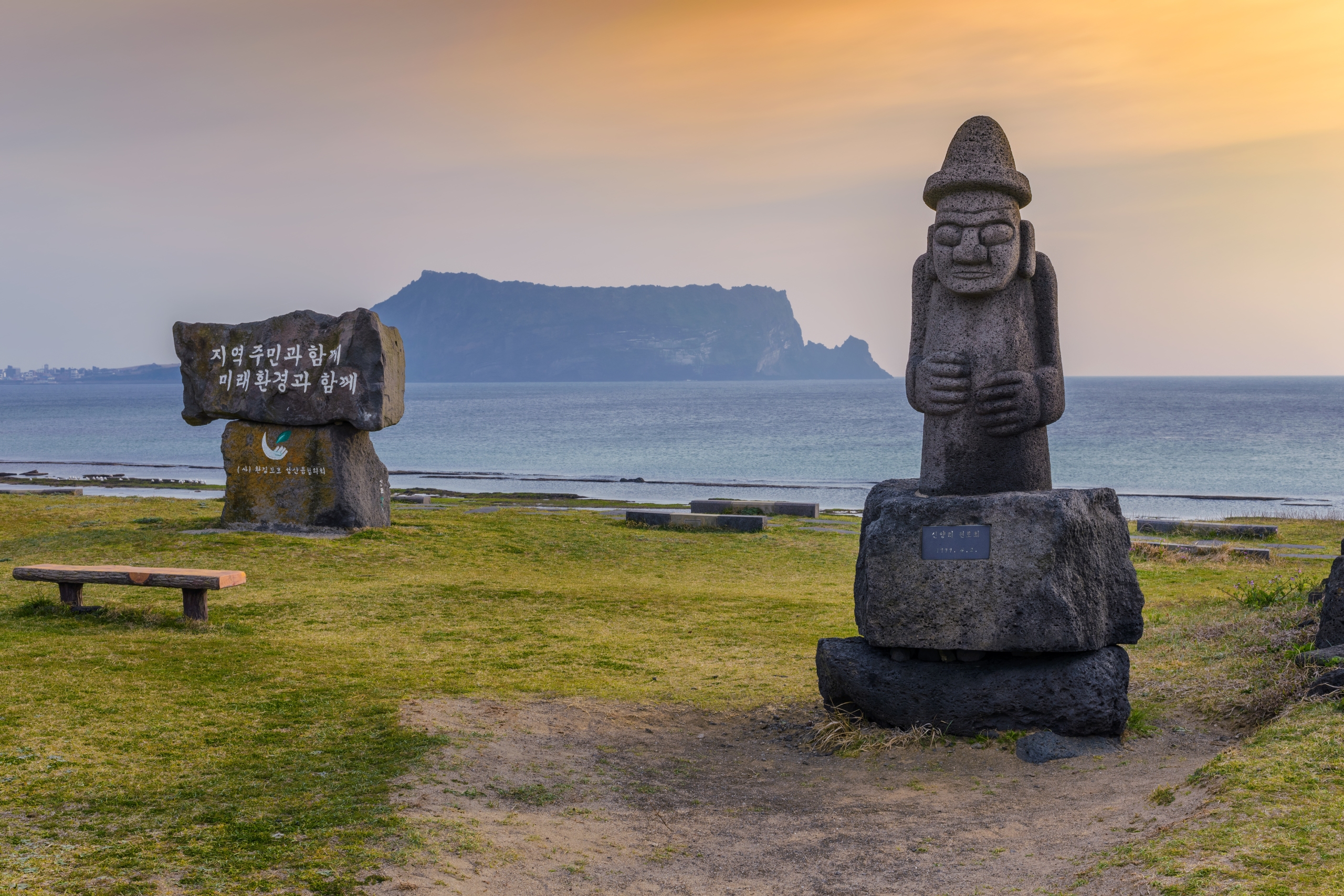
A dol hareubang – literally, “stone grandfather” – stands near the entrance of a coastal shrine as salt-laden wind moves across fields of black lava. In the distance, the sun lowers behind Hallasan, the island’s central volcanic peak, coloring the sky in muted tones. On Jeju, it is common to hear people speak as if every rock carries memory and every tree marks a presence. This is often described as the island of 18,000 deities: a place where landscape, myth, and daily life have long coexisted.
Jeju’s reputation rests not only on its dramatic geology but also on a dense network of stories and practices that continue to shape local identity. These traditions are not preserved solely as folklore. They remain embedded in seasonal rhythms, community rituals, and domestic customs. Notably, many of Jeju’s deities are addressed as grandmothers and grandfathers, a linguistic choice that signals familiarity rather than distance. Spiritual figures are framed as senior members of the community—protective, demanding, and integrated into everyday concerns.
In 2011, Jeju was selected as one of the New Seven Wonders of Nature, following a global vote recognizing its volcanic formations and ecological diversity. The designation highlighted lava tubes, crater cones, and coastal cliffs, but it also drew attention to a less tangible dimension: a worldview in which natural features are inseparable from narrative meaning. This island is also the home of Jeju Olle, the Korean “Camino de Santiago”.
The Island of 18,000 deities
Jeju is often described as home to 18,000 deities. The number is not meant to be taken literally. Rather, it expresses abundance: the idea that nearly every element of the environment – mountains, streams, trees, winds – has an associated guardian or presence. This perspective reflects a longstanding animistic framework in which the landscape is understood as active and relational.
Many of these figures are referred to using kinship terms: halmang (grandmother) and harabang (grandfather). Addressing a deity in this way implies intimacy and reciprocity. These figures are approached through conversation, offerings, and routine gestures rather than formal doctrine. The emphasis lies on balance and coexistence, not transcendence.
Among the most widely recognized figures is Yeongdeung Halmang, associated with wind and the sea. Her seasonal arrival in early spring traditionally marks changes in fishing conditions and marine abundance. Another is Yongwang, a dragon figure connected with the ocean and the well-being of fishing communities. At the village level, bonhyangdang deities function as local guardians, while households may acknowledge specific presences linked to the hearth, land, or storage areas—reflecting the close relationship between subsistence, space, and belief.
Origins of Jeju: Samseonghyeol
Jeju’s foundational narrative centers on Samseonghyeol, a site near the base of Hallasan. According to oral tradition, three ancestral figures—Go, Yang, and Bu—emerged from the earth at this location, marking the beginning of human settlement on the island. Their story continues with the arrival of three women from across the sea, bringing seeds, animals, and agricultural knowledge.
The union of these figures explains the origin of Jeju’s three principal family names and situates farming and animal husbandry at the core of island society. Samseonghyeol remains an active heritage site, where visitors encounter not only a mythic origin story but also a sense of continuity linking landscape, ancestry, and social structure.
Seolmundae Halmang and the shaping of the land
Another central figure in Jeju’s narrative tradition is Seolmundae Halmang, often described as a giant ancestral grandmother. She is credited with shaping Hallasan and the hundreds of smaller volcanic cones (oreum) scattered across the island. These stories provide a narrative logic for Jeju’s distinctive topography, transforming geological features into traces of human-scale action.
Accounts of Seolmundae Halmang also convey cautionary themes. One widely told story recounts how her many children unknowingly caused her death, later becoming stones around Hallasan. The tale links grief, landscape, and seasonal change—most famously through the spring azaleas said to mark mourning on the mountain’s slopes. Such stories function less as moral instruction than as frameworks for interpreting place.

Ritual practice today
Jeju’s ritual life continues to adapt rather than disappear. Community ceremonies still take place at coastal shrines and village sanctuaries, often led by simbang, ritual specialists who preserve oral narratives known as bon-puri. These events combine chant, percussion, and offering, reinforcing social bonds alongside cosmological order.
One of the most prominent ceremonies is the Chilmeoridang Yeongdeung-gut, recognized by UNESCO as Intangible Cultural Heritage. The ritual marks seasonal transition and renewal, emphasizing continuity rather than permanence. Its recognition reflects the cultural significance of these practices beyond religious affiliation.
Landscape and meaning
Jeju’s multiple international designations – as a Natural World Heritage site, Global Geopark, and Biosphere Reserve – underscore its environmental value. Yet what distinguishes the island is the way ecological features remain entwined with inherited narratives. Mountains, winds, and shorelines are not passive scenery; they are reference points in a shared cultural vocabulary.
In Jeju, myths function as living systems of meaning rather than distant legends. They guide relationships between people and place, shaping how land is used, remembered, and respected. The language of grandparents and guardians offers a model of engagement grounded in familiarity and responsibility. Through this lens, Jeju presents a distinctive example of how natural landscapes can sustain cultural imagination across generations.
AI Transparency Notice
PilgriMaps uses artificial intelligence tools to assist in the research, drafting and translation of editorial content. All AI-assisted content is reviewed, edited and verified by our editorial team before publication. We contrast information against primary sources, specialist literature and on-the-ground knowledge to ensure accuracy, cultural sensitivity and editorial integrity.
AI is one tool among many in our workflow. The judgement, curation and responsibility for everything published on this platform remain entirely human.
Viator Media S.L. — in compliance with the EU Artificial Intelligence Act (Regulation EU 2024/1689).
This post is also available in: