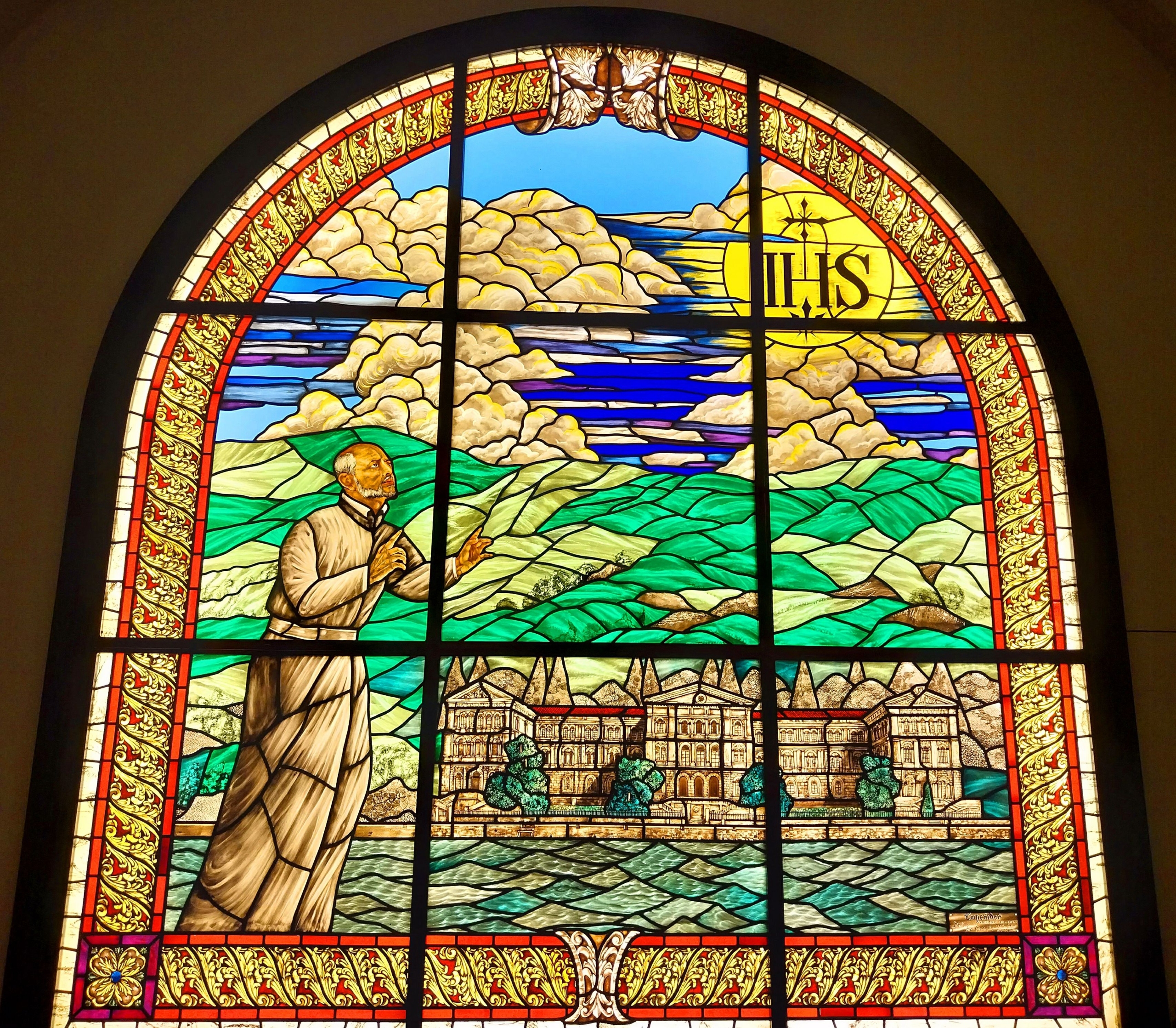
On the evening of September 22, 1523, the Franciscan friars in Jerusalem were urgently searching for a Basque pilgrim named Ignacio de Loyola. Under strict orders from the Custodian of the Holy Land, he was to be sent home the following day. Concerned by his impulsive temperament, the friars feared he had disappeared to remain clandestinely in the city.
As the sun descended over the horizon, Ignacio was finally spotted walking down the Mount of Olives, alone and dust-covered. Holding his walking staff, he returned to the convent in silence, as if concluding a personal farewell. Moments earlier, he had visited the Chapel of the Ascension, where tradition holds that a footprint in stone marks the final presence of Jesus before his departure.
One visit did not suffice. During the night, he evaded the guards a second time, offering them his scissors in exchange for another chance to examine the footprint more closely. For Ignacio, it was more than a stone—he saw it as a spiritual compass, a marker of orientation. According to later scholars, he sought to fix in his memory the direction of the ascent in order to reorient his life’s trajectory.
A Knight’s Journey Reimagined
To grasp the significance of Ignacio’s journey, one must turn to his earlier biography. Born Íñigo López de Loyola, he was a minor nobleman from the Basque Country and a soldier known for boldness in combat. After being seriously wounded during a siege in Pamplona in 1521, he underwent a dramatic personal transformation during a long period of convalescence.
After this turning point, he dedicated himself to a life of pilgrimage. Like many before him, his ultimate aspiration was to reach Jerusalem and remain there indefinitely. To do so, papal authorization was necessary. Ignacio traveled first to Rome to request formal approval.
Adopting the appearance of a traditional pilgrim—simple tunic, staff, and water gourd—he left his family home in Azpeitia on foot. In Montserrat, he symbolically abandoned his past by leaving behind his sword and helmet. That early stretch of his journey has since become the Camino Ignaciano, a marked pilgrimage route from Loyola to Manresa that continues to attract travelers tracing his early path of inner renewal.
Hardships and Passage to the East
The journey was fraught with physical and logistical challenges. He suffered illness and hunger, and spent several months in Manresa, where he developed the early ideas that would shape his Spiritual Exercises. Once in Barcelona, benefactors sponsored his passage to Rome. There, Pope Adrian VI granted him the necessary apostolic approval.
Traveling through Italy during a time of plague, Ignacio circumvented quarantined zones and eventually reached Venice, where he survived for weeks sleeping under the arcades of St. Mark’s Square. A wealthy Spanish expatriate took him in, helping him secure an audience with the Doge of Venice, who approved his passage on a merchant ship bound for the eastern Mediterranean.
Despite recent Ottoman expansion, including the conquest of Rhodes, which caused widespread alarm among European pilgrims, Ignacio remained committed. He embarked from Venice on July 14, stopped in Cyprus and Famagusta, and finally disembarked at Jaffa on August 31, 1523. Only thirteen pilgrims completed the voyage, arriving in a politically volatile region where pilgrim access was increasingly restricted.
Today, the route from Jaffa to Jerusalem is recognized as another significant pilgrimage path, sometimes retraced symbolically by those seeking to emulate historical movements toward the Holy City.
Days in the Holy Land
During his stay, Ignacio followed the established Latin pilgrimage circuit: attending mass on Mount Zion, praying in the Cenacle, keeping vigil at the Church of the Holy Sepulchre, and climbing the Mount of Olives to pray at the site of the Ascension.
His group also visited Bethany, the Garden of Gethsemane, the Kidron Valley, Bethlehem, and the Jordan River—sites associated with Jesus’ life and death according to Christian tradition. Ignacio reportedly experienced profound emotional intensity during these visits, impressions that would later inform his writings.
Restricted by Ottoman authorities, he was unable to travel to Nazareth or the Sea of Galilee. One particularly reflective moment occurred in Bethlehem, where he spent the night in the cave traditionally identified as the birthplace of Jesus. Years later, he expressed a desire to celebrate his first mass at that site, though it was eventually held in Rome at the Basilica of Santa Maria Maggiore, where relics linked to the Nativity were preserved.
A Defining Departure
Despite his deep desire to remain in Jerusalem, the Franciscan custodians deemed his continued presence untenable. His enthusiasm and lack of discretion were viewed as potential risks amid increasing political tensions. On September 22, the Custodian delivered a definitive mandate: Ignacio had to leave, and he was not to return.
Though deeply disappointed, he complied. He departed the following day under Franciscan escort, returning via ship to Barcelona in March 1524. Back in Spain, he began formal studies in grammar, Latin, and theology—laying the groundwork for what would become the itinerant mission of the Society of Jesus, founded years later.
This departure from Jerusalem marked the beginning of a new chapter: not a retreat, but a redirection. Denied permanence in the city, Ignacio became instead a perpetual traveler, a pilgrim of global scope. In Jesuit tradition, external journeying would later serve as a metaphor for interior readiness and global mission.
Legacy and Commemoration
Five centuries later, Ignacio never returned in person, but his symbolic presence endures. In 2023, the 500th anniversary of his pilgrimage was marked with reenactments along his route from Jaffa to Jerusalem. In Spain, the Camino Ignaciano has become a structured path for those interested in tracing his early spiritual evolution—offering not a re-creation of the eastern pilgrimage, but a reflective itinerary from Loyola to Barcelona.
His final night in Jerusalem encapsulates the broader meaning of pilgrimage: a figure who confronted personal loss not with resistance, but with conscious surrender. That last gaze toward the Ascension site was not an end, but a quiet beginning.
AI Transparency Notice
PilgriMaps uses artificial intelligence tools to assist in the research, drafting and translation of editorial content. All AI-assisted content is reviewed, edited and verified by our editorial team before publication. We contrast information against primary sources, specialist literature and on-the-ground knowledge to ensure accuracy, cultural sensitivity and editorial integrity.
AI is one tool among many in our workflow. The judgement, curation and responsibility for everything published on this platform remain entirely human.
Viator Media S.L. — in compliance with the EU Artificial Intelligence Act (Regulation EU 2024/1689).
This post is also available in: