On the banks of the Ebro River in northeastern Spain, the city of Zaragoza stands at the crossroads of pilgrimage, folklore, and deep-rooted regional pride. Rising from its heart is the Basílica del Pilar, a monumental site said to mark the earliest Marian devotion in Iberia, long venerated by travelers from across the Spanish-speaking world.
But beyond the gilded domes and riverfront arcades, a smaller, unmistakable emblem quietly weaves its way into the ritual and style of pilgrimage here: the cachirulo—a checked handkerchief, often in red and black or blue and black, worn knotted around the head or neck. Folded fabric, yes. But also symbol, tradition, and regional voice.
To walk the Plaza del Pilar during festival days or to follow the path of pilgrims arriving for October 12, the Fiesta del Pilar, is to witness the cachirulo in motion: worn with pride, wrapped in memory, passed from generation to generation. Its simplicity conceals its power.
More Than a Handkerchief
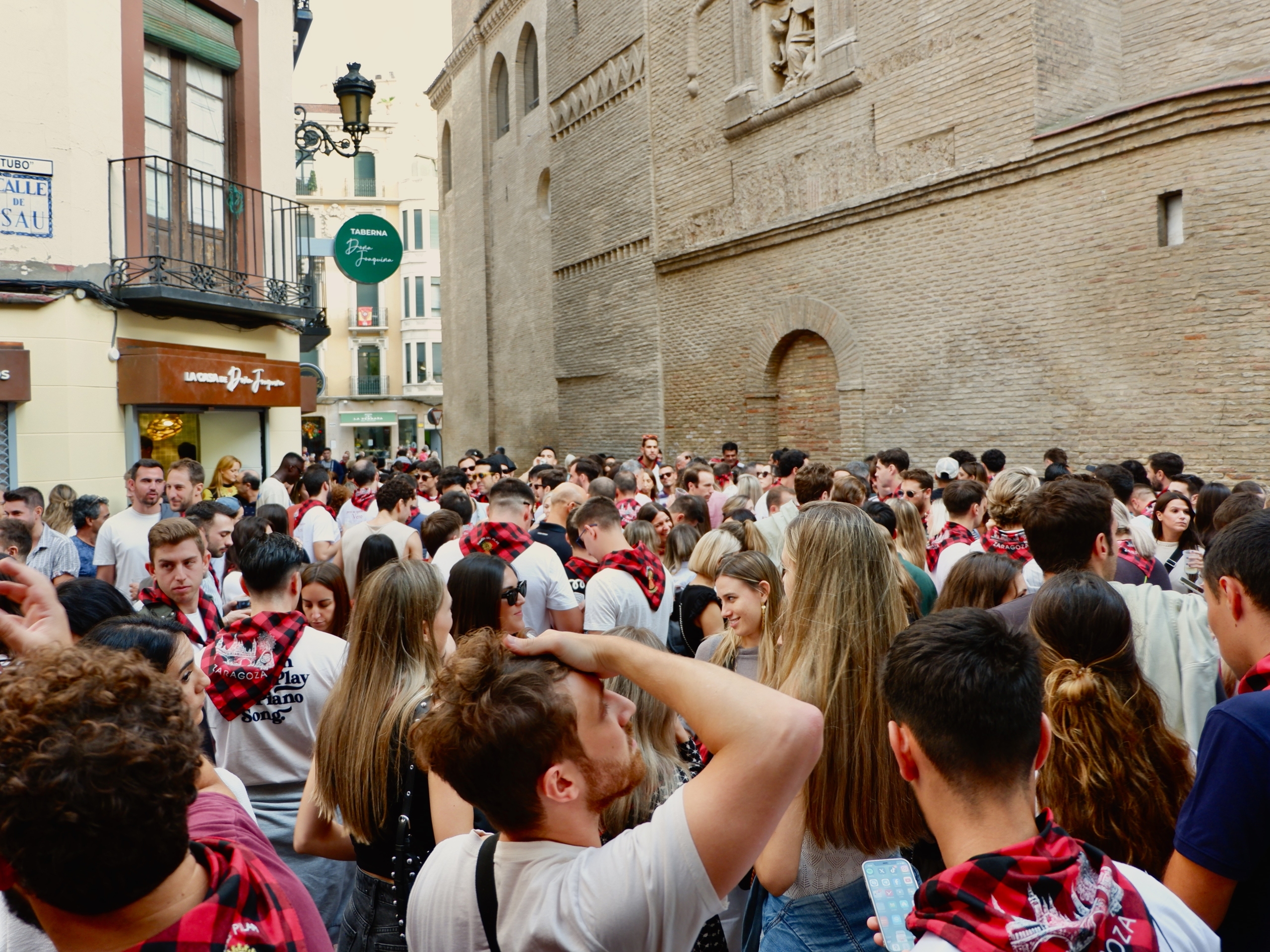
The cachirulo traces its roots to Aragonese peasant attire, particularly that of the baturros—rural inhabitants of the Ebro valley whose dress and music have come to symbolize a specific local identity. In traditional baturro costume, the cachirulo is worn by men as part of an ensemble that includes a short jacket, wide sash, and espadrilles, while women wear colorful mantones and long skirts.
The checkered pattern may seem familiar to those who’ve traveled in regions of Arab or Mediterranean influence. It reflects a broader textile tradition, but its regional coloring and function have made it singularly Zaragozan. As with so many folk garments, it began as utility—a protection against sun and dust, a quick rag, a cloth to tie around bread or tools. Over time, it became expressive: a badge of belonging, especially among pilgrims and festival-goers.
El Pilar and the Birth of a Pilgrimage Culture
According to local tradition, El Pilar marks the site where the Virgin Mary appeared to the Apostle James in 40 CE, standing on a column—pilar—as a gesture of support. Whether this account is taken as legend or historical memory, by the Middle Ages the site had become a recognized destination for pilgrimage, drawing travelers across the Iberian Peninsula and beyond.
The current Basílica, constructed between the 17th and 20th centuries, is a striking mix of Baroque, Neoclassical, and Mudéjar styles, with a riverside plaza that functions as both civic center and ceremonial space. During the Fiestas del Pilar, the city transforms: there are floral offerings, folk dances, open-air masses, and parades. And amid it all, the cachirulo emerges as an identifying mark of locals and pilgrims alike.
A Sign of Participation
Unlike the scallop shell of Santiago or the tau cross of Assisi, the cachirulo is not a universal Christian symbol—nor was it designed to be one. Its strength lies in its regional specificity. Worn by pilgrims, it acts as a form of participation in a tradition that blends devotion, folklore, and civic pride.
Visitors may buy a cachirulo in Zaragoza’s markets or be gifted one by locals. Some knot it around the wrist, others tie it at the neck or wear it bandana-style on the head. In doing so, they adopt—not appropriate—a tradition that invites inclusion without erasing its cultural roots.
It is not uncommon for pilgrims from other parts of Spain or Latin America to incorporate the cachirulo into their visit to El Pilar. It becomes both souvenir and symbol, something tactile to take home that is not made of gold or glass, but of cloth and gesture.

Baturro Identity in a Changing City
The baturro identity has long stood in for the stubborn, independent, rural Aragonese spirit, often caricatured in popular culture. In the early 20th century, zarzuela performances and regional festivals helped codify this image, sometimes in ways that bordered on stereotype.
But in Zaragoza today, there is a quiet reclamation underway. Young people wear the cachirulo alongside sneakers and denim. Folk groups nework traditional jotas with contemporary instrumentation. The cachirulo has become a living symbol, not a fossilized one. It appears during protests, concerts, and communal celebrations, always evoking a shared past—but not confined by it.
A Pilgrimage Thread That Endures
In a world of mass-produced souvenirs and globalized culture, the cachirulo remains resolutely local. It is not imported, not generic, not virtual. It stains, fades, creases, and softens. It carries the dust of festival streets and the scent of kitchen smoke. And for many pilgrims to El Pilar, it becomes part of the journey—a knot that holds together body, tradition, and place.
To wear a cachirulo is to walk with the region, not just through it.
If You Go
Best Time to Visit: October 12, during the Fiestas del Pilar, when Zaragoza fills with pilgrims, dancers, and floral processions.
Where to Get a Cachirulo: Local markets around Plaza del Pilar, especially during festival weeks.
Suggested Walk: A short city pilgrimage from the Puente de Piedra across the Ebro to the Basílica del Pilar, ending in the Plaza de la Seo, where you can take in the city’s layered architectural history—from Roman foundations to Gothic and Mudéjar spires.
The Cachirulo, like the pilgrimage to El Pilar, is not about spectacle. It’s about rootedness. In cloth and in movement, it ties the modern traveler to an enduring thread of Aragonese life—quietly, distinctively, and unmistakably.
AI Transparency Notice
PilgriMaps uses artificial intelligence tools to assist in the research, drafting and translation of editorial content. All AI-assisted content is reviewed, edited and verified by our editorial team before publication. We contrast information against primary sources, specialist literature and on-the-ground knowledge to ensure accuracy, cultural sensitivity and editorial integrity.
AI is one tool among many in our workflow. The judgement, curation and responsibility for everything published on this platform remain entirely human.
Viator Media S.L. — in compliance with the EU Artificial Intelligence Act (Regulation EU 2024/1689).
This post is also available in: