There are places whose importance far exceeds what they seem to occupy on a map. Territories that appear to be simple natural spaces, yet in reality contain centuries of history, exceptional biodiversity, and a profound relationship between human beings and the landscape. This is the case of Doñana National Park, located between Huelva, Seville, and Cádiz in southern Spain.
For decades, scientists from across Europe have studied its marshes, dunes, and ecosystems as though they were a vast natural laboratory. It is no coincidence that Doñana is considered one of the most intensively researched natural spaces on the continent.
The reason is clear: few territories contain such biological diversity within so small an area. Yet Doñana is not only an ecological sanctuary. It is also a historical landscape and, above all, a deeply symbolic place for millions of people. Here, science, memory, and popular spirituality converge.
Its international importance was recognized when it was declared a National Park in 1969 and later designated a Biosphere Reserve, Ramsar Wetland, and UNESCO World Heritage Site. Beyond official titles, however, Doñana remains a living, changing, and difficult-to-define territory.
A landscape born between ocean and river
Doñana is the result of thousands of years of geological transformation. In Antiquity, much of this territory formed an enormous estuary known to the Romans as the Lacus Ligustinus. Over time, sediments carried by the Guadalquivir River and the action of the Atlantic gradually created today’s marshes, beaches, and dunes.
The landscape now forms an extraordinary mosaic: floodable marshlands, Mediterranean forests, shifting dunes, seasonal lagoons, and kilometers of nearly untouched beaches. The dominant sensation is one of constant movement. Dunes advance slowly under the force of the wind; marshes transform with the seasons; water appears and disappears according to natural cycles repeated for centuries.
That dynamic explains much of the park’s ecological richness. It also explains its fragility. Doñana’s hydrological balance depends on a vast underground aquifer increasingly pressured by intensive agriculture and droughts linked to climate change. In recent decades, scientific concern has grown as many temporary wetlands have shortened in duration or disappeared entirely during some years.
For this reason, Doñana has also become a symbol of Europe’s environmental challenges. What happens here anticipates problems that may affect other Mediterranean ecosystems in the future.
Thousands of years of history
Although the dominant image today is one of untamed nature, Doñana has been connected to human activity since prehistoric times. Archaeological evidence points to Neolithic occupation and ancient coastal settlements.
During the Roman period, the region gained economic importance through fishing and the production of salted fish products. The archaeological site of Cerro del Trigo, one of the park’s most significant locations, preserves remains of garum factories, amphorae, and late Roman necropolises. These installations reveal that the territory formed part of Mediterranean trade routes.
Later, during the Middle Ages, Doñana became a royal hunting reserve. Alfonso X set aside these lands for the Crown in the thirteenth century, and they later became associated with the powerful House of Medina Sidonia. The region’s relative geographic isolation helped preserve vast natural areas almost untouched for centuries.
The name “Doñana” itself appears to derive from a noblewoman connected to the local aristocracy, probably a “Doña Ana” associated with the Medina Sidonia family. From the eighteenth century onward, romantic descriptions of the landscape began to circulate, portraying it as a wild and mysterious territory. Even Francisco de Goya visited the region through his links with the Duchess of Alba.
The real transformation, however, arrived in the twentieth century. Agricultural expansion, forest plantations, and urban development projects began seriously threatening the ecosystem. In response, a conservationist movement emerged, driven by scientists and international organizations.
In 1963, the Spanish state acquired thousands of hectares with support from WWF in order to protect the territory, and in 1969 Doñana National Park was officially established. That decision marked a decisive moment in the history of environmental conservation in Spain.

The great biological refuge of Southern Europe
Doñana’s ecological importance is extraordinary. The park shelters around 1,300 species of vascular plants and hundreds of animal species. Yet its greatest significance is linked to migratory birds.
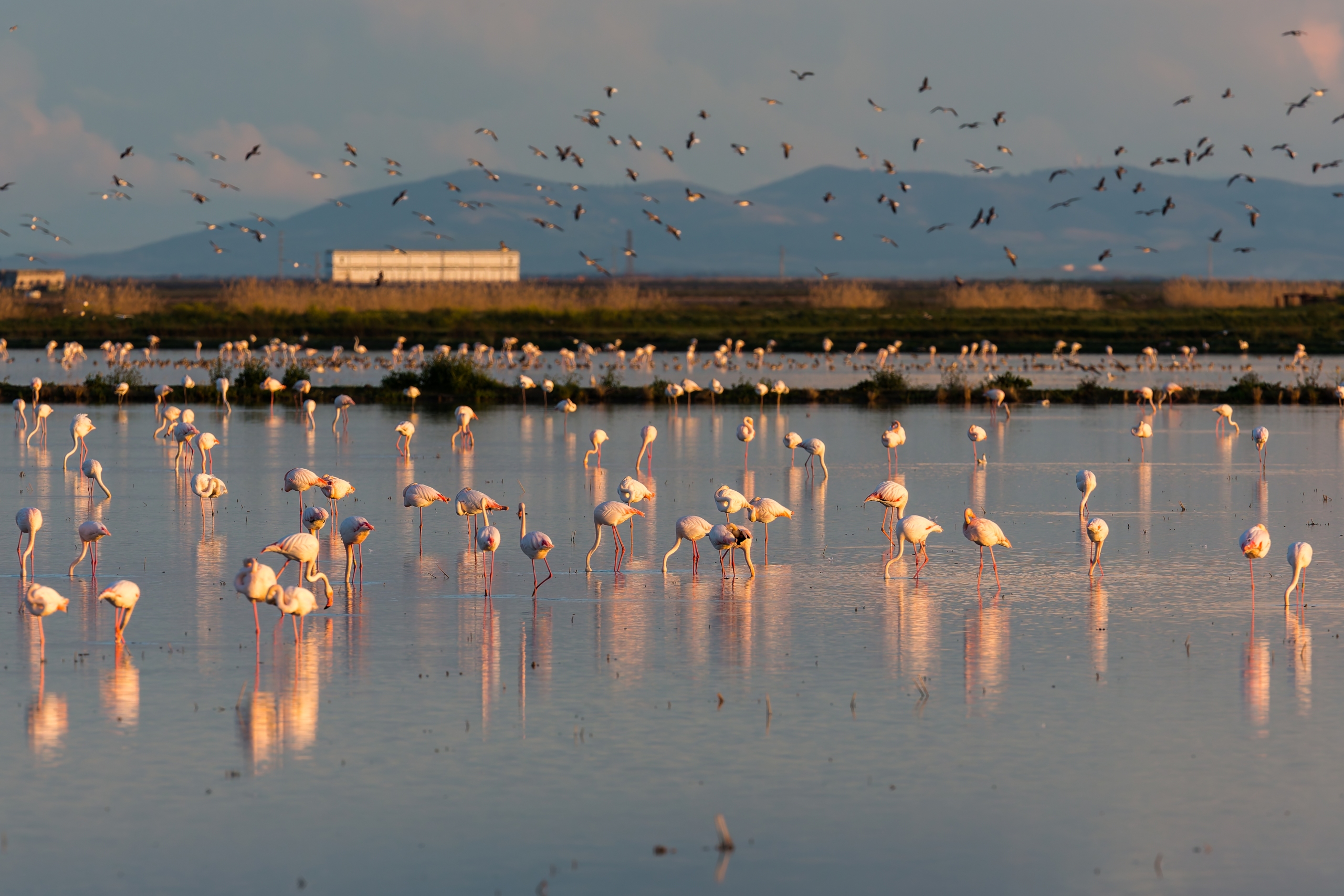
Every winter, more than half a million waterbirds use the marshes of Doñana as a refuge along routes between Europe and Africa. Flamingos, spoonbills, herons, and geese transform the landscape into one of the most remarkable natural spectacles on the continent.
The park also protects emblematic species such as the Iberian lynx and the Spanish imperial eagle, both symbols of European conservation efforts. Thanks to scientific projects and recovery programs — including Iberlince — several populations have survived after decades on the verge of disappearance.
But Doñana is far more than a catalogue of rare species. Its marshes regulate flooding, store carbon, and protect the Atlantic coastline. The ecological health of the park influences environmental processes on a continental scale.
For that reason, any threat generates international concern. The Aznalcóllar mining disaster in 1998 demonstrated how vulnerable the ecosystem could become to external human activities. Since then, debates surrounding water management and agricultural pressure have become central to the park’s future.
El Rocío: When nature becomes a spiritual route
There is, however, another dimension of Doñana that cannot be measured through ecological statistics or scientific studies: its spiritual and symbolic dimension, deeply connected to the Romería del Rocío.
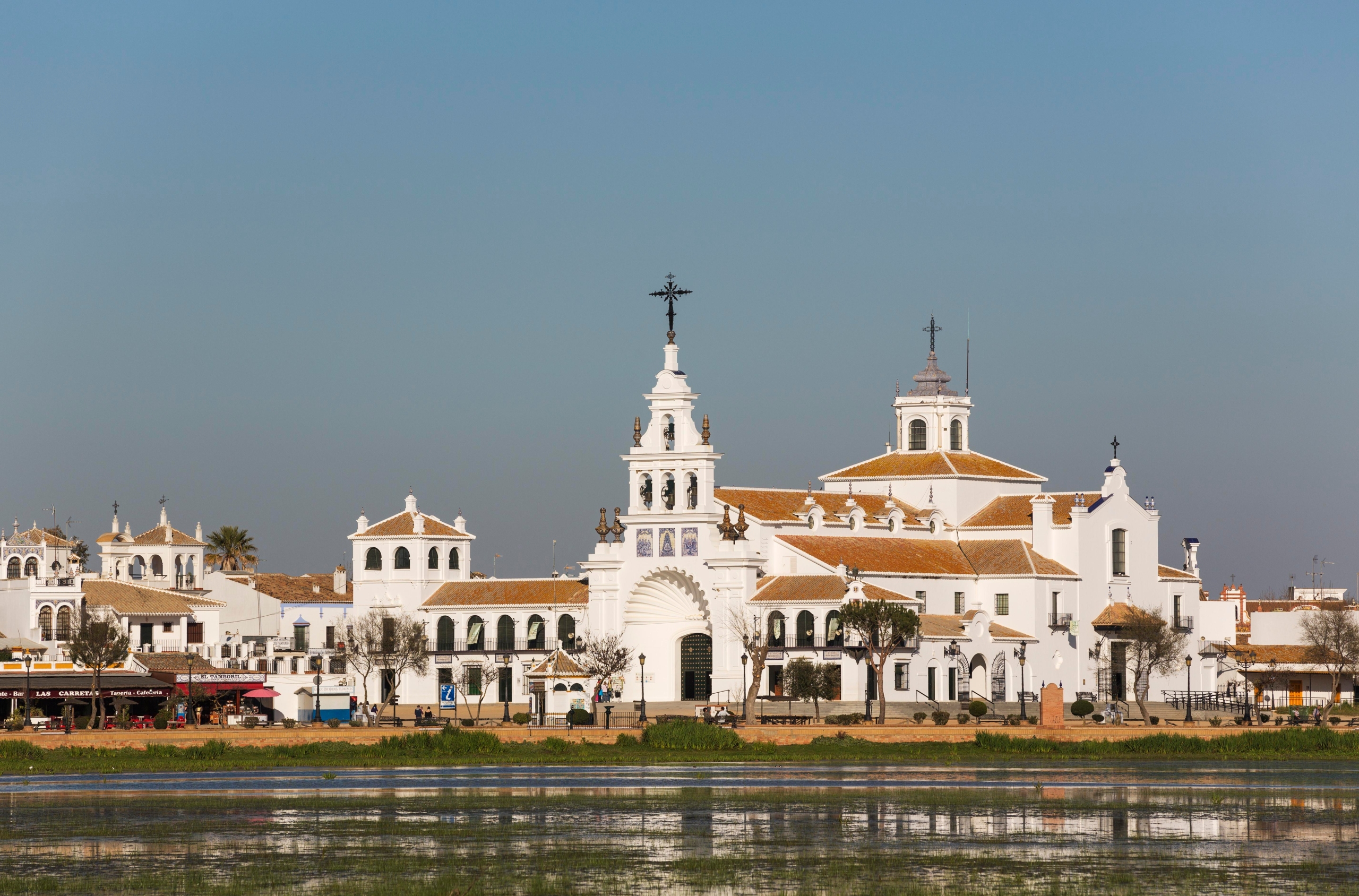
Every spring, hundreds of thousands of people cross sandy tracks, pine forests, and marshlands to reach the village of El Rocío in Almonte. The pilgrimage, one of Europe’s largest expressions of popular religiosity, transforms the landscape of Doñana for several days into a vast collective experience.
What makes El Rocío distinctive is that the territory itself forms an essential part of the ritual. The objective is not simply to arrive at a sanctuary. The journey constitutes the spiritual experience itself. Brotherhoods move through forests, cross rivers, and advance slowly along historical paths accompanied by wagons, horses, and traditional songs. Nature ceases to be a passive backdrop and becomes the protagonist.
Unlike many urban or monumental pilgrimages, El Rocío maintains an intimate relationship with the landscape. The silence of the marshes at dawn, the passage through pine forests, and the crossing of the Guadalquivir all form part of the pilgrims’ emotional memory. The spiritual experience emerges precisely through contact with the territory.
For centuries, this pilgrimage has blended religiosity, Andalusian identity, music, and communal life. The result is a tradition difficult to classify: at once a popular festival, a religious pilgrimage, and a cultural celebration. That singularity explains why it has been recognized as a Festival of International Tourist Interest and why proposals exist to expand its heritage protection.
Yet El Rocío reveals something deeper as well. In an increasingly urbanized and technological Europe, Doñana continues to function as a symbolic space of connection with nature. For many pilgrims, crossing the park means recovering an ancestral relationship with the landscape, with slow time, and with collective experience.
The spirituality of Doñana does not depend solely on religion. There is also a broader sense of sacred territory associated with the immensity of the marshes, the silence of the forests, and the historical continuity of the place. Few European landscapes still preserve such a capacity to generate an intense collective experience.
A sanctuary for the future
Doñana encapsulates many of the great contemporary challenges: climate change, water scarcity, biodiversity conservation, and the relationship between economic development and environmental protection. That is why it remains one of the most closely observed and studied territories in Europe.
Its importance, however, extends beyond science. In Doñana survive ancient forms of relationship between human beings and nature. Migratory birds, historical routes, marshlands, and the Romería del Rocío all belong to the same cultural and ecological system.
Protecting Doñana does not simply mean conserving a national park. It means preserving a landscape where historical memory, biodiversity, and spiritual experience still coexist. A territory that reminds us that nature is not only an economic resource or a scientific object, but also a space of identity, emotion, and collective transcendence.
AI Transparency Notice
PilgriMaps uses artificial intelligence tools to assist in the research, drafting and translation of editorial content. All AI-assisted content is reviewed, edited and verified by our editorial team before publication. We contrast information against primary sources, specialist literature and on-the-ground knowledge to ensure accuracy, cultural sensitivity and editorial integrity.
AI is one tool among many in our workflow. The judgement, curation and responsibility for everything published on this platform remain entirely human.
Viator Media S.L. — in compliance with the EU Artificial Intelligence Act (Regulation EU 2024/1689).
This post is also available in: