Each spring, thousands of people travel across the landscapes of southwestern Andalusia toward the village of El Rocío, on the edge of the Doñana National Park. Their destination is the Ermita de El Rocío, where an image known as the Virgen del Rocío is housed.
This annual event, the Romería del Rocío, has developed into one of the largest recurring gatherings in Spain. While commonly described as a pilgrimage, its historical formation and present dynamics reveal a more complex structure shaped by mobility, environment, and collective identity.
Origins and early references
The origins of El Rocío are traditionally linked to the late medieval period, when a small devotional image was said to have been discovered in a rural setting near the marshlands. Documentary references to a hermitage in the area appear by the 14th century, suggesting that a localized cult had already taken shape.
From its early phases, the site was connected to nearby communities, particularly Almonte, whose inhabitants assumed responsibility for maintaining the hermitage and organizing annual observances. These gatherings were initially regional in scope, structured around liturgical calendars and agricultural rhythms.
Brotherhoods and structured movement
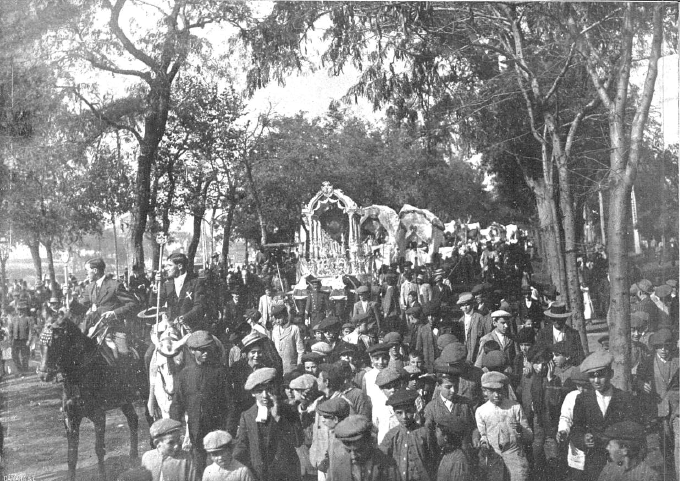
By the early modern period, participation in the Romería became organized through hermandades (brotherhoods), lay associations that coordinated travel, logistics, and representation. Each brotherhood developed its own identity, symbols, and routes, often departing from towns across Andalusia and beyond.
The movement toward El Rocío unfolds over several days. Participants travel on foot, horseback, or in ox-drawn carts (carretas), following established paths that cross forests, rivers, and sandy terrain. These routes are not merely practical; they structure the experience of the journey itself, creating a sequence of stages, stops, and shared activities.
Unlike long-distance pilgrimage routes such as the Camino de Santiago, El Rocío does not depend on a continuous infrastructure of hostels or waystations. Instead, the brotherhoods carry much of their own material culture with them, effectively creating mobile communities that converge on a single point.
Landscape as framework
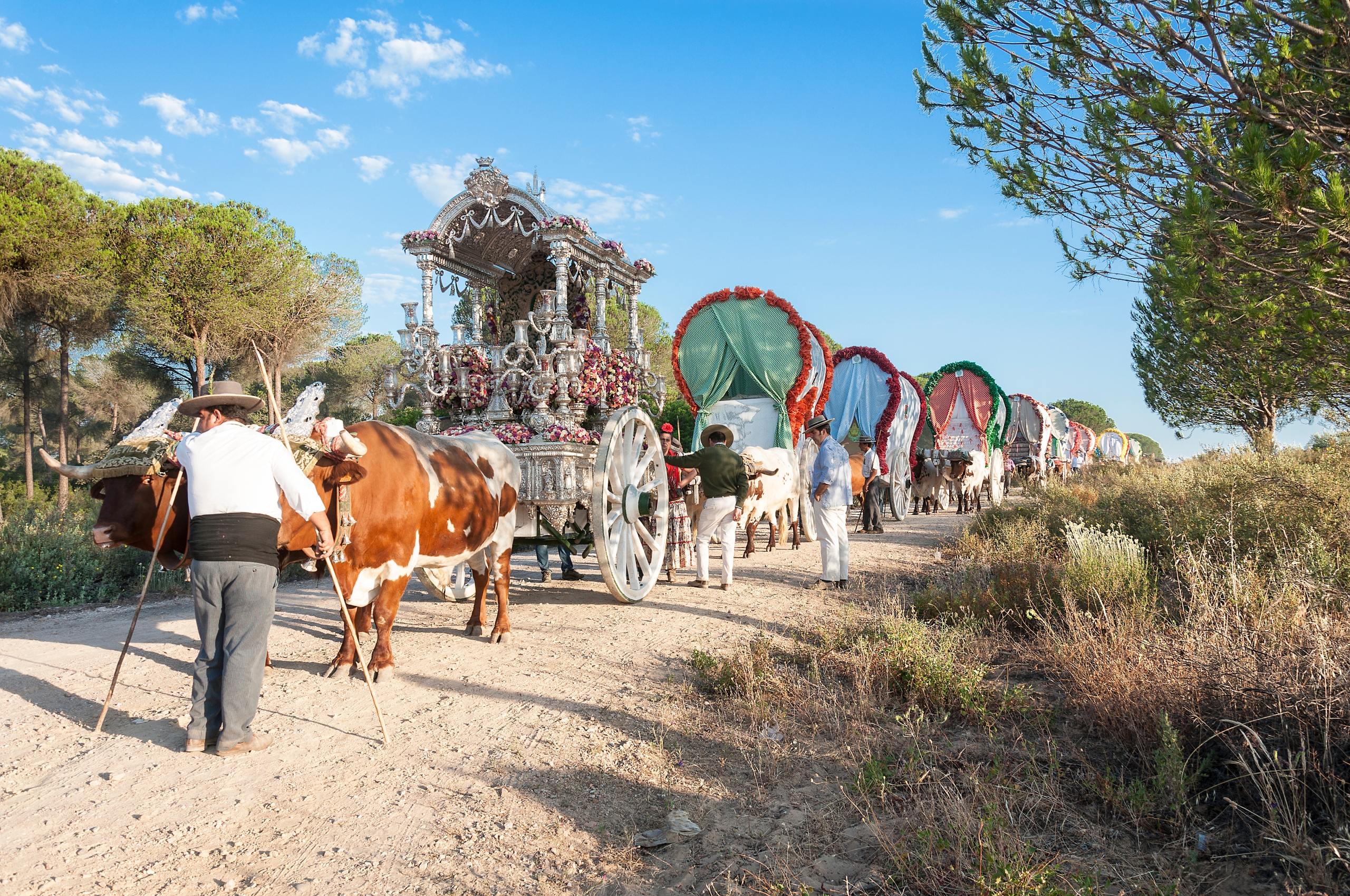
The geography of the Romería is integral to its meaning. The approach to El Rocío involves traversing sections of the Doñana marshes, pine forests, and shifting sandy paths. Seasonal conditions—particularly heat and water levels—shape both the timing and experience of the journey.
This environmental dimension recalls earlier forms of collective movement tied to landscape cycles. Travel is concentrated within a specific temporal window, aligned with the spring season, when conditions allow for large-scale crossing of otherwise difficult terrain. The physical effort required reinforces the communal aspect of the event, as groups navigate the environment together.
Ritual concentration and the “salida”
Upon arrival, participants gather in and around the hermitage. The culmination of the Romería occurs during the night between Pentecost Sunday and Monday, when the image of the Virgen del Rocío is carried out in a procession known as the salida. This moment concentrates the movement of preceding days into a densely shared experience.
The handling of the image is controlled by local custodians from Almonte, maintaining a continuity of authority that dates back centuries. The event draws large crowds, and access to the immediate vicinity of the image is limited, reinforcing its focal role within the broader gathering.
Pilgrimage, festival, or hybrid form?
The Romería del Rocío occupies an intermediate position between pilgrimage and festival. It involves intentional travel to a specific sacred site, structured by recurring routes and collective organization—features commonly associated with pilgrimage. At the same time, it incorporates elements of social celebration, including music, shared meals, and displays of regional identity.
Historically, the absence of centralized regulation and the strong role of local brotherhoods distinguish it from more institutionalized pilgrimage systems. Participation is not governed by formal obligations but by affiliation, tradition, and personal or communal motivations.
From an analytical perspective, El Rocío can be understood as a periodic aggregation system. Movement is cyclical and convergent, with dispersed groups traveling toward a single location at a defined moment, then dispersing again. This pattern aligns with broader anthropological models of seasonal gathering observed in various historical contexts.
How to participate in El Rocío
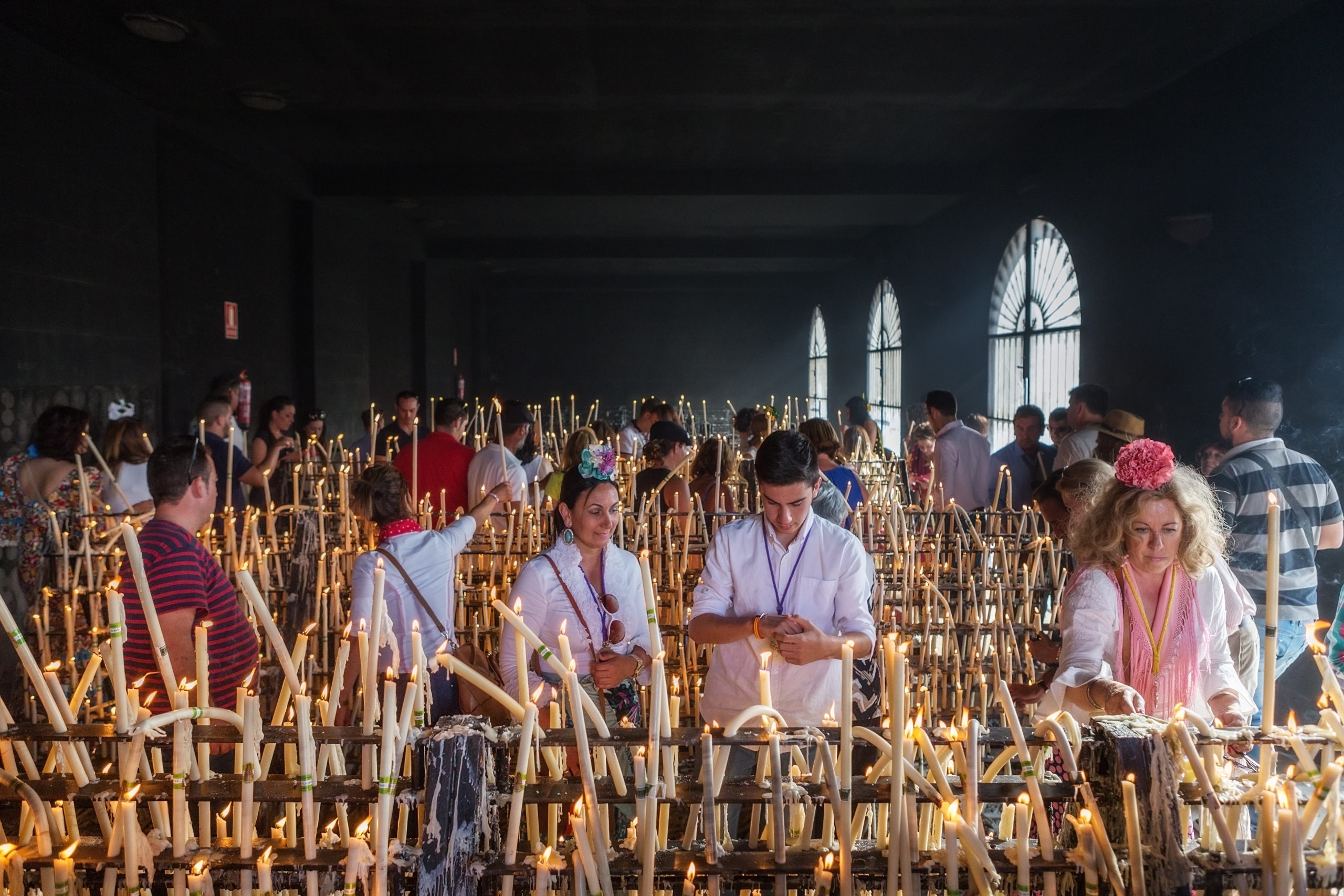
For those who wish to experience El Rocío, participation usually begins through a hermandad, or brotherhood. These associations organize the journey, register pilgrims, coordinate carts, horses, vehicles, food, overnight stops, and the liturgical presence of each group. In practice, joining a brotherhood’s official pilgrimage is the safest and most coherent way to take part in the Romería, especially for first-time participants.
It is also possible to visit El Rocío independently during the days of the Romería, but this requires careful planning. Accommodation in the village is limited, access may be restricted, and the crowds are very large. The Hermandad Matriz de Almonte maintains an Oficina de Atención al Peregrino for individuals, groups, institutions, and non-Rocío brotherhoods seeking guidance on the religious and cultural experience of El Rocío. (Hermandad del Rocío de Almonte)
Participation is not only logistical. El Rocío has its own codes: respect for the liturgical moments, for the brotherhoods’ order, for the image of the Virgin, and for the fragile environment around Doñana. The journey may include music, food, horses, and celebration, but at its center remains a devotional act: a collective movement toward the Virgen del Rocío and the hermitage that has shaped this landscape for centuries.
For 2026, the Romería is scheduled from 22 to 25 May, with the main events around Pentecost Sunday and the procession of the Virgin in the early hours of Monday. (Turismo de Almonte – Destino Doñana)
Continuity and expansion
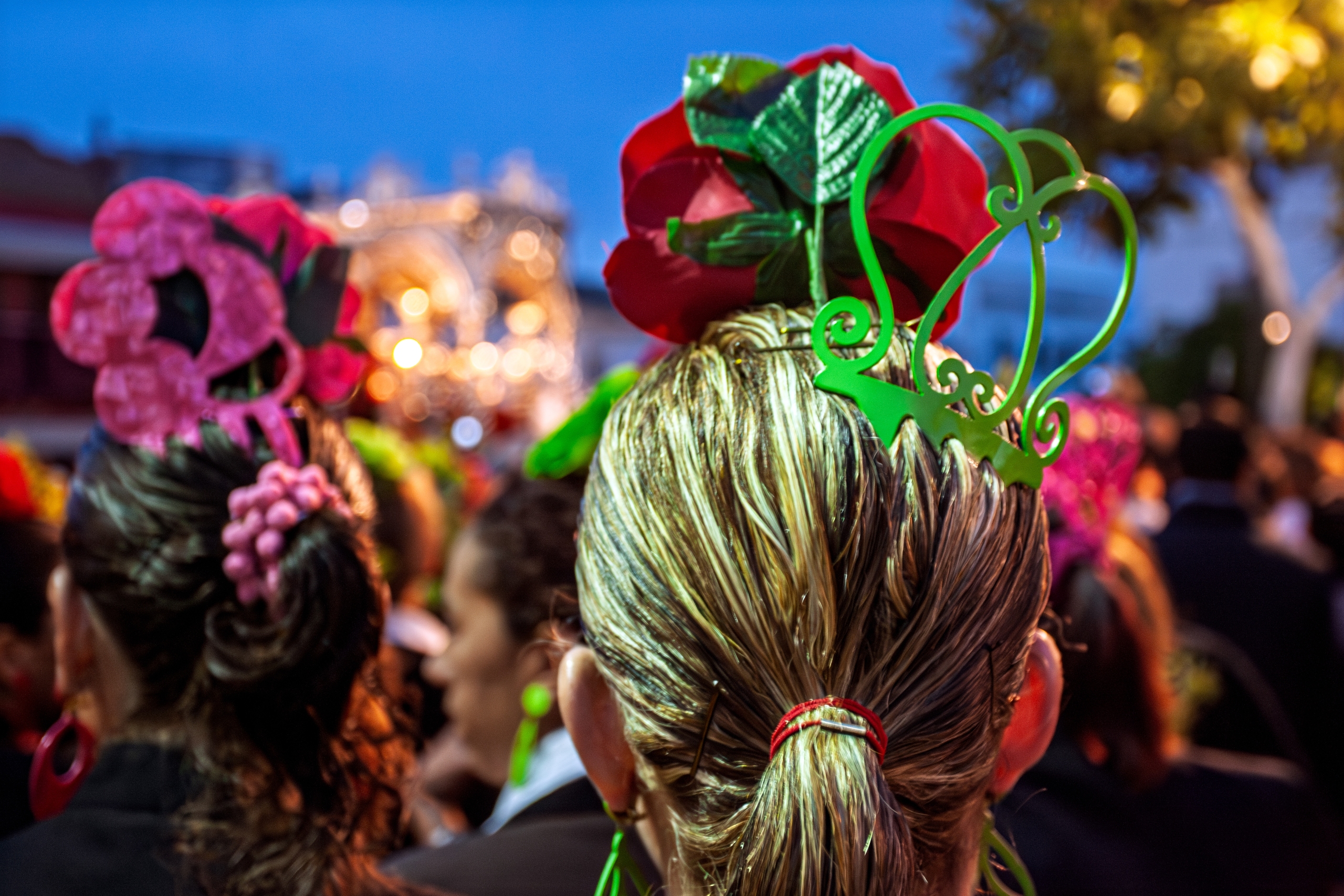
In the 20th and 21st centuries, the Romería has expanded significantly, facilitated by modern transportation and media visibility. New brotherhoods have formed, including some based outside Andalusia and even abroad. Despite these changes, the core structure—movement along traditional routes, convergence at the hermitage, and the centrality of the salida—remains intact.
This continuity underscores the adaptability of the event. While scale and logistics have evolved, the underlying pattern of collective movement anchored in place persists.
The Romería del Rocío thus illustrates how large-scale devotional movement can develop outside the frameworks typically associated with formal pilgrimage routes. Rooted in regional traditions, structured by brotherhood networks, and shaped by the Andalusian landscape, it represents a form of organized convergence that balances ritual, mobility, and social expression.
Rather than fitting neatly into a single category, El Rocío demonstrates the fluid boundaries between pilgrimage and other forms of collective travel. Its enduring vitality lies in this flexibility, allowing it to accommodate change while maintaining a recognizable structure of movement and gathering.
Doñana: A natural, historical and spiritual sanctuary of Southern Europe
AI Transparency Notice
PilgriMaps uses artificial intelligence tools to assist in the research, drafting and translation of editorial content. All AI-assisted content is reviewed, edited and verified by our editorial team before publication. We contrast information against primary sources, specialist literature and on-the-ground knowledge to ensure accuracy, cultural sensitivity and editorial integrity.
AI is one tool among many in our workflow. The judgement, curation and responsibility for everything published on this platform remain entirely human.
Viator Media S.L. — in compliance with the EU Artificial Intelligence Act (Regulation EU 2024/1689).
This post is also available in: