Among the many routes leading to Santiago de Compostela, the Camino de Invierno stands apart. It is neither the oldest, nor the shortest, nor the most widely travelled. It does not cross the most famous mountain passes, nor does it pass through the canonical cities associated with the Camino Francés. Yet those who discover it rarely forget it.
The Camino de Invierno—literally, the Winter Way—winds through valleys and river canyons, follows waterways and vineyard terraces, and crosses regions marked by quiet beauty and overlooked heritage. Officially recognised as a Camino de Santiago route in 2016, it has gradually drawn the attention of walkers seeking a different kind of long-distance journey: one that is more personal, less crowded, and shaped by time, silence, and surprise.
Far from the busy rhythms of the Camino Francés, the Camino de Invierno offers an alternative form of pilgrimage walking—defined not by numbers or notoriety, but by immersion in landscape and place, and by the experience of moving through a territory rich in history, art, and nature.
A route born of necessity
Unlike many Jacobean routes that developed from Roman roads, local devotional practices, or political planning, the Camino de Invierno emerged from a practical concern: climate. Its origins date to the Middle Ages, but it gained particular relevance from the 17th century onward, during the period known as the Little Ice Age.
In winter, traditional mountain crossings frequently became impassable due to snow. The ascent to O Cebreiro, the historic gateway into Galicia on the Camino Francés, was especially hazardous and often closed altogether.
To avoid this bottleneck, walkers began diverting south from Ponferrada, seeking lower elevations that allowed for continued travel. The valley of the Sil River provided a natural corridor, sheltered by mountains and free from heavy snowfall. Following the river’s course made it possible to progress safely through winter conditions. What emerged was not simply an alternative route, but a true winter road—longer, but considerably more reliable.
A documented example of this historical usage comes from the Italian cleric Gian Lorenzo Buonafede Vanti, who in 1717 chose to return from Santiago via this “direct route,” as he called it, specifically to avoid the snowbound pass of O Cebreiro.
Fewer walkers, greater quiet
This climatic origin makes the Camino de Invierno something of an exception within the broader network of Camino routes. It also helps explain why it remained largely forgotten for centuries, overshadowed by more established itineraries.
That long period of marginality has shaped its character. By avoiding major pilgrimage hubs and heavily trafficked stages, the route has preserved an atmosphere of calm that many walkers now actively seek. Traffic is sparse, infrastructure modest, and encounters more intimate. The Camino de Invierno appeals to those drawn away from mass tourism and toward a slower, more attentive way of walking.
Geographically, the route reinforces this sense of independence. Rather than rejoining the Camino Francés, it follows its own diagonal path across northwestern Spain, eventually meeting the Via de la Plata near Lalín. This autonomy strengthens its identity as a Camino with its own voice and logic.
Landscapes, villages, and hidden heritage
Walking the Camino de Invierno means travelling through a natural corridor of unexpected richness. From the Templar city of Ponferrada to the towers of Santiago’s cathedral, the route skirts mountains rather than climbing them, follows rivers without losing its way, and crosses regions where time seems to move at the pace of the walker.
Covering nearly 250 kilometres, the route passes through five distinct cultural regions and all four Galician provinces—an uncommon feature among Camino itineraries. Yet statistics alone do not define it. What distinguishes this path is its capacity to reveal something unforeseen each day.
The journey begins in Ponferrada, capital of El Bierzo, dominated by its medieval Templar castle. Here, the Camino Francés is left behind as the route turns southwest toward Las Médulas, a UNESCO-listed landscape shaped by Roman gold mining. Rust-coloured cliffs and sculpted hills create a dramatic opening, setting a tone of historical depth and visual intensity.
From there, the path settles into the Sil River valley, accompanying the river for more than 70 kilometres—the longest continuous river stretch of any Camino route. This proximity shapes both scenery and rhythm: water softens the landscape, carves canyons, sustains vineyard terraces, and provides a constant acoustic backdrop.
Crossing into Galicia through Valdeorras, the terrain shifts to slate hills and wine country. Towns such as O Barco, A Rúa, and Vilamartín retain a working, everyday character, where hospitality is expressed through conversation and simple food rather than spectacle.
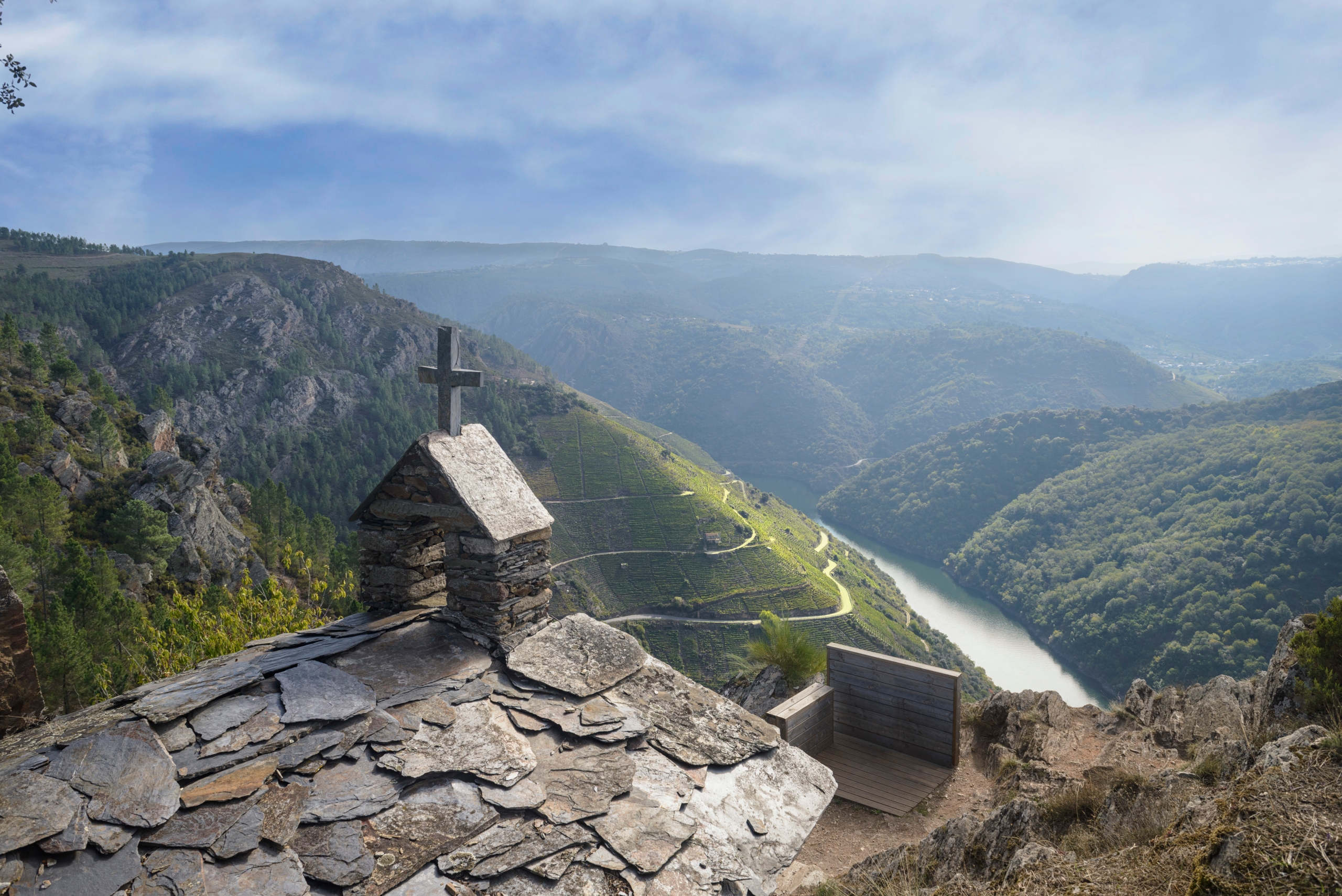
Further on, the route enters one of its most striking sections: the Ribeira Sacra. Here, the Sil cuts deep canyons between steep slopes planted with so-called “heroic” vineyards. Romanesque monasteries, many partially hidden by forest, reflect centuries of retreat and settlement in this demanding terrain. Viewpoints like Cabezoás or Aldea do Mundo offer panoramas that linger long after the walk ends.
The route continues through Monforte de Lemos, a monumental town defined by its hilltop fortress, historic bridges, and the Colegio de la Compañía—often referred to as the “Galician Escorial.” From there, the path heads toward Chantada, descending the evocative Codos de Belesar, a stone-paved zigzag that drops steeply toward the Miño River. Walking this section is both a physical effort and a sensory immersion, where forest, ruins, earth, and water converge.
In Pontevedra province, the Camino ascends Monte Faro, the highest point of the route at 1,187 metres. The climb is moderate, but the summit is symbolic: on clear days, all four Galician provinces are visible. Nearby stands the small chapel of Nosa Señora do Faro, a long-standing local landmark tied to seasonal movement and oral tradition rather than spectacle.
Wine as cultural thread
One constant accompanies the walker throughout the Camino de Invierno: wine. No other Jacobean route crosses three major Spanish denominations of origin – Bierzo, Valdeorras, and Ribeira Sacra. Terraced vineyards cling to steep slopes, some cultivated for centuries under challenging conditions. Along this path, wine is not an accessory but a record of labour, continuity, and place.
A Camino with its own identity
Within the diverse world of the Camino de Santiago, the Camino de Invierno remains a singular presence. It does not compete with major routes, nor does it need to. Its value lies not in numbers, but in the quality of the experience it offers.
Walking it means moving through an interior Galicia that is rural, lived-in, and often overlooked. It means encountering landscapes rarely found on postcards yet deeply memorable: the mineral reds of Las Médulas, the calm depth of the Sil canyon, the winding stones of Belesar, and the open horizon from Monte Faro.
Above all, the Camino de Invierno invites a return to the essential act of walking itself—accepting a slower rhythm, remaining attentive to place, and allowing space for reflection without prescription. It is not a route designed for collecting stages or credentials, but for observing, listening, and moving with intention.
For those seeking a quieter approach to Santiago, the Camino de Invierno offers a compelling alternative. And for those who have already walked it, the memory often endures as more than a journey to a destination: it becomes a lesson in another way of travelling—freer, quieter, and distinctly one’s own.
AI Transparency Notice
PilgriMaps uses artificial intelligence tools to assist in the research, drafting and translation of editorial content. All AI-assisted content is reviewed, edited and verified by our editorial team before publication. We contrast information against primary sources, specialist literature and on-the-ground knowledge to ensure accuracy, cultural sensitivity and editorial integrity.
AI is one tool among many in our workflow. The judgement, curation and responsibility for everything published on this platform remain entirely human.
Viator Media S.L. — in compliance with the EU Artificial Intelligence Act (Regulation EU 2024/1689).
This post is also available in: