Across prehispanic Mesoamerica, mobility shaped cultural life. Travelers moved along established corridors that linked coastal plains, forested basins, and highland plateaus, carrying goods, stories, and scientific knowledge. Among the many forces guiding this circulation stood Kukulkan—the Feathered or Plumed Serpent—whose imagery appeared in architecture, trade routes, and ceremonial gatherings from the northern Yucatán to the broader Maya region.
While Kukulkan today is often associated with modern tourism at Chichén Itzá, the figure’s prehispanic significance rested in ideas about order, rulership, and cycles of time. Pilgrimage within this world did not follow a single doctrine; instead, it reflected the social and cosmological logic of the Maya polities that flourished between the first millennium BCE and the Postclassic centuries.
Networks of movement
Travel in the Maya area relied on a web of sacbeob—raised limestone roadways—connecting settlements, markets, and civic-ceremonial centers. These roads structured regional movement and made periodic journeys possible for traders, emissaries, and community groups. In this landscape, sites associated with Kukulkan attracted visitors for specific seasonal or political reasons. The Feathered Serpent’s imagery had connections to rulership, lineage legitimacy, and the coordination of calendrical knowledge, making centers that emphasized this iconography highly influential.
Chichén Itzá, emerging as a major power during the Terminal Classic and early Postclassic periods, formed one of the most important nodes in this network. Its blend of Maya architectural foundations with styles seen across the wider Mesoamerican world created a magnetic destination for travelers. Pilgrimage to the city likely overlapped with diplomatic activity, market gatherings, and rituals coordinated around the solar year.
Kukulkan and the geometry of power
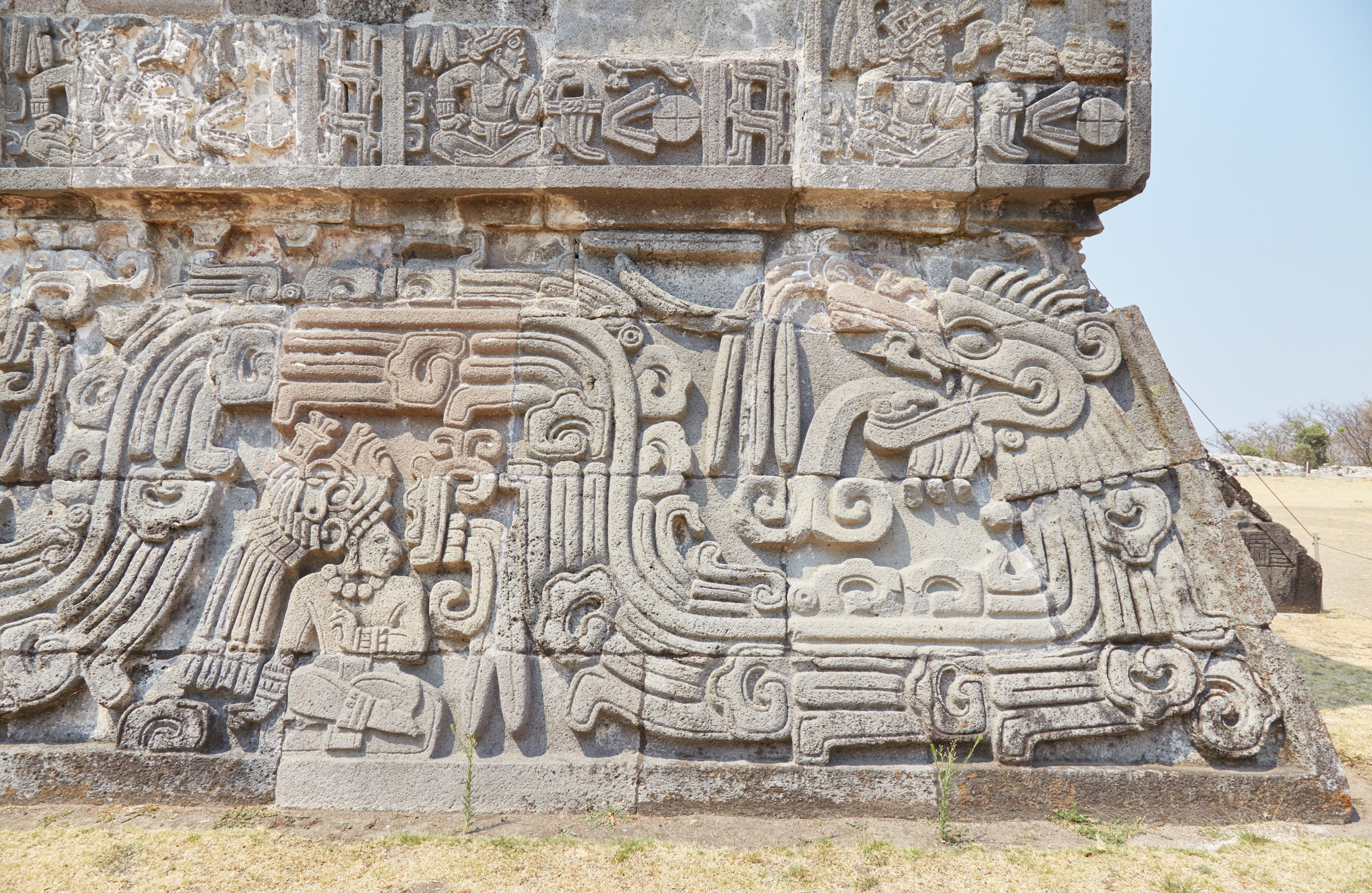
The figure of Kukulkan occupied a conceptual space linked to movement between realms—sky, earth, and watery underworld—symbolized through the serpent’s fluid body and feathered attributes. This imagery resonated with ideas about rain, renewal, and the regulated passages of celestial bodies. For prehispanic societies, such associations provided a framework for understanding political authority and the maintenance of social order.
Pilgrims visiting centers aligned with Kukulkan’s imagery did not arrive to venerate a deity in the modern sense. Instead, they engaged with a civic environment that used the Plumed Serpent as a political and astronomical emblem.
At Chichén Itzá, the Castillo pyramid (El Castillo) embodies this synthesis. Its stepped terraces, serpentine balustrades, and precisely calibrated orientation transform the entire structure into a solar marker during equinox sunsets, when light and shadow generate the illusion of a serpent descending the northern staircase. Although modern observers often treat this effect as a spectacle, its prehispanic value lay in its integration of architecture with timekeeping, agricultural planning, and state authority.
Seasonal journeys and collective experience
Travel to major centers typically coincided with market cycles or calendrical events. For many communities, these journeys involved extended families or guild-like groups who walked together along familiar routes. They carried offerings such as woven textiles, maize products, obsidian blades, or pigments—items that connected the economic networks of the region. Once at the destination, travelers participated in civic festivals, exchanged goods, and observed public ceremonies staged in plazas designed for mass gatherings.
In the case of Chichén Itzá and other cities with Kukulkan imagery, such events could include performances involving feathered regalia, processions along sacbeob, or activities associated with elite councils. Pilgrims therefore experienced the built environment as an instrument of narrative: stone façades, serpent motifs, and astronomical sightlines collectively communicated the host city’s identity and its place within larger regional alliances.
Centers beyond Chichén Itzá
While Chichén Itzá stands as the most visible example, other Maya sites integrated similar iconography. Mayapán, rising to prominence in the Postclassic period, adopted serpent imagery in its central temple complex, signaling both continuity with earlier traditions and the city’s own political aspirations. Coastal centers such as Tulum, controlling maritime routes along the Caribbean shore, also displayed Feathered Serpent motifs that linked port activity with inland ritual calendars.
Pilgrimage in these contexts served several functions. Travelers exchanged information about drought conditions, dynastic transitions, or shifting alliances. Ritual specialists studied architectural alignments, expanding their knowledge of astronomical cycles. Market participation strengthened interregional bonds, while the visual vocabulary of the Plumed Serpent offered a shared symbolic language across diverse communities.
Living landscapes
Routes leading to these cities passed cenotes, forest clearings, and agricultural zones shaped by centuries of human adaptation. Some paths incorporated stopping points where travelers observed local customs or received hospitality from resident families. The journey itself became part of the cultural record: stories accumulated along the road, linking distant towns with legendary travelers, historic rulers, or remembered ceremonies tethered to specific features of the landscape.
For many Maya groups, the act of moving through these environments signified participation in a broader regional order. The iconography of Kukulkan—dynamic, composite, and geographically widespread—supported this sense of shared orientation. Rather than promoting uniformity, it allowed local communities to anchor their traditions within a networked world.
Pilgrimage today
Modern interest in sites associated with Kukulkan continues along a very different spectrum. Contemporary visitors approach Chichén Itzá and related centers through archaeological interpretation, cultural tourism, and heritage conservation. The routes are no longer the sacbeob of antiquity, yet the sense of arrival—stepping into plazas structured around time, power, and cosmology—remains compelling.
Understanding prehispanic pilgrimage to Kukulkan-linked sites requires attention to mobility, architecture, and regional exchange rather than devotional practice. These journeys reflected a society that articulated its identity through movement, knowledge systems, and visual symbolism. In tracing these routes, present-day travelers encounter not a single tradition but a constellation of practices that once bound the Maya world together.
The Puuc Route: A journey through hills, symbols, and ritual pathways
AI Transparency Notice
PilgriMaps uses artificial intelligence tools to assist in the research, drafting and translation of editorial content. All AI-assisted content is reviewed, edited and verified by our editorial team before publication. We contrast information against primary sources, specialist literature and on-the-ground knowledge to ensure accuracy, cultural sensitivity and editorial integrity.
AI is one tool among many in our workflow. The judgement, curation and responsibility for everything published on this platform remain entirely human.
Viator Media S.L. — in compliance with the EU Artificial Intelligence Act (Regulation EU 2024/1689).
This post is also available in: