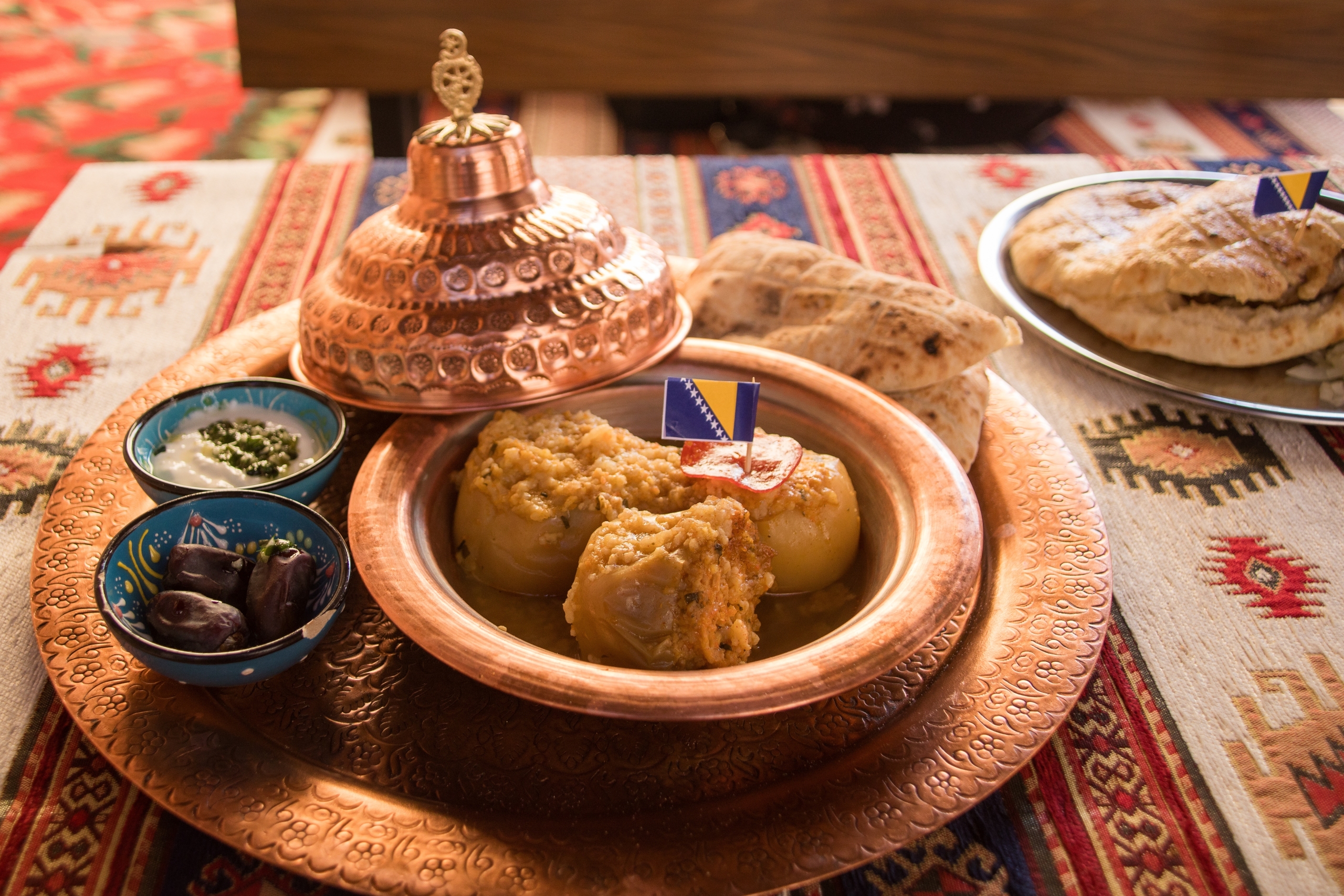
Few cuisines in Europe carry as many layers of history in a single dish. Bosnian food is the result of centuries of overlapping empires, trade routes, and religious traditions — and it has more to say to the pilgrim than might first appear.
There is a moment that repeats itself in the old bazaar quarter of Sarajevo, the Baščaršija, that tells you something essential about Bosnian cuisine before you have tasted a single thing. Within the space of a few hundred meters, you pass a mosque, an Orthodox church, a Catholic cathedral, and a synagogue. They have stood within earshot of each other for centuries. The food sold in the market around them — the grilled meats, the filled pastries, the slow-cooked stews, the honey-soaked sweets — is the edible record of every civilization that passed through and stayed.
Bosnia sits at one of the great crossroads of European history. It was Byzantine before it was medieval Bosnian. It was Ottoman for nearly four centuries. It was Austro-Hungarian for forty years that left a surprisingly deep culinary mark. And through all of it, it was home to Catholic, Orthodox, Muslim, and Sephardic Jewish communities whose dietary traditions, fasting practices, and festive foods wove together into something that belongs entirely to none of those traditions and unmistakably to all of them.
The Ottoman foundation
The longest and most formative influence on Bosnian cuisine is Ottoman, and it shows in the architecture of the meal as much as in specific dishes. The Ottoman culinary tradition brought with it a sophisticated understanding of spicing — not the aggressive heat of some Asian cuisines but a layered use of black pepper, cinnamon, allspice, and dried herbs that deepens flavor without overwhelming it. It brought phyllo pastry, stuffed vegetables, and the culture of the čaršija — the covered market where ingredients, spices, and prepared foods circulated alongside goods from across the empire.
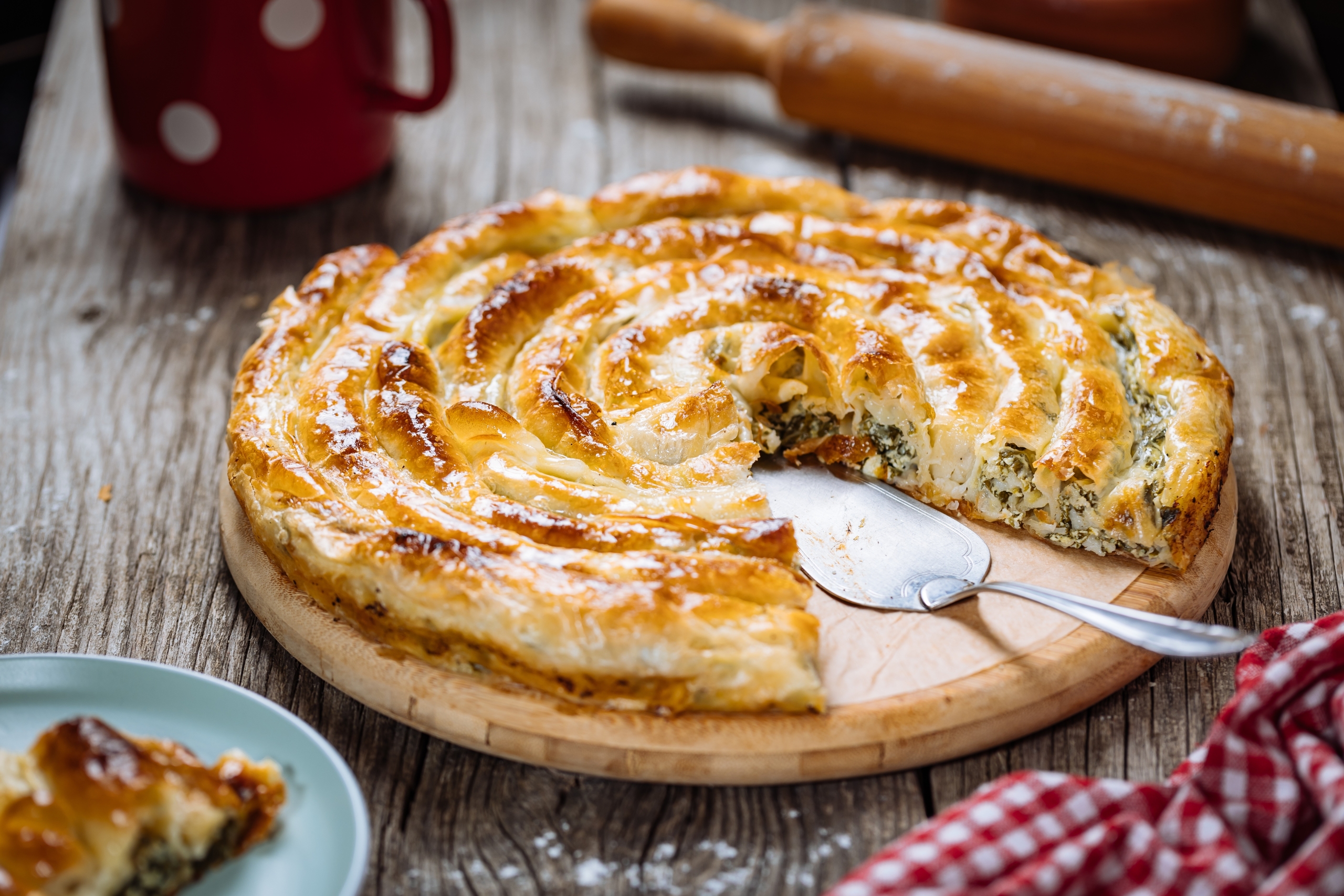
Burek — the spiral-coiled phyllo pastry filled with minced meat — is the most visible heir of this tradition, eaten for breakfast across Bosnia with yogurt so thick it is almost cheese. Pita, in the Bosnian sense, refers to the whole family of filled phyllo pastries: with spinach and cheese (zeljanica), with potato (krompirusa), with pumpkin (tikvenica). Each one is a study in the Ottoman art of making something substantial and nourishing from simple ingredients wrapped in the thinnest possible dough.
Ćevapi — small hand-rolled sausages of mixed beef and lamb, grilled over charcoal and served in a soft flatbread called somun with raw onion and kajmak, a clotted cream of singular richness — is the street food that has become Bosnia’s most recognizable culinary export. It is, at its best, a lesson in the power of restraint: three or four ingredients, extreme simplicity of technique, and a result that is difficult to improve upon.
The slow pot and the logic of patience
Beneath the grilled meats and the pastries lies another register of Bosnian cooking that is less immediately visible but in some ways more interesting: the tradition of long, slow cooking in sealed clay or cast-iron vessels. Sač cooking — in which meat and vegetables are covered with a domed iron lid and buried under embers — produces a tenderness and depth of flavor that no faster method replicates. Bosanski lonac, the Bosnian pot, layers meat and vegetables — cabbage, carrots, potatoes, leeks, tomatoes — in alternating strata and cooks them for hours until the boundaries between ingredients have dissolved into a unified, unctuous whole.
This is peasant cooking in the best sense: economical, patient, deeply satisfying, and structured around the logic of using what is available in a mountainous, landlocked terrain where winters are long and fresh ingredients are seasonal. The Dinaric Alps that run through much of Bosnia are not generous agricultural land. The cuisine that developed here is the cuisine of people who learned to do extraordinary things with lamb, cabbage, dried plums, walnuts, and whatever the garden produced in summer.
The Sephardic thread
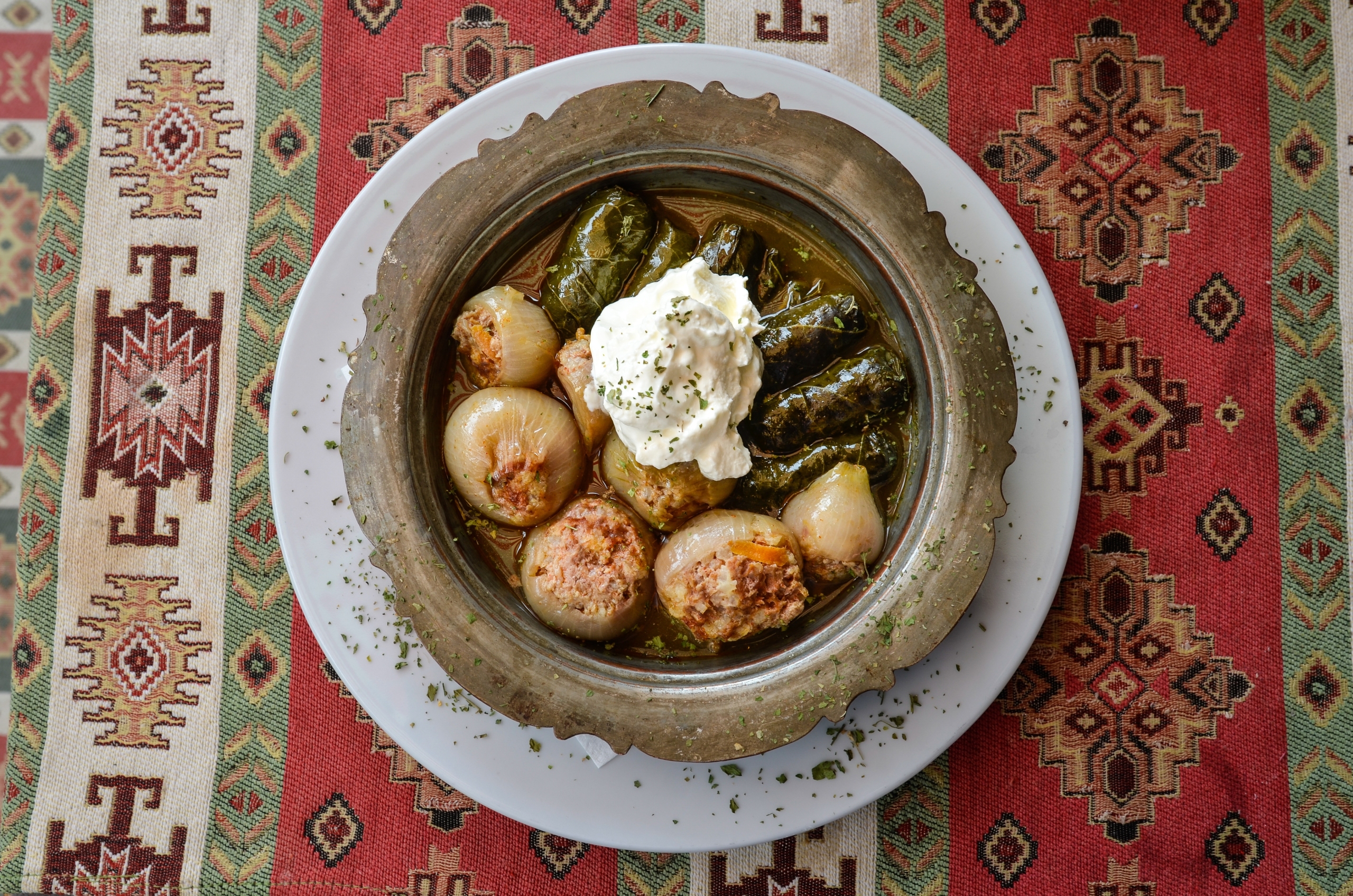
One of the less told chapters of Bosnian culinary history is Sephardic. After the expulsion from Spain in 1492, a significant community of Sephardic Jews settled in Sarajevo under Ottoman protection, bringing with them the food memories of the Iberian peninsula filtered through generations of Mediterranean diaspora. Sogan dolma — onions stuffed with minced meat and cooked in a sweet-sour sauce of tomato and lemon — is one of the dishes with clear Sephardic roots in the Bosnian tradition. The use of dried fruits in savory cooking, the combination of sweet and sour in meat dishes, the particular way of preparing eggplant: all of these carry traces of a culinary tradition that traveled from Castile to Sarajevo across five centuries.
Fasting and the table
Here the connection to pilgrimage becomes most direct. Bosnia’s three major religious communities — Muslim, Orthodox Christian, and Catholic — each brought with them elaborate traditions of fasting that shaped the cuisine in ways that are still visible. Muslim Ramadan practices, Orthodox Lenten restrictions, and Catholic fasting calendars created parallel tracks of meatless, dairy-free, and simplified cooking that developed their own repertoire of dishes. Tarhana soup — fermented dried vegetables reconstituted in broth — is fasting food. Uštipci, the fried dough fritters eaten at breakfast, appear in both festive and fasting contexts depending on what they are served with.
The pilgrim’s relationship to food has always been shaped by restriction and simplicity. On any long route, the body adjusts to eating less, eating simply, and finding pleasure in plain things. Bosnian cuisine — particularly its fasting and everyday register — understands this logic instinctively. The somun and ćevapi eaten standing at a counter in the Baščaršija, the bowl of bosanski lonac carried out of a kitchen that has been cooking since early morning: these are not elaborate productions. They are food that sustains, that comforts, and that asks for attention rather than analysis.
Sarajevo as pilgrimage city
Sarajevo itself has something of the character of a pilgrimage destination — not in the formal sense, but in the sense that it draws people who want to understand something about how human beings have managed, imperfectly and sometimes catastrophically, to live alongside profound difference. The old city is a compressed map of that history, and the food in its markets and restaurants is one of the most immediate ways to read it.
To eat in Sarajevo is to eat at a table set by Ottomans, Sephardim, Austro-Hungarians, and Slavic mountain farmers simultaneously. No single tradition dominates. Each has left something the others absorbed. The result is a cuisine that is, in the deepest sense, a cuisine of encounter — which is, finally, what every pilgrimage route produces at its best: not the triumph of one culture over another, but the slow, patient, sometimes painful work of people learning to share a table.
Further reading: Claudia Roden, The Book of Jewish Food (1996); Marianna Karamanou et al. on Ottoman culinary influence in the Balkans; Zilka Spahić-Šiljak, Bosnian cultural heritage and interfaith dialogue.
AI Transparency Notice
PilgriMaps uses artificial intelligence tools to assist in the research, drafting and translation of editorial content. All AI-assisted content is reviewed, edited and verified by our editorial team before publication. We contrast information against primary sources, specialist literature and on-the-ground knowledge to ensure accuracy, cultural sensitivity and editorial integrity.
AI is one tool among many in our workflow. The judgement, curation and responsibility for everything published on this platform remain entirely human.
Viator Media S.L. — in compliance with the EU Artificial Intelligence Act (Regulation EU 2024/1689).
This post is also available in: