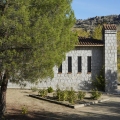
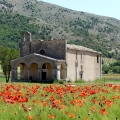
Bete Giyorgis (“House of St. George”) is considered the most iconic of the eleven rock-hewn churches of Lalibela, Ethiopia. It was constructed in the early 13th century under the reign of King Gebre Mesqel Lalibela of the Zagwe dynasty, who envisioned creating a “New Jerusalem” in Ethiopia. According to local tradition, the king received divine guidance, and St. George himself, the patron saint of Ethiopia, intervened to ensure the church’s completion. Historical chronicles suggest that it was the last church built in the complex and reflects a culmination of the artistry and architectural innovation of the period.
The church’s distinctive cross-shaped design symbolizes Christian devotion, with its roof bearing a triple cross motif and serving both aesthetic and functional purposes, such as rainwater drainage. The site’s historical significance is underscored by its inclusion as a UNESCO World Heritage Site in 1978, highlighting its role as a pilgrimage destination for Ethiopian Orthodox Christians, especially during Timqet (Epiphany). Its architectural style shows influences from Axumite and Byzantine traditions, marking it as a masterpiece
- Address
22JR+MCQ, Lalibela, Ethiopia - Web
None - Visiting Hours
Unknown - What to see
Cross-shaped church carved in the Rock
AI Transparency Notice
PilgriMaps uses artificial intelligence tools to assist in the research, drafting and translation of editorial content. All AI-assisted content is reviewed, edited and verified by our editorial team before publication. We contrast information against primary sources, specialist literature and on-the-ground knowledge to ensure accuracy, cultural sensitivity and editorial integrity.
AI is one tool among many in our workflow. The judgement, curation and responsibility for everything published on this platform remain entirely human.
Viator Media S.L. — in compliance with the EU Artificial Intelligence Act (Regulation EU 2024/1689).
This post is also available in: