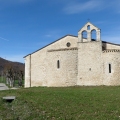
The old convent of the Barefoot Franciscans of Puente del Arzobispo, built between 1617 and 1620, was financed by the alms of the inhabitants of the town and especially by the nobleman Don Juan de Villarroel. After the War of Independence, the community returned briefly until the convent was finally abandoned in the first quarter of the 19th century. The convent buildings were reused as farmhouses and stables, and the church was used as a storehouse. In the nineties of the twentieth century, the remaining buildings were demolished, leaving only the church, which remains today as the only testimony of the old convent.
The convent church, declared an Asset of Cultural Interest, is a building of large proportions with a Latin cross floor plan, a single nave with three bays covered by a barrel vault and a transept crowned by a dome on pendentives. The supporting walls are in masonry, reinforced with ashlars in the corners, and the original entrance was marked by a segmental brick arch. The brick Herrerian belfry with pediment and semicircular arch, located at the foot of the church, stands out. The interior has a choir and an altar with a flat apse. The church and its outstanding structure reflect the historical and architectural importance of the convent, which is planned to being restored to serve as a pilgrims’ hostel.
- Address
C. Talavera, 44C, El Puente del Arzobispo, Toledo - Web
None - Visiting Hours
Closed - What to see
Ancient monastery
AI Transparency Notice
PilgriMaps uses artificial intelligence tools to assist in the research, drafting and translation of editorial content. All AI-assisted content is reviewed, edited and verified by our editorial team before publication. We contrast information against primary sources, specialist literature and on-the-ground knowledge to ensure accuracy, cultural sensitivity and editorial integrity.
AI is one tool among many in our workflow. The judgement, curation and responsibility for everything published on this platform remain entirely human.
Viator Media S.L. — in compliance with the EU Artificial Intelligence Act (Regulation EU 2024/1689).
This post is also available in: