Across the historic routes of pilgrimage, where travelers for centuries sought healing and meaning, a quiet transformation is taking place. This shift is not about the construction of new sanctuaries but about accessibility—reshaping the idea of who can embark on a journey and how. With advances in technology and growing awareness of disability rights, pilgrimages once thought inaccessible are opening to a wider spectrum of participants, redefining the boundaries of possibility.
Historical Roots, Persistent Obstacles
Accessibility is not a modern concern. Medieval sources, including the 12th-century Codex Calixtinus preserved in Santiago de Compostela, mention travelers with physical limitations who set out on pilgrimages despite difficulties. Their stories illustrate a long-standing human drive to walk, roll, or be carried toward a destination of significance.
Yet until recently, the idea of someone using a wheelchair or adaptive cycle along the Camino de Santiago seemed improbable. Steep gradients, uneven terrain, and unprepared facilities reinforced the perception that pilgrimage was reserved for those who could endure hardship unaided. The barriers were both physical and cultural.
A Turning Point: Pietro Scidurlo’s Journey
A decisive shift came in 2012, when Pietro Scidurlo, from Lombardy and paraplegic since birth, completed the Camino de Santiago with a handbike. His journey was more than a personal achievement: it became a demonstration that pilgrimage could be reimagined as inclusive.
Scidurlo went on to found Free Wheels Onlus, an association dedicated to accessible travel. Collaborating with experienced walker Luciano Callegari, he produced the first accessibility guide for the Camino, documenting over 4,000 points of interest and nearly 500 accommodations. His work reframed disability not as limitation but as a perspective to be integrated into the broader culture of walking.
Adaptive Technology and Expanded Horizons
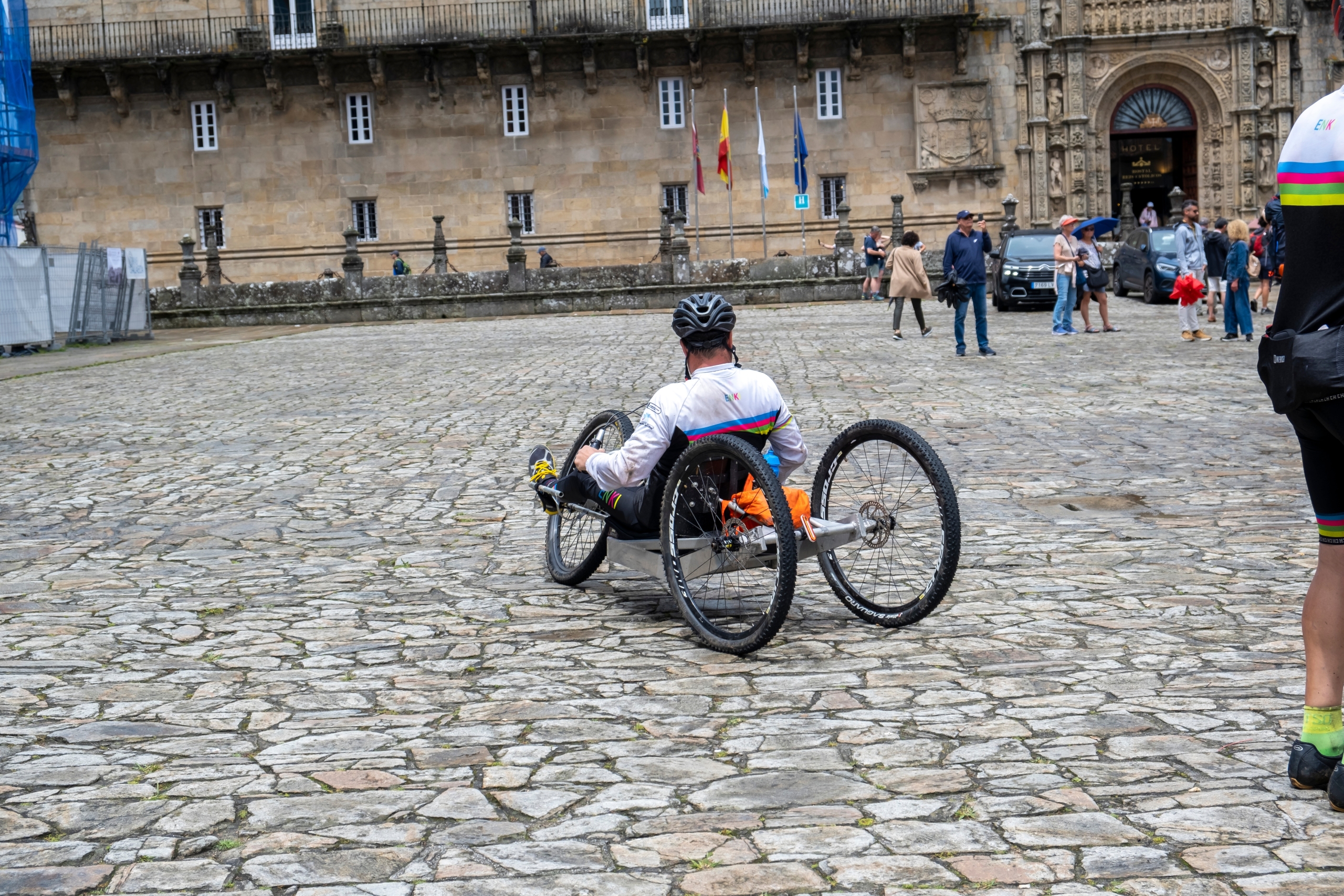
Technological innovation has played a crucial role in this evolution. Handbikes, once basic, are now sophisticated machines adapted to varied terrains: from lightweight road models to off-road versions and pedal-assist hybrids. Specialized trekking wheelchairs, with reinforced wheels and electric support, allow travelers with significant mobility restrictions to participate in outdoor routes once deemed inaccessible.
These devices are more than equipment. They extend autonomy, enabling individuals to explore landscapes and routes at their own pace. With each mechanical refinement comes an advance in independence and dignity.
Mapping the Invisible
Another revolution lies in data collection. Using GPS, sensors, and on-site surveys, accessibility mapping projects now document gradients, surface quality, and facility readiness in detail. Santiago per tutti (“Santiago for All”), a Free Wheels initiative, exemplifies this approach by offering three parallel routes: the classic Camino, an asphalt path suitable for handbikes, and a mixed itinerary for manual or electric wheelchairs.
These maps provide crucial information. As one wheelchair user explained: “It’s not only about whether the path exists, but whether I can do it safely. The data makes the difference between starting and giving up.”
Tools for Inclusion
The ecosystem of adaptive solutions is expanding rapidly:
- Tandem bicycles designed for two, enabling shared journeys.
- Specialized tricycles with harnesses and support systems for travelers with cognitive or motor difficulties.
- Electric trekking wheelchairs with reinforced structures to handle rugged trails.
- Mobile apps with audio-guided navigation tailored to blind or visually impaired travelers.
Together, these tools enable more people to experience pilgrimage not as extreme challenge but as accessible journey.
Beyond the Physical
The benefits extend beyond mobility. While many travelers report improvements in strength and endurance, the greater impact is psychological: heightened independence, social inclusion, and self-confidence. A study by the UK-based organization Wheels for Well-being found that 69% of cyclists with disabilities felt happier and more integrated when using adaptive cycles compared to traditional walking.
In this sense, pilgrimage becomes not only a physical route but also a path of transformation, where autonomy and meaning intersect.
Challenges and Future Directions
Despite progress, barriers remain. Some routes, such as parts of the Via Francigena or the Camino Materano, still present steep inclines and unprepared infrastructure. In response, organizations are creating alternative paths, accessible rest points, and adjusted itineraries.
Institutions and associations are also exploring next-generation solutions: artificial intelligence for route planning, robotics for mobility assistance, augmented reality for orientation, and wearable devices for real-time feedback. These innovations point toward a future of “intelligent pilgrimage” that adapts to diverse needs.
Measurable Change
The impact of inclusive guides is already visible. After the release of Santiago per tutti, the number of pilgrims with disabilities on the Camino nearly multiplied tenfold. The data underscores a growing movement: more people are taking to the routes, supported by technology and shared advocacy.
Yet behind every statistic lies an individual story—each one an encounter with landscape, resilience, and community.
A Broader Lesson
When a wheelchair rolls over a trail once thought impassable, or when a handbike rider reaches Santiago, the achievement goes beyond personal fulfillment. It redefines what is possible in collective imagination.
In a world still marked by physical and social barriers, accessible pilgrimage offers a powerful metaphor. It suggests a society where mobility and meaning are universal rights, and where innovation is measured not only in efficiency but in inclusion.
AI Transparency Notice
PilgriMaps uses artificial intelligence tools to assist in the research, drafting and translation of editorial content. All AI-assisted content is reviewed, edited and verified by our editorial team before publication. We contrast information against primary sources, specialist literature and on-the-ground knowledge to ensure accuracy, cultural sensitivity and editorial integrity.
AI is one tool among many in our workflow. The judgement, curation and responsibility for everything published on this platform remain entirely human.
Viator Media S.L. — in compliance with the EU Artificial Intelligence Act (Regulation EU 2024/1689).
This post is also available in: