In the heart of Konya, Turkey, stands a place of quiet reverence and cultural significance — the Mausoleum of Rumi, housed within the Mevlâna Museum. Once the center of the Mevlevi order, better known as the Whirling Dervishes, this complex is a landmark of Sufi heritage, drawing visitors from around the world. Beyond its ornate architecture and historical depth, the site continues to resonate as a space of reflection, where poetry, philosophy, and devotion intertwine.
Mevlâna Rumi, the poet of divine love
Jalal ad-Din Muhammad Rumi (1207–1273) was a Persian poet, scholar, and mystic whose teachings have endured through the centuries, making him one of the most influential figures in Sufism and world literature. Born in Balkh (present-day Afghanistan), Rumi later moved to Konya, in the Seljuk Empire, where his life and philosophy were profoundly transformed by his encounter with the enigmatic dervish Shams of Tabriz.
From their intense spiritual and philosophical connection emerged some of Rumi’s most celebrated works, including the Masnavi, an extensive didactic poem often described as “the Qur’an in Persian,” and the Divan-i Shams-i Tabrizi, a collection of lyrical poetry filled with passion and mysticism.
Today, Rumi’s influence remains immense. His verses have been translated into dozens of languages and are widely quoted in both spiritual contexts and popular culture. From East to West, his message of love, unity, and transcendence continues to resonate with millions, inspiring not only poets and philosophers but also spiritual leaders, artists, and seekers of meaning in the modern world.
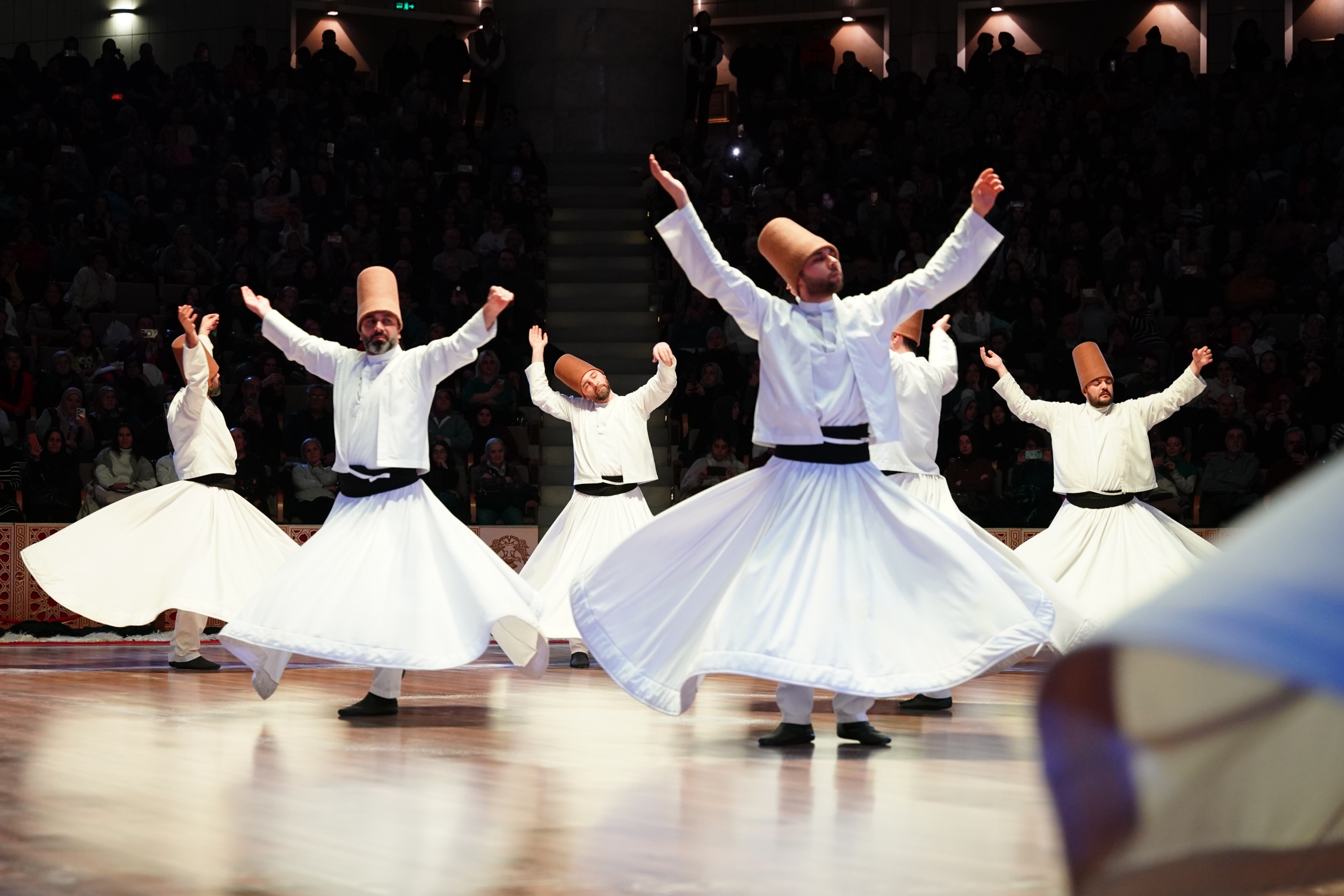
In the United States, for instance, Rumi has been one of the most widely read poets in recent decades, with adaptations of his poetry reaching diverse audiences. His legacy lives on in the practice of the Sufi whirling dance of the Mevlevi Order and in the annual Seb-i Arus ceremony in Konya, a commemorative event that draws pilgrims and admirers from around the world.
A History Rooted in Spiritual Legacy
The story of the Mevlâna Museum begins in the 13th century, when the Seljuk sultan ‘Ala’ al-Din Kayqubad granted a rose garden in Konya as a burial site for Baha’ ud-Din Walad, the father of Jalal ad-Din Muhammad Rumi – the Persian mystic and poet who would later be known simply as Rumi. When Rumi himself passed away in 1273, his followers buried him beside his father, marking the beginning of what would become a sacred space for generations to come.
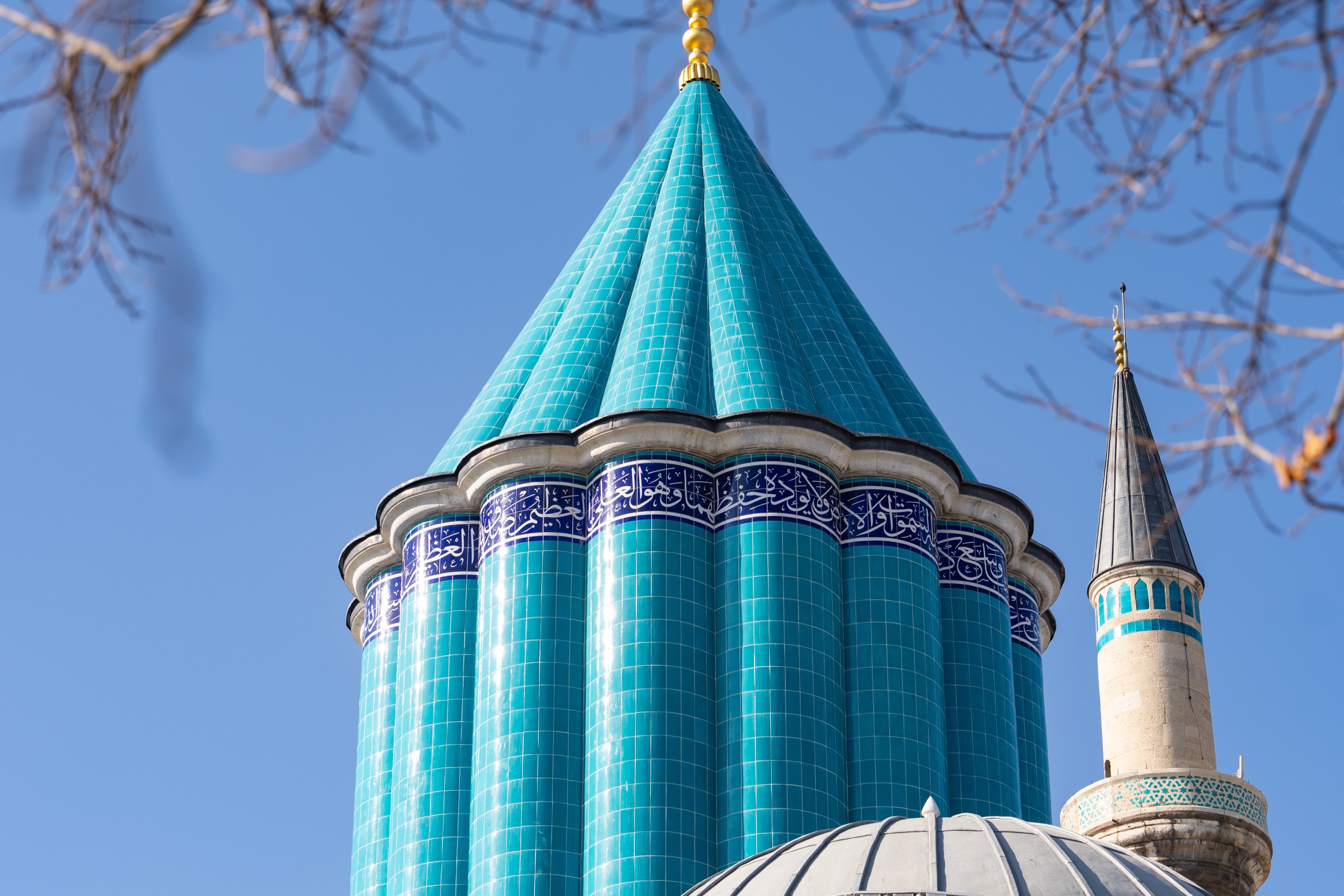
Rumi’s devoted disciple and successor, Hüsamettin Çelebi, commissioned a mausoleum over his master’s tomb. Designed by the architect Badr al-Din Tabrizi, the Kubbe-i-Hadra, or Green Dome, was completed in 1274. Its striking turquoise tiles and cylindrical drum became an enduring symbol of Konya. Over the centuries, additional structures were added to the site, transforming it into a full complex, including a dervish lodge, a kitchen, and spaces for spiritual practice.
With the dissolution of the Mevlevi order in 1925, the site was converted into a museum in 1927 by order of Mustafa Kemal Atatürk, preserving its historical and cultural significance. Today, the Mevlâna Museum remains one of Turkey’s most visited sites, welcoming millions of visitors each year.
Inside the Mevlâna Museum: A Space of Reflection and History
The Courtyard and Dervish Cells
Entering through the Devisan Kapısı, or Main Gate, visitors step into a marble-paved courtyard, surrounded by 17 dervish cells. These small, domed rooms once housed members of the Mevlevi order, serving as places of study and contemplation. Nearby stands the matbah, or dervish kitchen, where initiates learned not only the art of cooking but also the principles of discipline and spiritual practice.
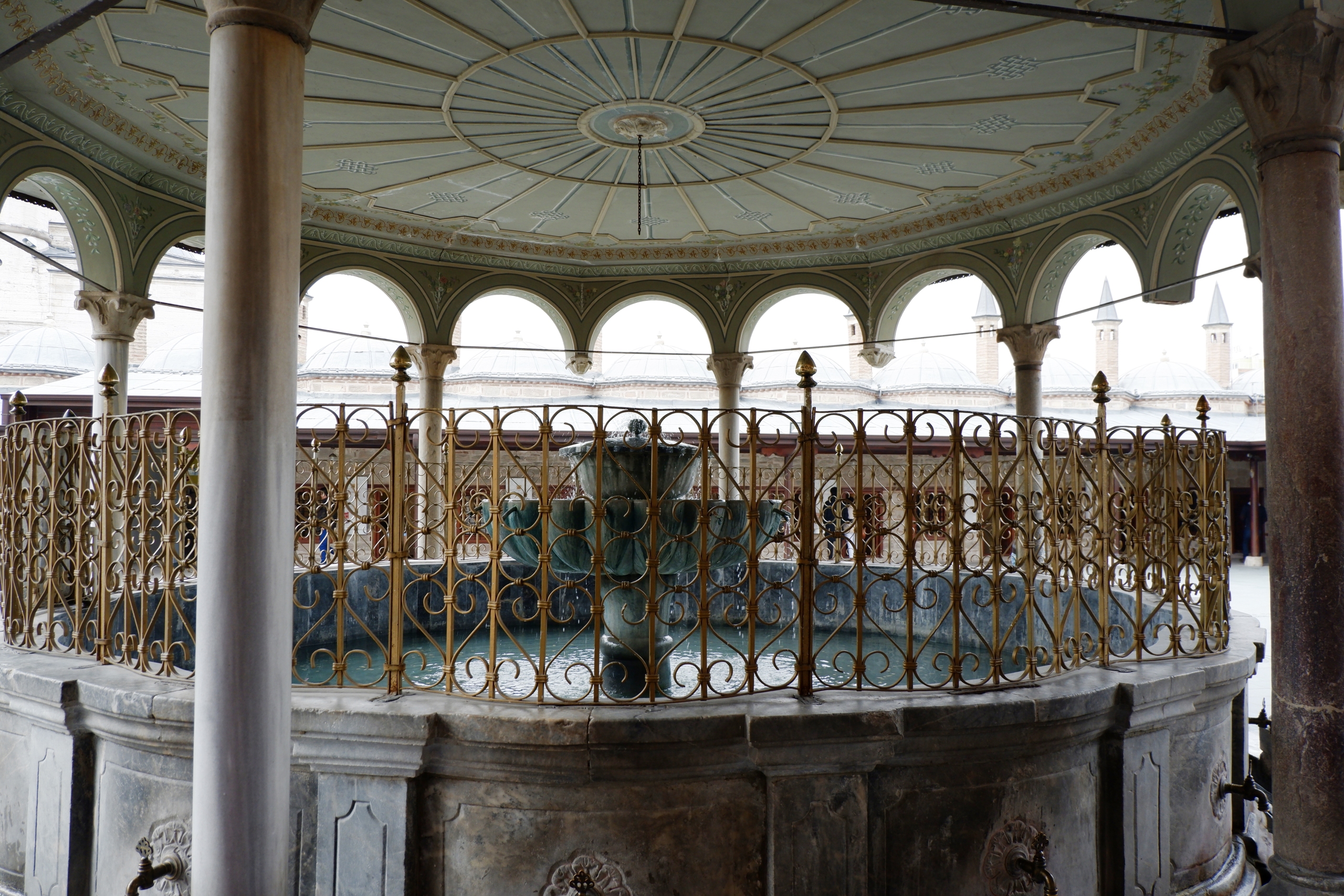
At the courtyard’s center, an ablutions fountain (şadırvan), built during the reign of Sultan Selim I, reflects the museum’s continued use as a space of purification and preparation.
The Ritual Hall: Echoes of the Whirling Dervishes
One of the most significant sections of the museum is the Semahane, or Ritual Hall, where the Whirling Dervishes once performed their mystical dance, the Sema. This sacred movement, a form of meditation in motion, was accompanied by traditional instruments such as the ney (reed flute), the rebab (stringed instrument), and the kudüm (small drum)—some of which are still displayed within the museum.
The room also houses artifacts such as Rumi’s clothing, centuries-old prayer rugs, and rare manuscripts, including a Divan-i-Kebir (Rumi’s collection of lyric poetry) from 1366 and a Masnavi, his magnum opus, copied in 1278.
The Heart of the Complex: Rumi’s Mausoleum
Passing through the Türbe Kapısı (Tomb Gate), visitors enter the Tilavet Room, once used for continuous Quranic recitation. From here, a silver door, crafted in 1599, leads into the Mausoleum, where Rumi’s final resting place lies beneath the iconic Green Dome.
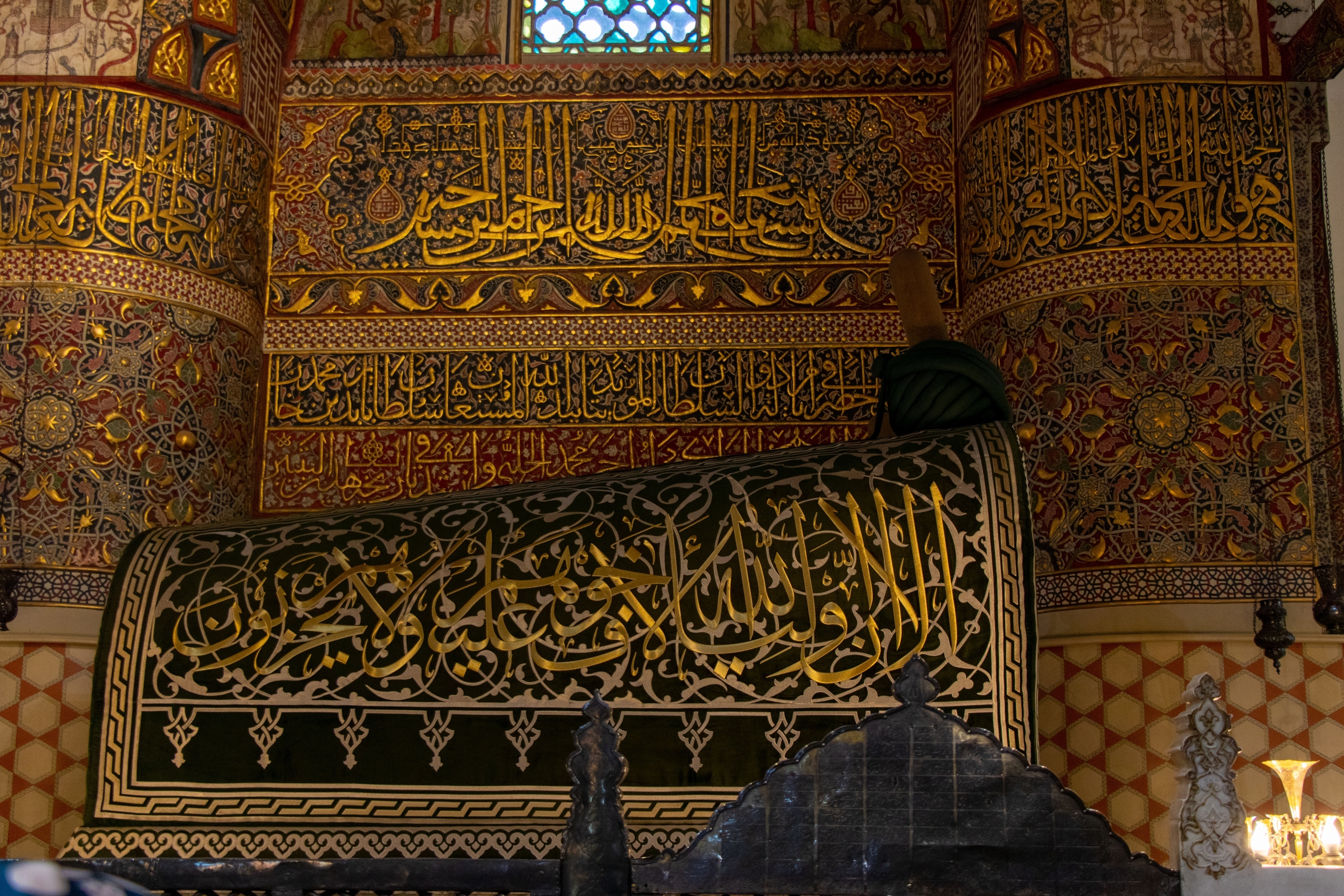
Rumi’s sarcophagus, draped in brocade embroidered with verses from the Quran, is one of the most revered spots in the museum. The original wooden sarcophagus, a masterpiece of Seljuk woodcarving, remains preserved as a historical artifact. Surrounding Rumi’s tomb are the resting places of his father, Bahaeddin Veled, his son, Sultan Veled, and other important figures of the Mevlevi order.
A striking silver lattice, crafted in 1579, encloses the sacred space, adding to the mausoleum’s solemn beauty. Above, the turquoise dome, a defining feature of Konya’s skyline, symbolizes the spiritual vastness Rumi so often evoked in his poetry.
“Come, Come, Whoever You Are”
Beyond its historical and architectural splendor, the Mevlâna Museum holds a place of deep cultural significance. The inscription above Rumi’s tomb bears his most famous invitation:
“Come, come, whoever you are.
Wanderer, worshipper, lover of leaving—come.
Ours is not a caravan of despair.
Even if you have broken your vows a thousand times—come, come again.”
This spirit of openness defines the Mevlâna Museum. It is more than a historic site; it is a place where poetry, devotion, and the human search for meaning continue to converge. Whether drawn by history, architecture, or the enduring legacy of Rumi’s words, every visitor leaves carrying something intangible – a sense of the timeless beauty of the journey itself.
AI Transparency Notice
PilgriMaps uses artificial intelligence tools to assist in the research, drafting and translation of editorial content. All AI-assisted content is reviewed, edited and verified by our editorial team before publication. We contrast information against primary sources, specialist literature and on-the-ground knowledge to ensure accuracy, cultural sensitivity and editorial integrity.
AI is one tool among many in our workflow. The judgement, curation and responsibility for everything published on this platform remain entirely human.
Viator Media S.L. — in compliance with the EU Artificial Intelligence Act (Regulation EU 2024/1689).
This post is also available in: