In the city of Agra, on the banks of the Yamuna River, the Taj Mahal receives millions of visitors each year. Most arrive as tourists, guided by images long familiar. Yet the experience of approaching the monument often unfolds with a different rhythm—one that resembles a form of pilgrimage. Not a pilgrimage defined by doctrine or obligation, but one shaped by a universal narrative: the human attempt to give permanence to love.
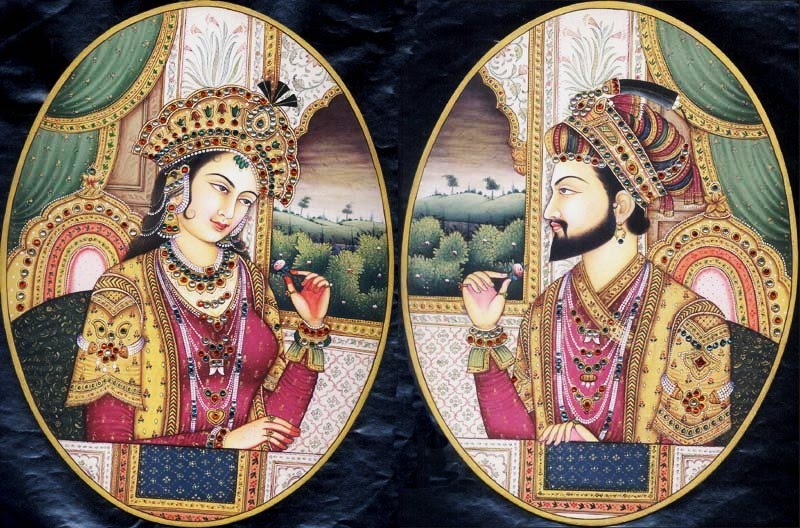
Commissioned in the 17th century by the Mughal emperor Shah Jahan in memory of his wife Mumtaz Mahal, the Taj Mahal is formally a funerary complex. Its historical function is clear: it houses a tomb. Its cultural function, however, has expanded far beyond its origins. Over time, it has become a site where visitors enact a quiet, often personal journey—one that echoes the structure of pilgrimage without requiring religious affiliation.
Approaching the monument
The sequence of arrival is deliberate. Visitors enter through a monumental gateway, pass into a charbagh garden structured along geometric lines, and move gradually toward the white marble mausoleum. The central axis guides movement forward, framing the building at each step.
This progression is not incidental. It creates a sense of transition—from the exterior world into a contained, ordered space. The soundscape shifts; the visual field narrows and then opens. Even in the presence of large crowds, the approach maintains a certain introspective quality.
In many pilgrimage traditions, movement toward a focal point serves to structure reflection. At the Taj Mahal, this dynamic operates in a secular register. The destination is not a relic or a shrine, but a narrative embodied in architecture.
Architecture as narrative
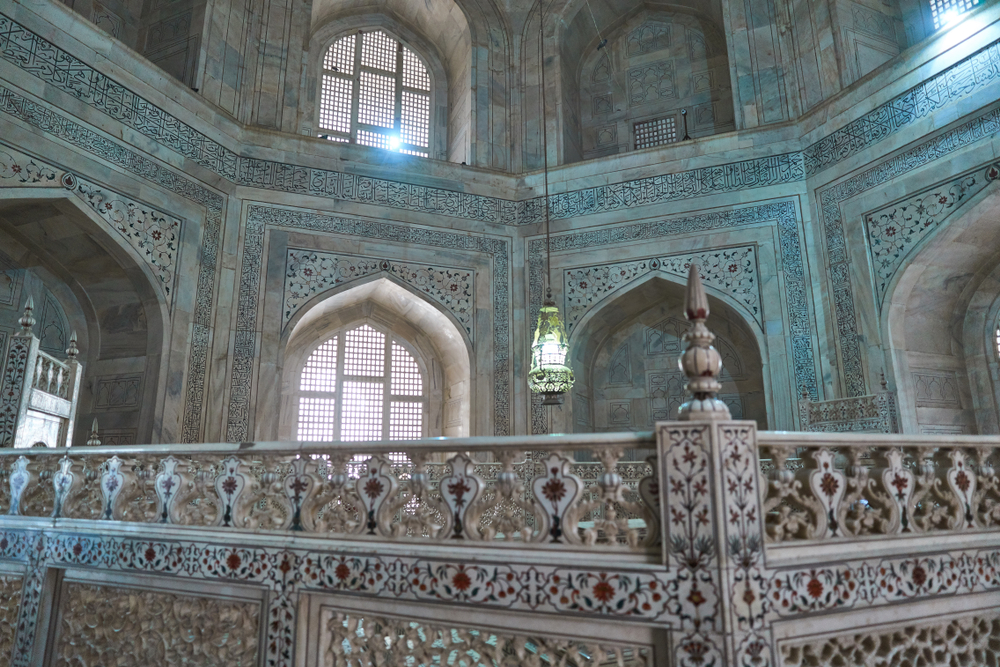
The Taj Mahal’s design communicates through symmetry, material, and light. Built primarily in white marble, it reflects changing tones throughout the day—cool at dawn, luminous at midday, and warm at sunset. The building appears both solid and weightless, its surfaces animated by shifting conditions.
Decorative elements—calligraphy, floral inlays, and geometric patterns—draw on a wide range of artistic influences present in the Mughal world. These details do not function as explicit doctrinal messages; rather, they contribute to an atmosphere of refinement and continuity.
At the center lies the tomb chamber, where the cenotaphs of Mumtaz Mahal and Shah Jahan are positioned. The actual graves rest below, in a more austere space. Visitors circulate around the upper chamber, often in silence, observing the intricate stonework and the filtered light.
The architectural language conveys an idea: that memory can be ordered, framed, and preserved. In this sense, the Taj Mahal operates as a constructed response to loss.
A pilgrimage without doctrine
Unlike traditional pilgrimage sites, the Taj Mahal does not require adherence to a specific belief system. There are no prescribed rituals for visitors to follow, no formal acts of devotion expected. Yet patterns of behavior emerge that parallel those found in established pilgrimage contexts.
Visitors move along a shared route, pause at key points, and engage in acts of observation that carry personal meaning. Some come as couples, marking anniversaries or significant moments. Others arrive individually, drawn by the monument’s symbolic weight.
The idea of a “pilgrimage of love” provides a useful framework. It does not imply uniform interpretation. Rather, it acknowledges that the site invites reflection on attachment, loss, and continuity—experiences that cut across cultural and religious boundaries.
Global circulation of meaning
The Taj Mahal’s status as a global icon has shaped the way it is experienced. Reproduced in images, films, and literature, it circulates as a symbol detached from its immediate context. This visibility attracts visitors from diverse backgrounds, each bringing different expectations.
Despite this global familiarity, the physical encounter retains its specificity. The scale of the structure, the texture of the marble, and the alignment of space cannot be fully anticipated through representation. The act of being present—of walking the path and entering the enclosure—remains central.
In this respect, the Taj Mahal aligns with other destinations that function simultaneously as heritage sites and as places of personal significance. Its meaning is not fixed; it is continually reinterpreted through individual experience.
Between memory and landscape
The setting of the Taj Mahal contributes to its effect. Positioned along the Yamuna River, it engages with a broader landscape that includes water, gardens, and open sky. Historically, the river formed part of a larger network of movement and exchange, linking the site to regional routes.
Today, environmental pressures and urban expansion have altered this context. Yet the relationship between the monument and its surroundings remains perceptible, particularly at quieter hours.
The garden, with its linear pathways and water channels, organizes space into a sequence of views. It functions both as an approach and as a place of pause. Visitors often linger here, extending their time within the site beyond the central structure.
Practical considerations
For those planning a visit, several practical elements shape the experience:
Timing: Early morning and late afternoon offer softer light and reduced crowds.
Access: The site is reached through controlled entry points; tickets are required.
Circulation: Movement follows a defined route, from the main gate through the gardens to the mausoleum.
Conduct: The interior chamber requires quiet behavior; photography is restricted in certain areas.
Climate: Seasonal conditions in northern India vary significantly; planning accordingly is advisable.
These factors influence not only logistics but also the tempo of the visit. A slower pace allows the spatial sequence to unfold more clearly.
Enduring appeal
The Taj Mahal endures not solely because of its architectural qualities, but because of the narrative it embodies. It presents an attempt to render an emotional bond in material form, to stabilize memory within a structured environment.
As a destination, it invites movement toward it—physical, visual, and interpretive. In doing so, it mirrors the logic of pilgrimage while remaining accessible to a broad public.
A journey to the Taj Mahal does not culminate in a doctrinal affirmation. It concludes, instead, in an encounter with a constructed idea: that love, translated into space and stone, can outlast the moment that produced it.
AI Transparency Notice
PilgriMaps uses artificial intelligence tools to assist in the research, drafting and translation of editorial content. All AI-assisted content is reviewed, edited and verified by our editorial team before publication. We contrast information against primary sources, specialist literature and on-the-ground knowledge to ensure accuracy, cultural sensitivity and editorial integrity.
AI is one tool among many in our workflow. The judgement, curation and responsibility for everything published on this platform remain entirely human.
Viator Media S.L. — in compliance with the EU Artificial Intelligence Act (Regulation EU 2024/1689).
This post is also available in: