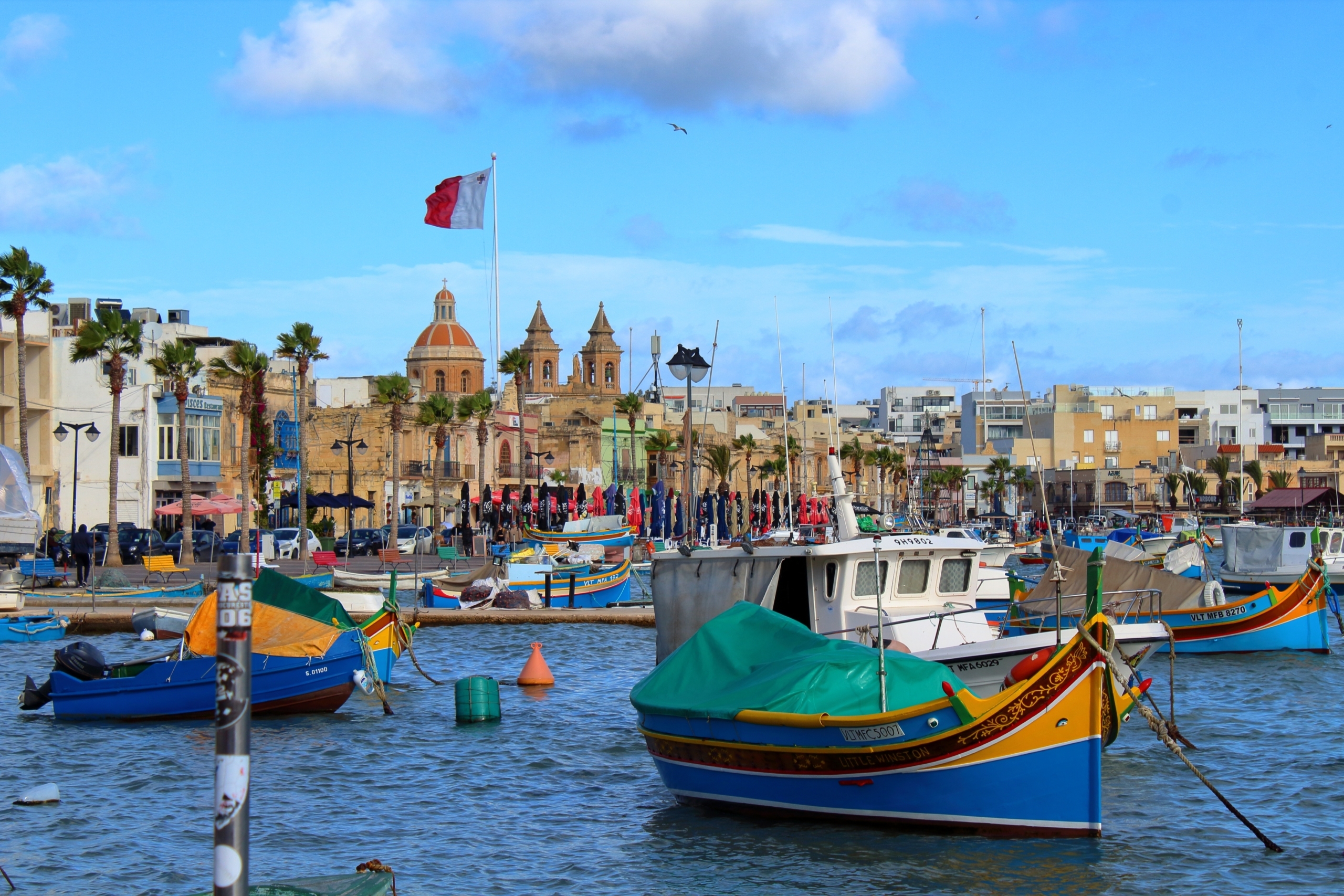
The harbor at Marsaxlokk curves gently into Malta’s southeastern coastline, its calm inlet framed by limestone shores and the painted eyes of luzzu fishing boats. Today, it is best known for its daily catch and seasonal festivals, yet this maritime landscape has also borne a long and layered history of symbolic meaning.
From prehistoric rituals centered on fertility to the worship of Phoenician goddesses and, later, to forms of Marian devotion shaped by Malta’s continuous Christian presence, Marsaxlokk occupies a distinctive place in the island’s sacred geography—a site where women, both divine and human, have held enduring cultural significance.
Prehistory and the Sacred Feminine
Long before the arrival of seafaring civilizations, Malta’s earliest communities built megalithic temples oriented toward solar and lunar cycles. A few kilometers inland from Marsaxlokk lie the Tarxien Temples and the subterranean Ħal Saflieni Hypogeum, both dating to roughly 4000–2500 BCE. These were not settlements but ritual spaces, and among their most iconic features are corpulent figurines commonly interpreted as representations of a mother or fertility deity.
While Marsaxlokk itself does not host monumental remains from this period, its proximity to these sites suggests it belonged to a broader sacred environment in which land and sea were bound to ritual cycles. The coastline likely served as both boundary and conduit—a space of transformation, linked to the seasonal rhythms that governed early agrarian and spiritual life.
A Harbor for Astarte: Phoenician and Punic Periods
By the 8th century BCE, Marsaxlokk had emerged as a strategic anchorage for Phoenician traders crossing the Mediterranean. Among the deities they carried with them, Astarte occupied a central role. Associated with fertility, protection, and maritime activity, she became the focus of local cult at Tas-Silġ, a hilltop sanctuary overlooking the bay.
Archaeological excavations at Tas-Silġ have uncovered terracotta figurines, altar fragments, and votive offerings dating from the Phoenician through the Roman periods. These remains suggest that Astarte’s worship involved both private petitions and formal rites, possibly linked to safe voyages, reproductive health, and household well-being. Her cult placed female divinity in direct relationship with the sea—a domain of risk and trade, but also of renewal.
Tas-Silġ demonstrates not only Marsaxlokk’s integration into Phoenician religious networks, but also the persistence of female-centered devotion in a maritime context.
Roman Syncretism and Christian Transition
Following Malta’s incorporation into the Roman world in the 3rd century BCE, Tas-Silġ continued as an active sanctuary, this time under the patronage of Juno—Rome’s goddess of women, marriage, and civic protection. Roman religious practice often absorbed earlier cults, allowing the site to evolve without erasure. Here, as in many parts of the Mediterranean, cultural and ritual continuity was achieved through adaptation.
With the eventual spread of Christianity, the sanctuary was once again reinterpreted. By late antiquity, archaeological layers suggest the existence of a Christian chapel at Tas-Silġ. Whether intentionally or by cultural continuity, the site retained its association with female intercession and protection. The figure of Mary, central to the Christian tradition, embodied many of the roles previously held by goddesses like Astarte and Juno—but with new theological dimensions and ritual forms.
Malta’s uninterrupted Christian tradition—dating back at least to the 4th century CE—has played a defining role in reconfiguring earlier motifs of the sacred feminine. Rather than simply absorbing the past, Christianity in Malta created novel frameworks of veneration. In figures like the Virgin Mary, themes of care, mediation, and maritime guardianship were not only preserved but transformed—offering a distinctly Christian vision of female presence that surpassed ancient ritual forms in symbolism, institutional integration, and emotional resonance.
Our Lady of Pompei and Contemporary Practice
The most visible expression of female veneration in modern Marsaxlokk is the Parish Church of Our Lady of Pompei, constructed in 1890 and located directly at the harbor’s edge. The church became central to village life, especially among fishing families. Votive paintings depicting ships in distress—offered in thanks for survival—still hang inside its walls, and annual maritime processions in honor of the Virgin Mary remain a focal point of the local calendar.
This tradition reflects enduring themes: female figures invoked as protectors, intermediaries, and patrons of those whose lives depend on the sea. Yet within the context of Maltese Catholicism, these themes are articulated through a sustained theological and liturgical framework. Here, the sacred feminine is no longer dispersed across polytheistic iconography but consolidated within the figure of Mary—a shift that marks both continuity and redefinition.
Oral histories collected in the region point to the central role of women in sustaining these practices. Household shrines, feast preparations, and ritual knowledge are often maintained by mothers and grandmothers, underscoring the intergenerational transmission of belief and tradition in domestic and communal life.
A Continuum Recast
Marsaxlokk’s history does not suggest an unbroken religious tradition, nor a singular identity for the female figures venerated along its shores. Instead, it presents a continuum of sacred association—one in which cultural meanings have been layered over time, shaped by migration, empire, revelation, and the evolving functions of place. From prehistoric temple complexes to hilltop sanctuaries and waterfront churches, the southeastern coast of Malta has long provided a landscape where the veneration of women could take multiple, evolving forms.
Yet what distinguishes the Christian era—particularly in Malta—is the sustained development of a cohesive framework of female devotion, rooted in two millennia of theological tradition and popular practice. This framework has absorbed ancient motifs but also surpassed them, offering new ritual forms, liturgical spaces, and symbolic languages that continue to shape how sacred femininity is expressed in Marsaxlokk today.
In that sense, the harbor is more than a site of memory. It is a space where past and present meet—not in replication, but in reinterpretation. The sea remains, as always, a threshold. And along its edge, devotion continues to evolve.
AI Transparency Notice
PilgriMaps uses artificial intelligence tools to assist in the research, drafting and translation of editorial content. All AI-assisted content is reviewed, edited and verified by our editorial team before publication. We contrast information against primary sources, specialist literature and on-the-ground knowledge to ensure accuracy, cultural sensitivity and editorial integrity.
AI is one tool among many in our workflow. The judgement, curation and responsibility for everything published on this platform remain entirely human.
Viator Media S.L. — in compliance with the EU Artificial Intelligence Act (Regulation EU 2024/1689).
This post is also available in: