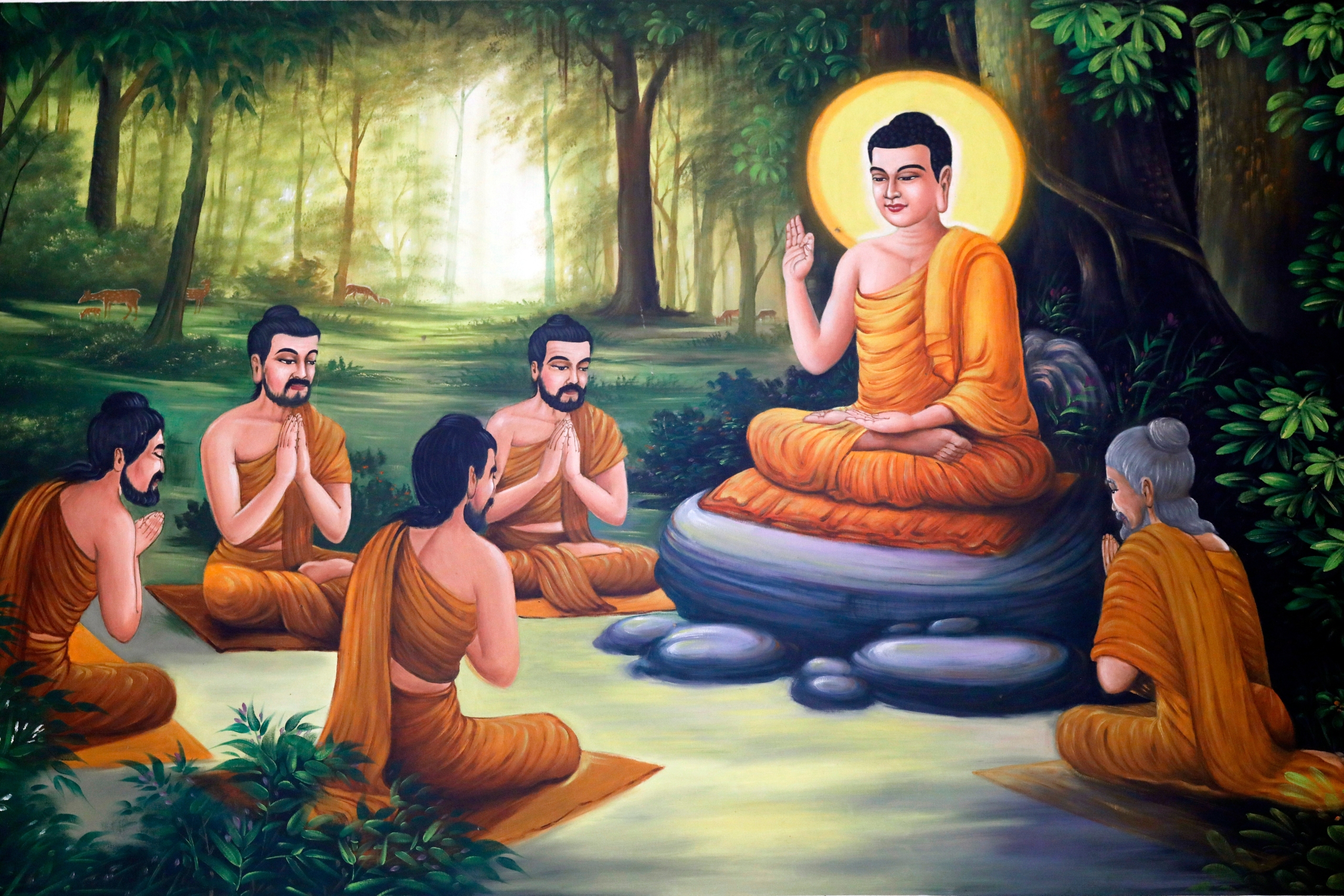
The monsoon clouds had just begun to gather over the plains of northern India when Siddhartha Gautama, newly awakened from his long meditation beneath the Bodhi tree, began his journey toward Sarnath. The story, preserved in early Buddhist texts, recalls him walking along forest paths lined with sal and teak, his resolve quiet yet unwavering. He was no longer the seeker who had left Kapilavastu years before; he was now the Buddha—“the Awakened One.” What awaited him was not a throne or a hermitage, but five companions who had once abandoned him.
They were ascetics—his earliest followers during years of self-denial. When Gautama chose a middle course between extreme austerity and indulgence, they had dismissed him as having lost discipline. Yet, as the Buddha approached the Deer Park at Sarnath, a place near the Ganges known for its quiet groves and gentle deer, something in his bearing persuaded them otherwise. Tradition holds that his calm presence disarmed their skepticism before he even spoke. What followed became known as the Dhammacakkappavattana Sutta—the “Setting in Motion of the Wheel of Dharma.”
The scene at the deer park
Sarnath in the 5th century BCE lay just north of the sacred city of Varanasi, one of the oldest urban centers of the Ganges basin. The site’s name, derived from Isipatana—the “place where seers fell”—suggests an earlier association with wandering ascetics. Groves of mango and pipal trees shaded its open clearings, and monsoon winds carried the scent of wet earth. Here, the Buddha’s first discourse unfolded not as a proclamation but as a dialogue—measured, reflective, and centered on the insight he had reached beneath the Bodhi tree.
He began by addressing two extremes: the pursuit of sensual pleasure and the practice of severe asceticism. Both, he said, were unworthy of a seeker of truth. In rejecting them, he articulated what he called the Middle Way—a balanced path leading to understanding and freedom from suffering.
Then, in deliberate cadence, he described the Four Noble Truths. The first recognized the pervasive condition of suffering (dukkha), present in birth, decay, and loss. The second identified its cause: craving and attachment. The third affirmed the possibility of cessation, a state in which craving subsides. The fourth outlined the path toward that cessation, later known as the Noble Eightfold Path—right view, intention, speech, action, livelihood, effort, mindfulness, and concentration.
The discourse was concise, yet within it lay the foundation for the entire Buddhist tradition. The Buddha’s language, according to the Pāli Canon, was pragmatic rather than metaphysical. He spoke not of gods or creation but of experience, of how suffering arises and how it can end through disciplined insight.
The turning of the wheel
In Buddhist imagery, this sermon is described as “turning the wheel of Dharma.” The wheel’s spokes symbolize the elements of the Eightfold Path, its circular form the continuity of understanding. At Sarnath, the Buddha is said to have set this wheel in motion for the first time, initiating a movement that would, over centuries, spread across Asia.
Among the five listeners, one—Kondañña—was said to have grasped the meaning fully. His realization marked the birth of the saṅgha, the community of practitioners. With this, the Three Jewels of Buddhism took shape: the Buddha, the Dharma (teaching), and the Saṅgha (community).
Archaeological memory
Centuries later, Emperor Aśoka, who ruled the Mauryan Empire in the 3rd century BCE, commemorated Sarnath with a stone pillar crowned by four lions facing the cardinal directions. This Lion Capital of Aśoka—now India’s national emblem—symbolizes both sovereignty and moral authority. Excavations have revealed stupas, monastic remains, and fragments of carved railings that attest to Sarnath’s importance through successive dynasties. Pilgrims from Sri Lanka, China, and Tibet later visited the site, recording impressions of its quiet sanctity and the enduring presence of the Dharma’s first turning.
By the early centuries CE, Sarnath had become a renowned center of learning, linked to the schools of Buddhist philosophy that debated the nature of perception and reality. Its monasteries flourished until the 12th century, when they fell into decline under the changing political landscape of North India. Yet the Deer Park remained, and modern Sarnath continues to draw visitors of many traditions—monastics, historians, and travelers alike.
Reflections on a beginning
To imagine that first sermon is to picture an austere yet profound moment: a small gathering in the open air, a teacher speaking not of divine revelation but of the human condition. The Buddha’s words, preserved through centuries of oral transmission, spoke to observation rather than belief—an invitation to examine the nature of one’s own mind.
Today, visitors walking the pathways of Sarnath encounter layers of stone and memory: the great Dhamek Stupa, rising from an ancient foundation; the remains of monastic cells arranged in precise geometry; and the quiet deer that still wander the park. Each element forms part of a landscape where philosophy, history, and pilgrimage converge.
In that setting, the idea of a “first sermon” takes on a meaning beyond doctrine. It becomes an instance of clarity shared among people searching for understanding, marking the beginning of a tradition grounded not in worship, but in awareness. The wheel that turned at Sarnath continues to symbolize that motion—the ongoing search for balance, insight, and liberation that began with a walk through the forests of the Ganges plain more than two millennia ago.
AI Transparency Notice
PilgriMaps uses artificial intelligence tools to assist in the research, drafting and translation of editorial content. All AI-assisted content is reviewed, edited and verified by our editorial team before publication. We contrast information against primary sources, specialist literature and on-the-ground knowledge to ensure accuracy, cultural sensitivity and editorial integrity.
AI is one tool among many in our workflow. The judgement, curation and responsibility for everything published on this platform remain entirely human.
Viator Media S.L. — in compliance with the EU Artificial Intelligence Act (Regulation EU 2024/1689).
This post is also available in: