Ferdinand Magellan did not die in Europe, nor on the high seas that carried him beyond the known maps of his time. He died on the shores of a small island in the central Philippines—Mactan—on April 27, 1521. His death was not a martyrdom, nor a solemn conclusion to a sacred journey. It was the culmination of a global expedition driven by empire, spice, and curiosity—an audacious gamble by the Spanish Crown to reach Asia by sailing west.
Today, the Philippines is home to some of the greatest Catholic pilgrimage traditions in Asia. From the Black Nazarene processions in Manila to the Marian devotions in Cebu and beyond, it attracts millions of faithful. But the first European to set foot on these islands came not as a missionary or pilgrim, but as a navigator whose compass pointed toward trade and territorial claim. That his final breath was drawn here adds a deep, if unintended, resonance to the layered meanings of this land.
A voyage to encircle the Earth
Ferdinand Magellan was born around 1480 in northern Portugal, a country then at the forefront of maritime expansion. After years of service in Portuguese India and the Spice Islands (modern-day Maluku), he defected to Spain, seeking royal patronage for a westward route to the fabled riches of the East. On September 20, 1519, he set sail from Seville with five ships under Spanish flag, tasked with finding a westward passage to Asia. This was not a spiritual enterprise; it was commercial, political, and imperial.
The fleet endured mutiny, starvation, storms, and the treacherous passage now named the Strait of Magellan, which finally opened into the vast Pacific. It was here, across an ocean so immense that no European had crossed it before, that Magellan earned his reputation as a formidable mariner. After months of aimless drifting and dwindling supplies, the expedition reached the Philippines in March 1521.
Encounter with the Islands
Magellan’s arrival in the Visayas marked the first European contact with the Philippine archipelago. The local societies he encountered were not passive recipients of foreign presence. They were politically complex, linguistically diverse, and actively engaged in regional trade networks. Rajah Humabon of Cebu, a local ruler, received Magellan cordially and entered into a mutual alliance—sealed, in European fashion, by baptism.
Magellan interpreted this alliance as more than political. In his letters, he imagined himself a bringer of civilization, authority, and faith—an envoy of empire with a divine mandate. But he misunderstood the limits of his influence, and the independence of other local leaders.
The battle of Mactan
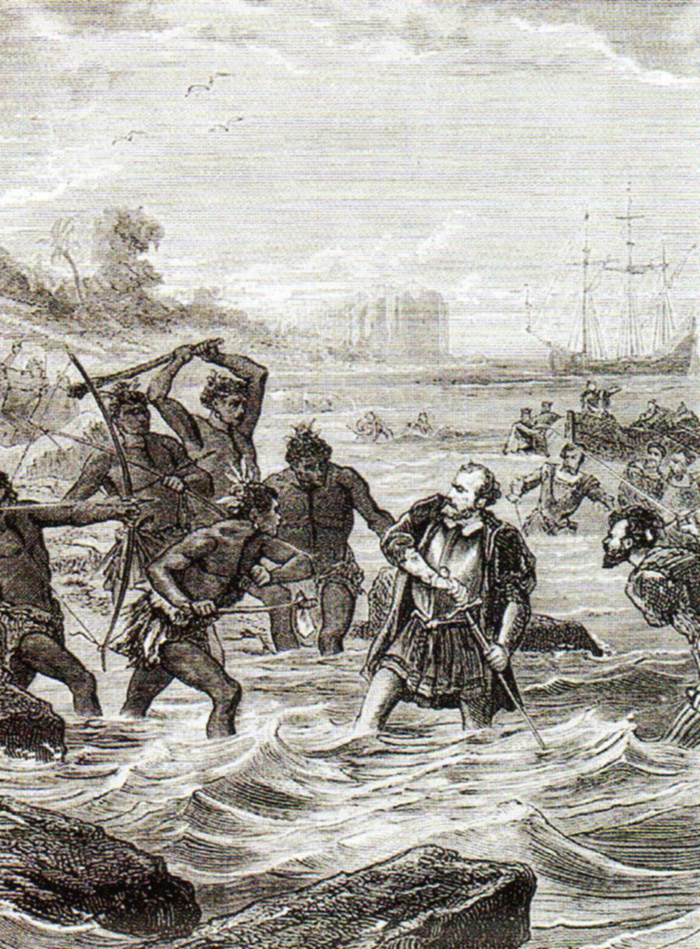
Just across the strait from Cebu lay the island of Mactan, ruled by Lapu Lapu, a local datu (chieftain) who refused submission to the Spaniards and rejected the authority claimed by Rajah Humabon. Rather than negotiate or withdraw, Magellan opted to make an example of him. On the morning of April 27, 1521, he led a contingent of fewer than 60 men, clad in armor, armed with crossbows and firearms, in an assault on Mactan.
What followed was a strategic failure. The tide and coral shoals prevented the ships from providing support. Magellan and his men had to wade through surf under attack from hundreds of defenders. Lapu Lapu’s warriors used spears, arrows, and fire-hardened bamboo weapons. The Spanish armor, so effective in European battles, became a liability in the heat and shallows. Magellan was struck in the leg, then surrounded and overwhelmed.
According to Antonio Pigafetta, the expedition’s chronicler and one of the few survivors, Magellan fell not as a commander in glory, but as a man cut down in unfamiliar territory—stripped of command, encircled, and left behind by his fleeing crew. His body was never recovered.
Aftermath and legacy
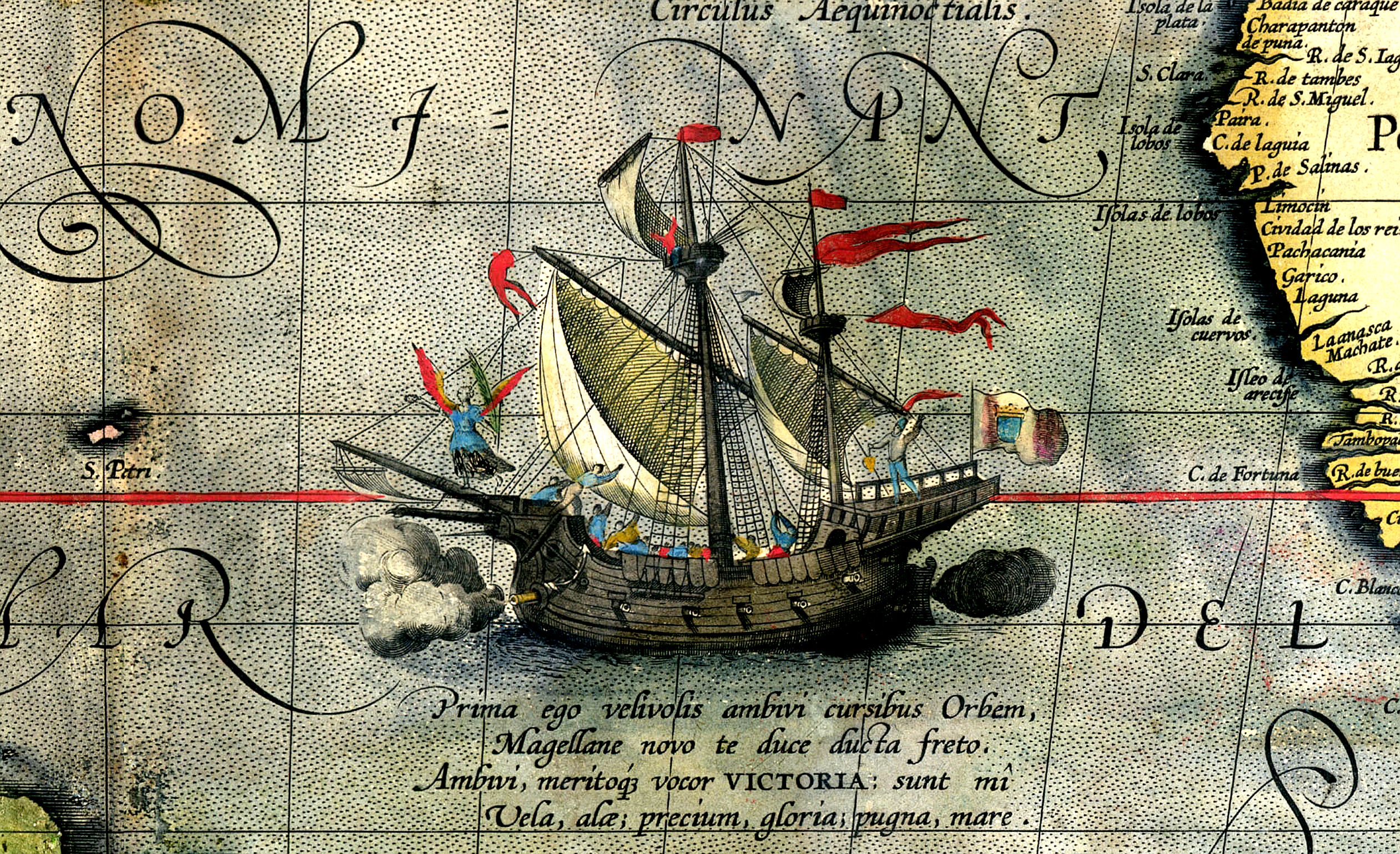
Magellan’s death did not end the voyage. Under new leadership, the remaining ships fled the Philippines and reached the Spice Islands, eventually returning to Spain in 1522 with only one surviving vessel—Victoria—and 18 men out of the original 270. They had circumnavigated the globe for the first time in human history, confirming empirically that the world was round, vast, and interconnected.
In the Philippines, Magellan’s legacy is complex. His arrival signaled the beginning of over three centuries of Spanish colonization, Christianization, and cultural transformation. Today, the archipelago is one of the largest Catholic-majority nations in the world. Devotional sites such as the Basilica Menor del Santo Niño in Cebu, said to house a figure brought by Magellan himself, draw millions of pilgrims each year. Yet the memory of Lapu Lapu endures just as powerfully—as a symbol of resistance and sovereignty. A towering monument to him stands on Mactan Island, commemorating his defiance.
A site of memory, not pilgrimage
Unlike the sacred paths of Compostela or the devout circuits of Shikoku, Magellan’s route to the Philippines was never meant as a pilgrimage. It was a route of empire disguised in the language of evangelization, a maritime corridor toward markets and monopolies. But the very island where he died—Mactan—has become a historical waypoint on a land where religion and memory often converge.
For travelers on historical or cultural pilgrimages through Southeast Asia, the Philippines offers a distinctive narrative: a place where the global Age of Exploration collided with local agency, where the European cross met archipelagic complexity, and where one of the boldest seafaring ventures ended not with a conquest, but a defeat.
Magellan’s death reminds us that the world was never discovered, only encountered. And those encounters, as in Mactan, were never one-sided.
AI Transparency Notice
PilgriMaps uses artificial intelligence tools to assist in the research, drafting and translation of editorial content. All AI-assisted content is reviewed, edited and verified by our editorial team before publication. We contrast information against primary sources, specialist literature and on-the-ground knowledge to ensure accuracy, cultural sensitivity and editorial integrity.
AI is one tool among many in our workflow. The judgement, curation and responsibility for everything published on this platform remain entirely human.
Viator Media S.L. — in compliance with the EU Artificial Intelligence Act (Regulation EU 2024/1689).
This post is also available in: