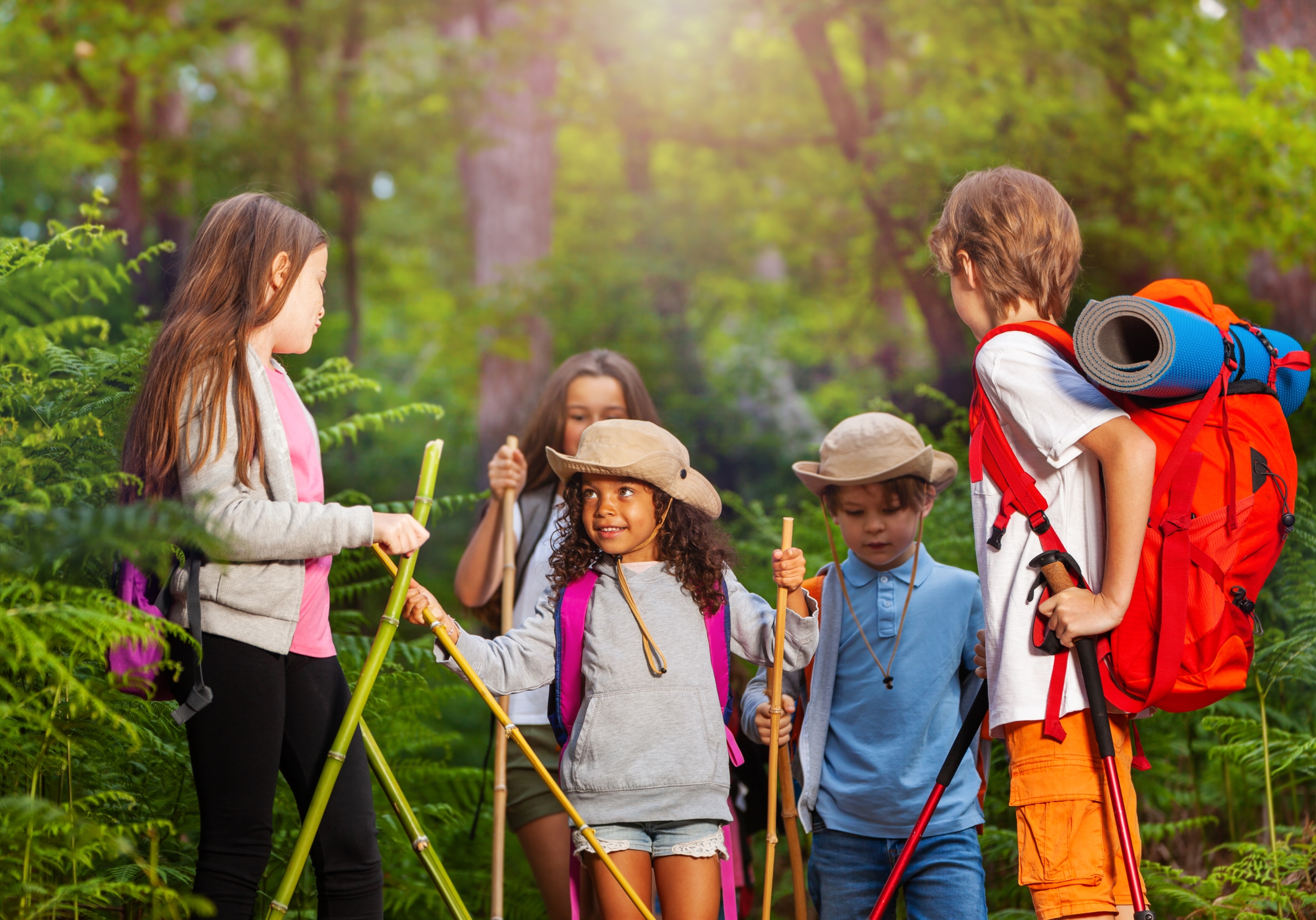
Most parents recognize the familiar refrains: “I’m tired,” “How much farther?” “Can you carry me?” Even short walks can feel like a negotiation. Yet research consistently shows that walking matters – not only for children’s physical health, but for cognitive development and sustained attention.
A large Danish study involving nearly 20,000 children – the Mass Experiment 2012 – found that those who walked or cycled to school demonstrated significantly better concentration than peers who arrived by car. The effect persisted for up to four hours after reaching the classroom. In practical terms, accompanying children on even relatively short walks can support measurable cognitive responses alongside physical activity.
The walking brain
The link between movement and cognition is well established. Research published in Frontiers in Public Health indicates that aerobic walking significantly improves children’s performance in tasks involving sequential memory and attentional focus. Older children show particularly strong gains in sequencing tasks.
Additional findings from the University of Nevada suggest that as little as 20 minutes of walking can increase brain activity and improve performance on academic tests. Cardiovascular movement boosts blood flow and oxygenation to the brain, supporting overall neural function. Images of heightened brain activity following brief walking sessions have become widely cited in pediatric neuroscience literature.
Play as strategy: gamifying the walk
If science explains why walking helps, imagination explains how to make children eager to participate. Introducing playful elements – points, challenges, light competition, or symbolic rewards – can turn a routine walk into an engaging experience.
Practical games for any walk
No technology is required to make walking appealing. These adaptable activities work across age groups and settings.
Treasure hunts along the route
A scavenger hunt reframes a walk as an exploratory mission. Before setting out, prepare a simple list or folder with images of natural elements: a red leaf, an acorn, a bird, a cloud shaped like an animal. Children search for each item along the way. The small reward at the end matters less than the shared attention and careful observation the activity encourages.
Walking stories
Collaborative storytelling during a walk – often called “walking stories” – keeps children engaged through imagination. Trees become gentle giants, a passing squirrel turns into a messenger, a bend in the path signals a new chapter. Each participant contributes, allowing the story to evolve with the landscape.
Storytelling in nature
Outdoor storytelling has deep roots in experiential education, including Waldorf pedagogy and many Indigenous traditions. As educators at the Wilderness Awareness School note, stories help children interpret and integrate outdoor experiences. A fallen log becomes a ship, rocks form a fortress, a winding path suggests a journey into the unknown. Narratives organize sensory information and provide children with frameworks to understand their surroundings.
Reinvented classics
Traditional games adapt easily to walking:
- “I spy” (by color or texture) sharpens observation.
- Countdown challenges—five leaves, four stones, three flowers, two insects, one animal—encourage active searching.
- The sound game invites children to close their eyes for one minute and count distinct sounds: wind, footsteps, birds, traffic.
- Shape hunting involves finding natural objects that resemble familiar forms.
For children who enjoy competition, brief stage challenges work well: reaching the next tree first or counting steps to a lamppost. Keeping goals short and celebrating each milestone maintains motivation.
An investment in the future
Inviting children to walk is not a burden; it is a long-term investment. Habits formed in childhood often extend into adulthood. Studies indicate that individuals who adopt healthy behaviors early – including regular walking – are more likely to maintain them later in life. Children are also more inclined to walk when their parents do, and parents are uniquely positioned to teach safe, confident navigation of local environments.
Ultimately, the question shifts from “How do I get my child to walk?” to “What adventure will we share today?” Every walk offers an opportunity – to move, to imagine, to observe, and to experience the world together. In that sense, walking becomes less about persuasion and more about rediscovering curiosity, one step at a time.
AI Transparency Notice
PilgriMaps uses artificial intelligence tools to assist in the research, drafting and translation of editorial content. All AI-assisted content is reviewed, edited and verified by our editorial team before publication. We contrast information against primary sources, specialist literature and on-the-ground knowledge to ensure accuracy, cultural sensitivity and editorial integrity.
AI is one tool among many in our workflow. The judgement, curation and responsibility for everything published on this platform remain entirely human.
Viator Media S.L. — in compliance with the EU Artificial Intelligence Act (Regulation EU 2024/1689).
This post is also available in: