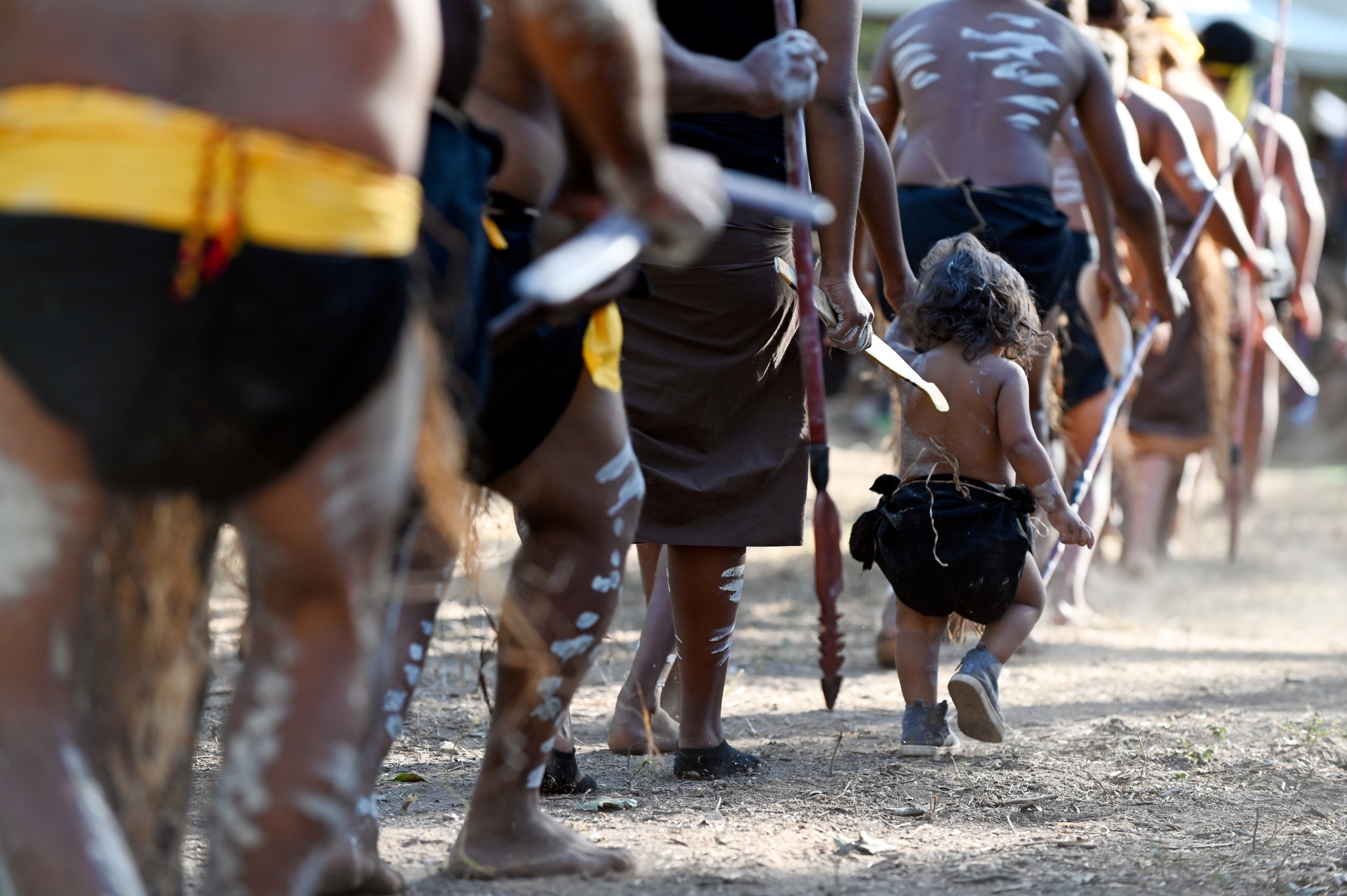
A man walks slowly across the Australian desert. He carries no map, no compass, no visible technology. He sings.
But what exactly is he singing? It is not an abstract melody or a private expression. In his voice unfolds an itinerary. Each verse names a place: a rock rising on the horizon, a hidden waterhole, a barely perceptible curve in the land. Each stanza recalls the passage of an ancestral being who, along that same route, shaped the world. The song does not describe the landscape from the outside—it moves through it from within.
As he advances, the man “reads” the territory with his voice. The song tells him when to turn, where to stop, which story belongs to that place, and which rules govern it. In this seemingly simple act—walking and singing—a radically different way of understanding the world is condensed.
An Australian phenomenon with deep roots
Songlines are a cultural phenomenon specific to the Aboriginal peoples of Australia. They consist of networks of itineraries that connect places in the landscape through creation narratives, songs, dances, and ritual practices. Rather than physical paths, they are complex structures integrating geography, memory, social norms, and cosmology.
Analytically, they can be understood as cultural infrastructures of knowledge. Through them, knowledge about the land is transmitted—how to traverse it, where to find resources—as well as knowledge about social organization, obligations, and relationships with ancestors.
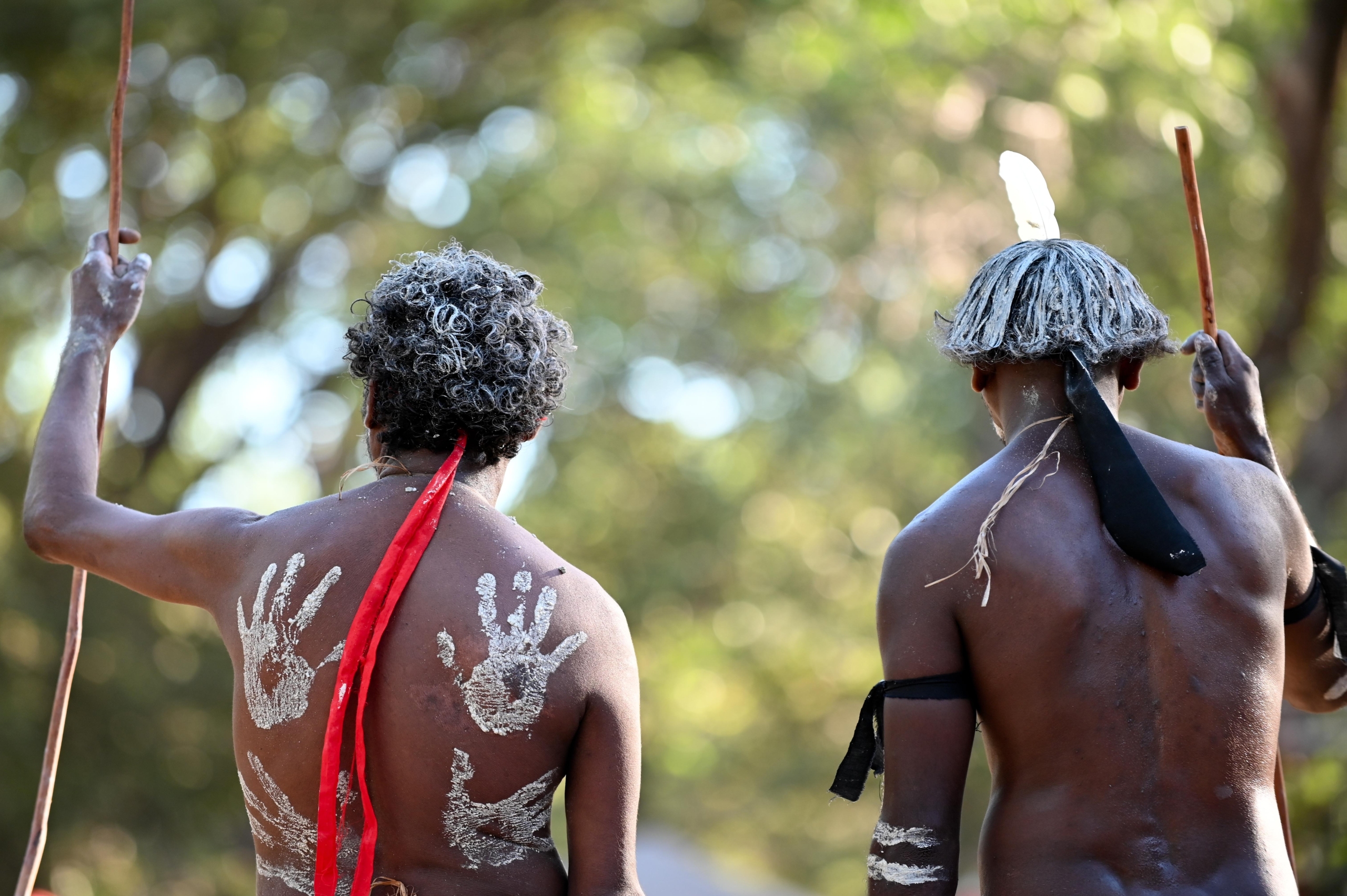
Their origins lie in the ancestral traditions of Indigenous Australian peoples, extending back tens of thousands of years. Songlines are closely linked to what is referred to in English as the Dreaming or Dreamtime, a concept encompassing diverse ways of understanding the origin of the world, the continuity of time, and the norms governing life. Within these narratives, ancestral beings traverse the land and, in doing so, create the landscape, species, and social relations.
The term songline, however, is much more recent. It does not belong to Indigenous languages but was popularized globally through The Songlines (1987) by Bruce Chatwin. This dissemination helped bring visibility to the phenomenon, but it also sparked debate by simplifying a far more diverse and complex reality.
Today it is understood that there is no single universal “songline,” nor a single equivalent term across Aboriginal cultures. Each region, language, and community maintains its own categories and ways of naming these relationships with the land.
Singing, navigating, remembering, regulating… and journeying
Songlines are not only music, nor solely geography, nor exclusively religion or law. They encompass all of these simultaneously.
They are, first, cosmology in motion. Many traditions describe how ancestral beings moved across the land during the time of creation, shaping mountains, rivers, species, and social relations.
They are also embodied geography. The songs function as precise maps: each segment corresponds to an element of the landscape, and the full sequence enables orientation across vast distances. There is no drawn map because the map is the song itself.
Yet this knowledge carries authority. Songlines are also law. To know a song is not merely to know a route—it is to hold a legitimate relationship with that territory, with associated rights and responsibilities. In some contemporary cases, song and ceremony have even been used as evidence in land claims within the Australian legal system.
All of this is transmitted performatively. Knowledge is not stored in books but in people. It is learned through singing, walking, and listening.
In this sense, some researchers have suggested that these practices may be understood—cautiously—in terms analogous to pilgrimage: journeys connecting significant places, activating foundational narratives, and reaffirming collective identities. However, unlike many pilgrimages in institutionalized religious traditions, there is not necessarily a single destination or hierarchical center. The journey itself constitutes the meaning.
Two ways of understanding a map
In Western traditions, a map is an external representation of territory. It is fixed on a medium—paper or screen—and aims to provide an objective view. The observer remains separate from the space being observed.
In the context of songlines, the map is not an object. It is a living practice. It is not consulted but performed. It does not separate the subject from the land—it intertwines them. And it is not static: it exists only as it is sung and traversed.
While Western maps describe space, songlines produce and sustain it.
Yet speaking of songlines requires translating concepts deeply rooted in specific cultural contexts. Different Australian peoples use their own terms—such as Tjukurpa, Jukurrpa, or Altyerre—which condense complex meanings related to origin, law, and land. None of these corresponds exactly to Western categories such as “myth” or “history.”
To understand songlines is to accept that part of their meaning remains untranslatable.
Between visibility and protection: the Australian context
The global dissemination of songlines has generated growing interest, but also tensions. To understand them properly, it is important to situate these tensions within the specific context of Australia.
Australia is a modern state with a legal system rooted in the Anglo-Saxon tradition, built upon a colonial past that long ignored or denied Indigenous land rights. It was not until the late 20th century that certain forms of Indigenous relationships to land began to receive legal recognition, particularly through the Native Title Act of 1993, which opened the possibility for Aboriginal communities to demonstrate continuous connection to a territory.
Within this framework, elements such as song, ceremony, and memory associated with songlines have gained relevance as forms of cultural evidence in legal processes. This has required the Australian legal system to confront a complex issue: how to translate non-written, relational, and performative forms of knowledge into evidence admissible in court.
At the same time, national institutions such as the Australian Institute of Aboriginal and Torres Strait Islander Studies (AIATSIS) have developed ethical codes establishing standards for research and the management of Indigenous knowledge. These frameworks emphasize principles such as Indigenous leadership, informed consent, and community benefit.
A living legacy
The man continues walking and singing. Now it is clear he is not alone. In his voice travel ancestral trajectories, social norms, and invisible maps. His song does not represent the world—it sustains it in existence.
Far from belonging to the past, songlines remain active in contemporary Australia. They appear in exhibitions, educational programs, debates on technology, and legal processes related to land. They continue to form a fundamental basis of identity and cultural continuity for many communities.
Perhaps this is the most profound insight offered by songlines: that territory is not only a space to be crossed, but a story to be sung—step by step.
AI Transparency Notice
PilgriMaps uses artificial intelligence tools to assist in the research, drafting and translation of editorial content. All AI-assisted content is reviewed, edited and verified by our editorial team before publication. We contrast information against primary sources, specialist literature and on-the-ground knowledge to ensure accuracy, cultural sensitivity and editorial integrity.
AI is one tool among many in our workflow. The judgement, curation and responsibility for everything published on this platform remain entirely human.
Viator Media S.L. — in compliance with the EU Artificial Intelligence Act (Regulation EU 2024/1689).
This post is also available in: