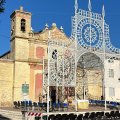
The Basilica Menor de San Francisco in La Paz, built between the 16th and 18th centuries in mestizo baroque style, is an architectural treasure that reflects centuries of history and culture in every detail. Erected over a pre-Inca ceremonial site, its construction involved indigenous hands, creating a remarkable example of the fusion between baroque style and pre-Columbian elements, such as masks and motifs of tropical flora and fauna. This magnificent building, made entirely of stone, stands as one of the most significant heritage of the city, enclosing in its walls the traces of its past and the very essence of the Paceña identity. Considered the cradle of the city, the Basilica of San Francisco was the epicenter of the revolution of 1809, a crucial milestone in Bolivian history that marked the beginning of the independence process.
Today, the Basilica of San Francisco is not only a place of worship, but also an important cultural center that houses the Centro Cultural Museo San Francisco. Here, visitors have the opportunity to explore the different spaces of the convent and the basilica, immersing themselves in the rich history and traditions that have shaped the region. The museum tour offers a unique window through which to appreciate the architectural magnificence of the site, as well as an impressive collection of paintings, hymn books, liturgical objects and vestments that narrate the religious and cultural history of Bolivia.
- Address
Sagarnaga St 173, La Paz (Bolivia)
- Web
https://www.facebook.com/CCMSFLP/?locale=es_LA - Visiting Hours
Monday to Saturday from 10:00 a.m. to 6:00 p.m., includes a bilingual Franciscan Tourist Host service, who provides a guided tour at any time. - What to see
Cloister, liturgical artifacts, paintings
AI Transparency Notice
PilgriMaps uses artificial intelligence tools to assist in the research, drafting and translation of editorial content. All AI-assisted content is reviewed, edited and verified by our editorial team before publication. We contrast information against primary sources, specialist literature and on-the-ground knowledge to ensure accuracy, cultural sensitivity and editorial integrity.
AI is one tool among many in our workflow. The judgement, curation and responsibility for everything published on this platform remain entirely human.
Viator Media S.L. — in compliance with the EU Artificial Intelligence Act (Regulation EU 2024/1689).
This post is also available in: