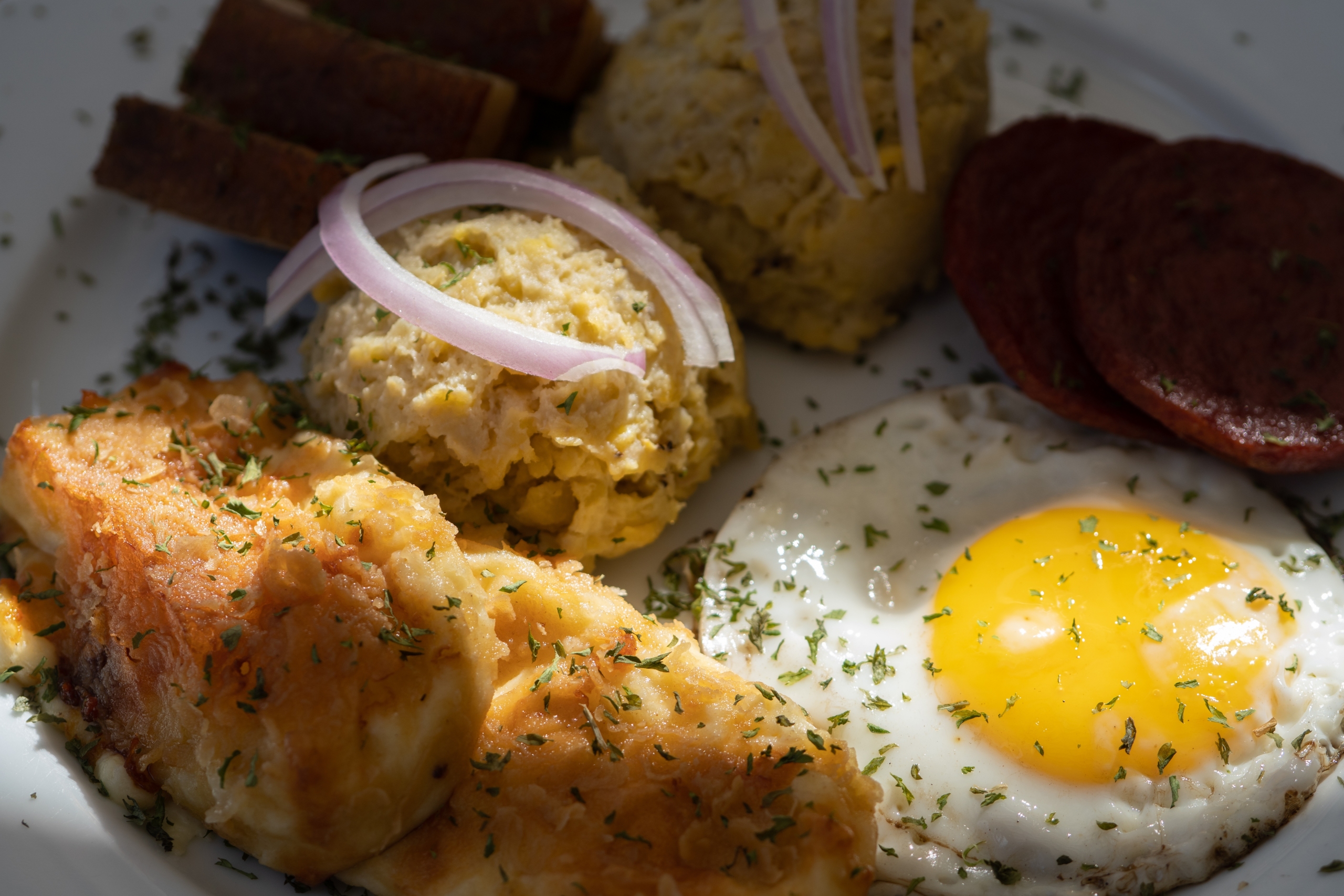
At first glance, mangú appears as a simple preparation: green plantains boiled and mashed, often served with sautéed onions and accompanied by eggs, cheese, and salami in the ensemble widely known as los tres golpes. Yet this dish, central to everyday meals in the Dominican Republic, carries a layered history shaped by movement, encounter, and adaptation. Read through the lens of pilgrimage—understood here as sustained movement across landscapes with cultural meaning—mangú becomes a record of the populations that formed the island and the routes that connected them.
Plantains and transatlantic routes
The plantain, the foundation of mangú, did not originate in the Caribbean. It arrived through transatlantic circulation tied to European colonial expansion and African displacement between the 16th and 19th centuries. Enslaved Africans brought agricultural knowledge and culinary techniques that proved adaptable to new environments. Across West and Central Africa, boiled and pounded plantains or yams formed staple foods; these methods persisted and transformed in the Caribbean.
On the island historically known as Hispaniola, plantains found fertile ground. Over time, they became embedded in daily subsistence, not as an imported curiosity but as a reliable crop integrated into local food systems. The act of boiling and mashing—practical, efficient, and nutritionally dense—echoes techniques carried across the Atlantic under conditions of coercion, yet adapted to new ecological and social contexts.
Colonial landscapes and creole synthesis
Spanish colonial structures shaped the social and economic framework in which mangú developed. Livestock, dairy production, and cured meats—elements visible in the accompaniments to mangú—reflect Iberian influences filtered through local conditions. Fried cheese and salami, now standard alongside mashed plantains, illustrate this layered exchange: European animal husbandry combined with Caribbean preservation techniques and local taste preferences.
Indigenous Taíno populations, present on Hispaniola prior to European arrival, contributed knowledge of local crops, land use, and cooking practices. While their demographic presence was drastically reduced during the early colonial period, aspects of their material culture persisted in altered forms. The resulting cuisine is neither a direct continuation of any single tradition nor a simple fusion; it is a creole system shaped by unequal encounters and long-term coexistence.
Mangú as daily practice
Unlike ceremonial foods tied to specific dates, mangú belongs to routine. It is prepared in urban kitchens and rural homes, served in roadside eateries and family gatherings. Its consistency—soft, warm, and filling—supports labor and daily movement. The sautéed onions added on top, often cooked in vinegar, introduce acidity that balances the density of the plantain.
This ordinariness is part of its significance. Pilgrimage, in a broad cultural sense, is not limited to exceptional journeys; it also includes repeated paths—commutes, market routes, seasonal work—that structure everyday life. Mangú accompanies these rhythms. It is eaten before departure, after return, and during pauses that punctuate movement across the island.
Routes of devotion and shared meals
Each year, thousands travel to the Basilica of Our Lady of Altagracia, one of the country’s main pilgrimage destinations. Participants arrive on foot, by bus, or in organized groups, converging from different regions. Along these routes, food operates as both sustenance and social connector. Dishes like mangú are prepared in advance or shared upon arrival, reinforcing continuity between home and destination.
In this context, mangú functions as a stable reference point within movement. It does not mark the sacred site itself but accompanies the journey toward it. Its ingredients are accessible, its preparation scalable, and its taste widely recognized. The dish becomes part of the logistical and social infrastructure that supports collective travel.
Migration, diaspora, and continuity
From the late 19th century onward, and more intensively in the 20th and 21st centuries, migration has extended Dominican foodways beyond the island. In cities such as New York City and Madrid, mangú appears in homes and restaurants, maintaining continuity across distance. Plantains, now widely available through global supply chains, enable this persistence.
Within diaspora communities, preparing mangú can carry associative meanings tied to origin, memory, and identity. The dish travels without requiring specialized tools or rare ingredients, making it adaptable to new settings. In this sense, it accompanies another form of pilgrimage: migration itself, often undertaken for economic or social reasons rather than explicitly religious ones.
Reading mangú as a cultural route
Mangú offers a way to read Dominican history through material practice. Its components trace paths linking Africa, Europe, and the Caribbean; its preparation reflects adaptation under constraint; its consumption aligns with patterns of movement ranging from daily routines to large-scale journeys.
Approached through the framework of pilgrimage, the dish highlights how food participates in mobility. It sustains bodies in transit, anchors communities in unfamiliar settings, and encodes historical processes within ordinary acts. The plate, in this case, is less a static object than a node in a network of routes—agricultural, colonial, migratory, and social—that continue to shape the Dominican Republic today.
AI Transparency Notice
PilgriMaps uses artificial intelligence tools to assist in the research, drafting and translation of editorial content. All AI-assisted content is reviewed, edited and verified by our editorial team before publication. We contrast information against primary sources, specialist literature and on-the-ground knowledge to ensure accuracy, cultural sensitivity and editorial integrity.
AI is one tool among many in our workflow. The judgement, curation and responsibility for everything published on this platform remain entirely human.
Viator Media S.L. — in compliance with the EU Artificial Intelligence Act (Regulation EU 2024/1689).
This post is also available in: