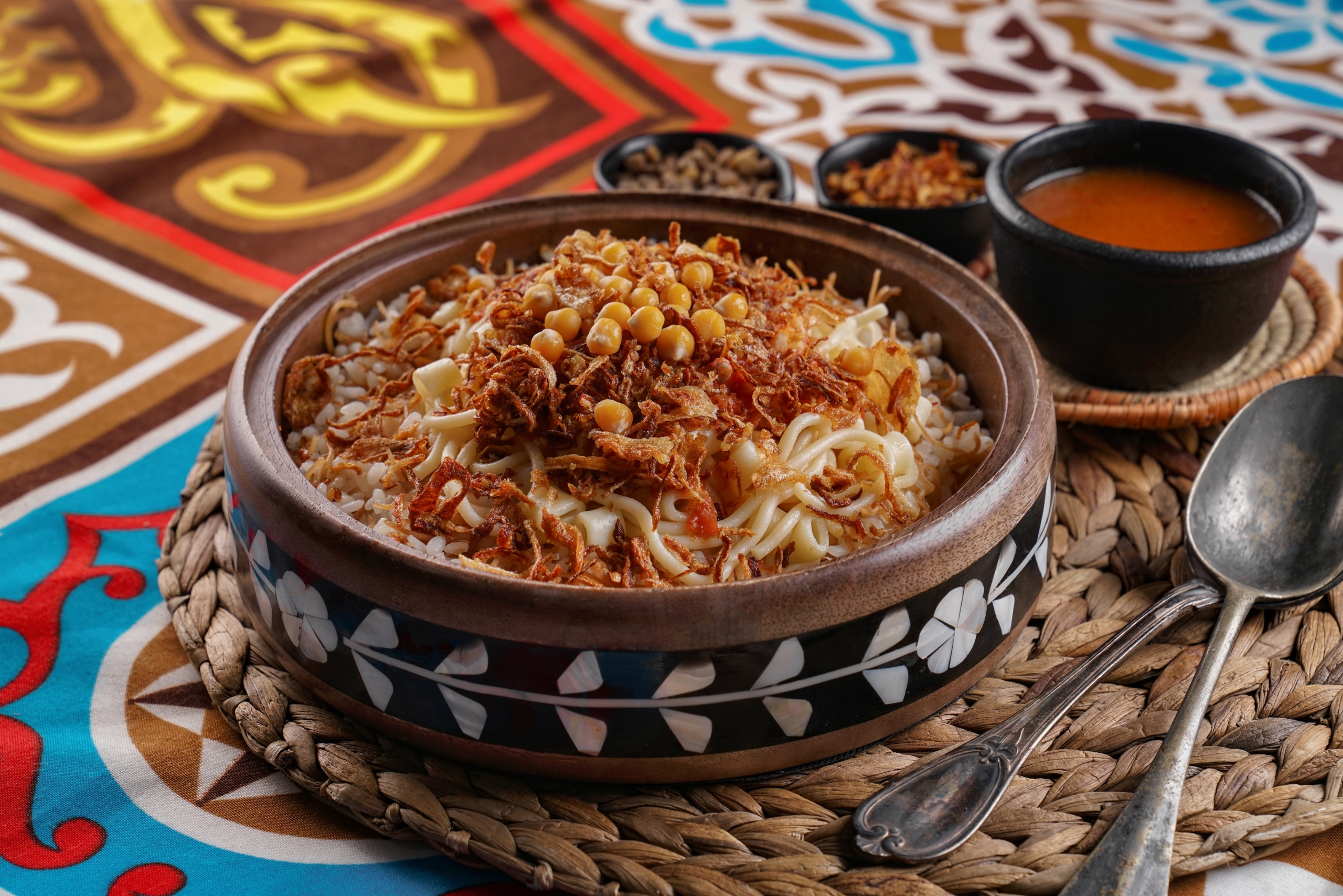
Koshari appears at first glance as a striking combination of rice, pasta, lentils, spiced tomato sauce, and crisp fried onions. Yet this mixture reflects centuries of agricultural continuity, global exchange, and urban adaptation. Today, it holds a place in Egypt’s culinary identity comparable to that of longstanding landmarks, forming a bridge between Egypt’s ancient agrarian foundations and its modern, cosmopolitan character.
A foundation with deep roots
Several ingredients central to koshari were staples of the Nile Valley in antiquity. Archaeological research documents the cultivation and daily use of lentils, chickpeas, onions, and garlic throughout pharaonic history. These foods appear in funerary offerings, painted scenes, and administrative records, underscoring their importance in both domestic life and agricultural planning. Rice, a later introduction, eventually joined this long-established group of ingredients. The foundation of koshari therefore reflects a continuity of flavors that have accompanied Egypt’s communities for millennia.
The nineteenth century: A crossroads of influence
The recognizable form of koshari emerged in the late 19th century, a period when Egypt experienced significant political, commercial, and demographic change. Under British control, the country became a node linking South Asia, the Mediterranean, and Europe. New populations – including soldiers and laborers from the Indian subcontinent – brought culinary habits that entered local foodways.
Among these influences was khichdi, a rice-and-lentil dish widely consumed across South Asia. Its name contributed to the term “koshari”, and its structure informed the early composition of the Egyptian dish. Soon, other communities added their own flavors. Italian immigrants active in Alexandria, Cairo, and the coastal ports introduced pasta and tomato sauces, both of which quickly found resonance within local cooking. Over time, chickpeas, fried onions, garlic-infused vinegar (dakka), and hot sauces enriched the formula, producing a dish defined by layered textures and aromatic intensity.
Urbanization and social mobility
By the early 20th century, koshari had become a visible presence in Egypt’s urban centers. Street carts served it to workers seeking inexpensive, filling meals, and small restaurants prepared increasingly elaborate versions. Its adoption across social boundaries marked its rise from utilitarian sustenance to a shared emblem of Egyptian urban life. The combination of familiar ingredients and accessible price points ensured its spread through markets, train stations, and neighborhood kitchens.
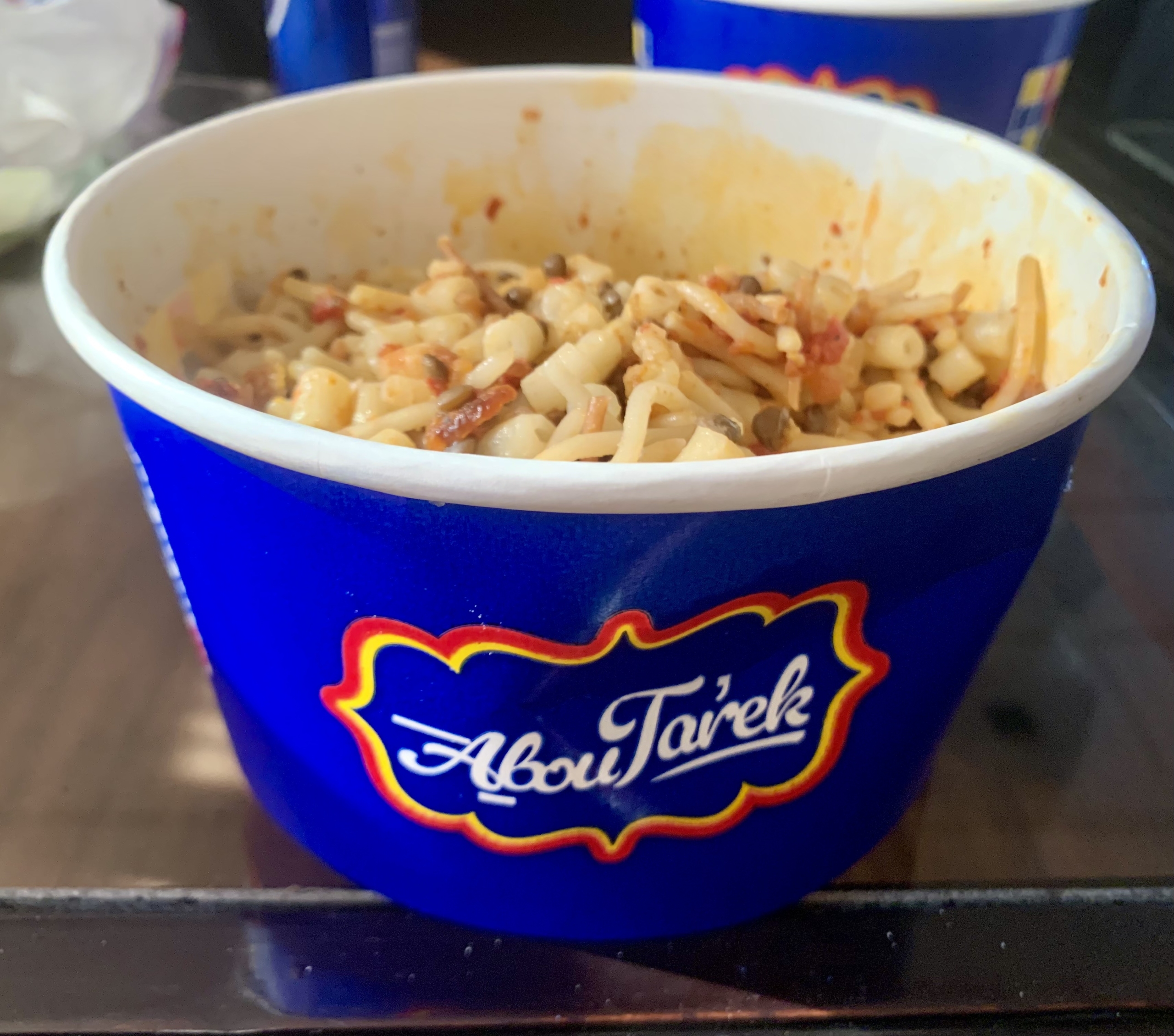
One site that illustrates this evolution is Abou Tarek in downtown Cairo. Founded in 1950, it developed into a landmark associated with koshari’s urban narrative. Visitors encounter a bustling atmosphere and an interior covered with photographs of past guests. Eating there provides a view of the dish as a living practice embedded in Cairo’s daily rhythms.
National symbolism and public life
As koshari gained prominence, it accumulated symbolic meaning. Its composition – a blend of grains, legumes, imported pasta, and contemporary sauces – offered a tangible example of how Egypt integrates diverse influences within a unified culinary identity. The dish became a point of reference for residents and travelers alike, frequently cited as an essential experience of Cairo’s culinary landscape.
Public enthusiasm occasionally led to dramatic displays. In 2014, Egyptian cooks prepared an eight-ton batch to register a Guinness record, an event framed as a celebration of hospitality and a demonstration of Egypt’s contemporary food culture. Though spectacular, it reflected the broader trend of presenting koshari as an ambassador of national identity in international contexts.
Diaspora, innovation, and global circulation
In recent decades, koshari has expanded beyond Egypt through the movement of people and the growing global interest in street food. Egyptian diasporic communities introduced it to cities such as London, New York, and Dubai, where chefs and entrepreneurs positioned it as a nutritious vegan option and a distinctive representation of Egyptian cuisine. Social media amplified this diffusion: tutorials, tastings, and ingredient comparisons circulate widely, generating new audiences for the dish.
Within Egypt, chefs experiment with updated techniques and alternative ingredients – including lamb, quinoa, or herbal sauces – while maintaining the layered structure that defines the traditional bowl. Instant versions, packaged as quick-cook meals, bring koshari into the sphere of contemporary convenience foods.
For many Egyptians living abroad, preparing koshari offers continuity with their own culinary heritage. Restaurateurs use the dish as a point of cultural communication, explaining its history to international customers and situating it within broader narratives of Egyptian migration and global exchange. Some Cairo-based chains, such as Koshary El Tahrir, have expanded into European cities, exporting a recognizable urban experience alongside the recipe.
Cultural diplomacy and tourism

Tourism agencies in Egypt increasingly integrate koshari into cultural itineraries, presenting it as part of the country’s living heritage. Travel writers highlight its ubiquity and affordability, and television programs routinely feature it. Such treatments frame the dish as an accessible entry point into Egypt’s contemporary culture, complementing visits to archaeological sites with everyday encounters in cafés and street stalls.
In international events and diplomatic receptions, koshari occasionally appears as a culinary representative of Egypt. Its simple ingredients, combined in a distinctive manner, make it an approachable introduction to the country’s modern food landscape.
A bowl with a long horizon
Koshari’s appeal does not depend on elaborate techniques or rare ingredients. Its significance arises from the histories it carries: ancient staples, 19th-century migrations, urban creativity, and global movement. It documents how foodways evolve through exchange, adaptation, and the daily choices of communities.
Across Egypt and within its diaspora, the dish remains a compact expression of cultural continuity. A bowl of rice, pasta, lentils, onions, and spiced tomato sauce encapsulates centuries of encounters, linking agricultural pasts with contemporary urban life. In this layered mixture, Egypt presents one of its clearest culinary narratives – rooted in the Nile Valley, shaped by global currents, and continually reimagined in kitchens near and far.
AI Transparency Notice
PilgriMaps uses artificial intelligence tools to assist in the research, drafting and translation of editorial content. All AI-assisted content is reviewed, edited and verified by our editorial team before publication. We contrast information against primary sources, specialist literature and on-the-ground knowledge to ensure accuracy, cultural sensitivity and editorial integrity.
AI is one tool among many in our workflow. The judgement, curation and responsibility for everything published on this platform remain entirely human.
Viator Media S.L. — in compliance with the EU Artificial Intelligence Act (Regulation EU 2024/1689).
This post is also available in: