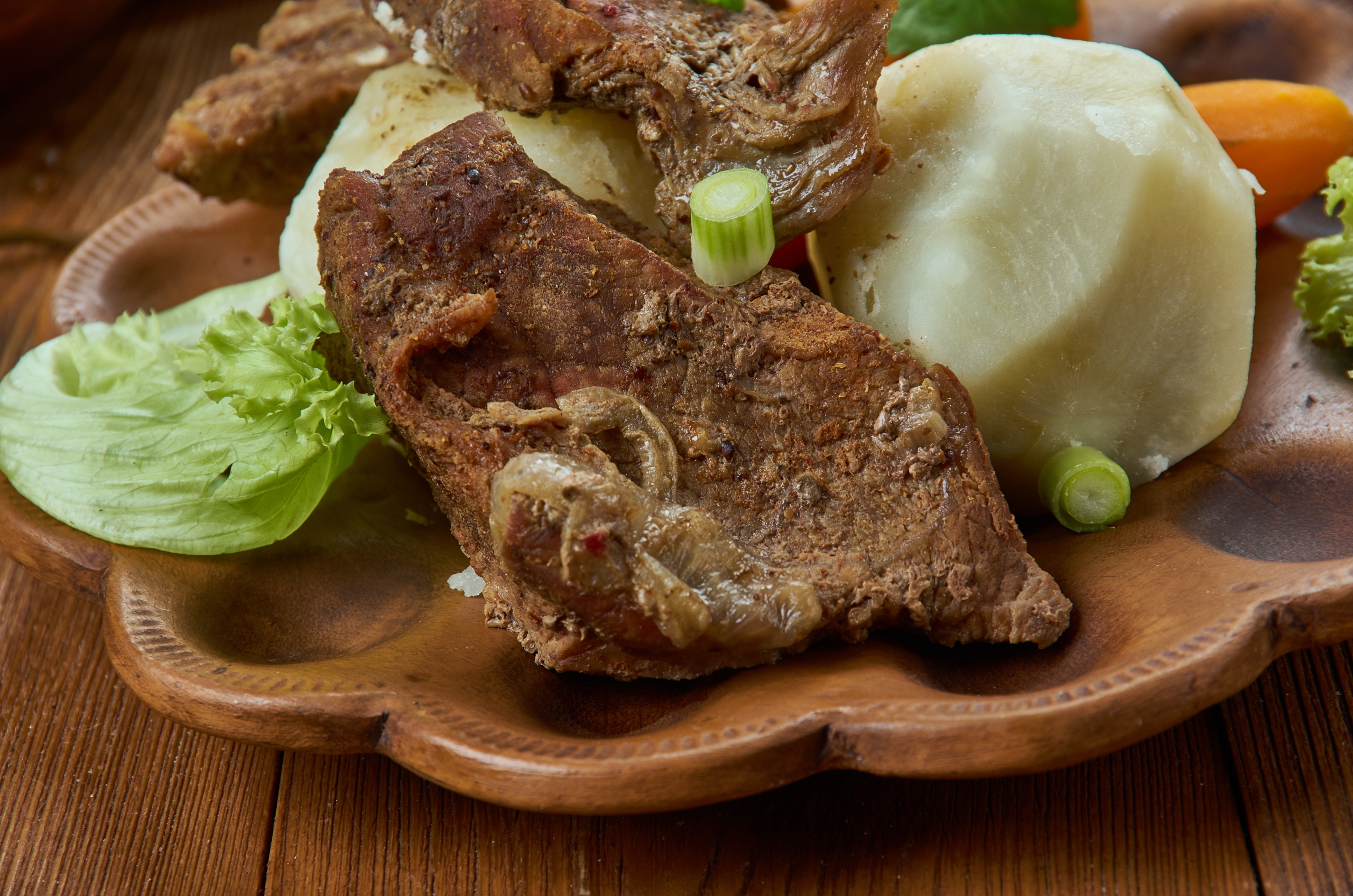
In Mongolia, there are foods that nourish and foods that explain. Khorkhog belongs firmly to the second category. It is not a dish ordered casually in a restaurant, nor a quick solution to an evening meal. It requires time, space, and company—and, above all, context.
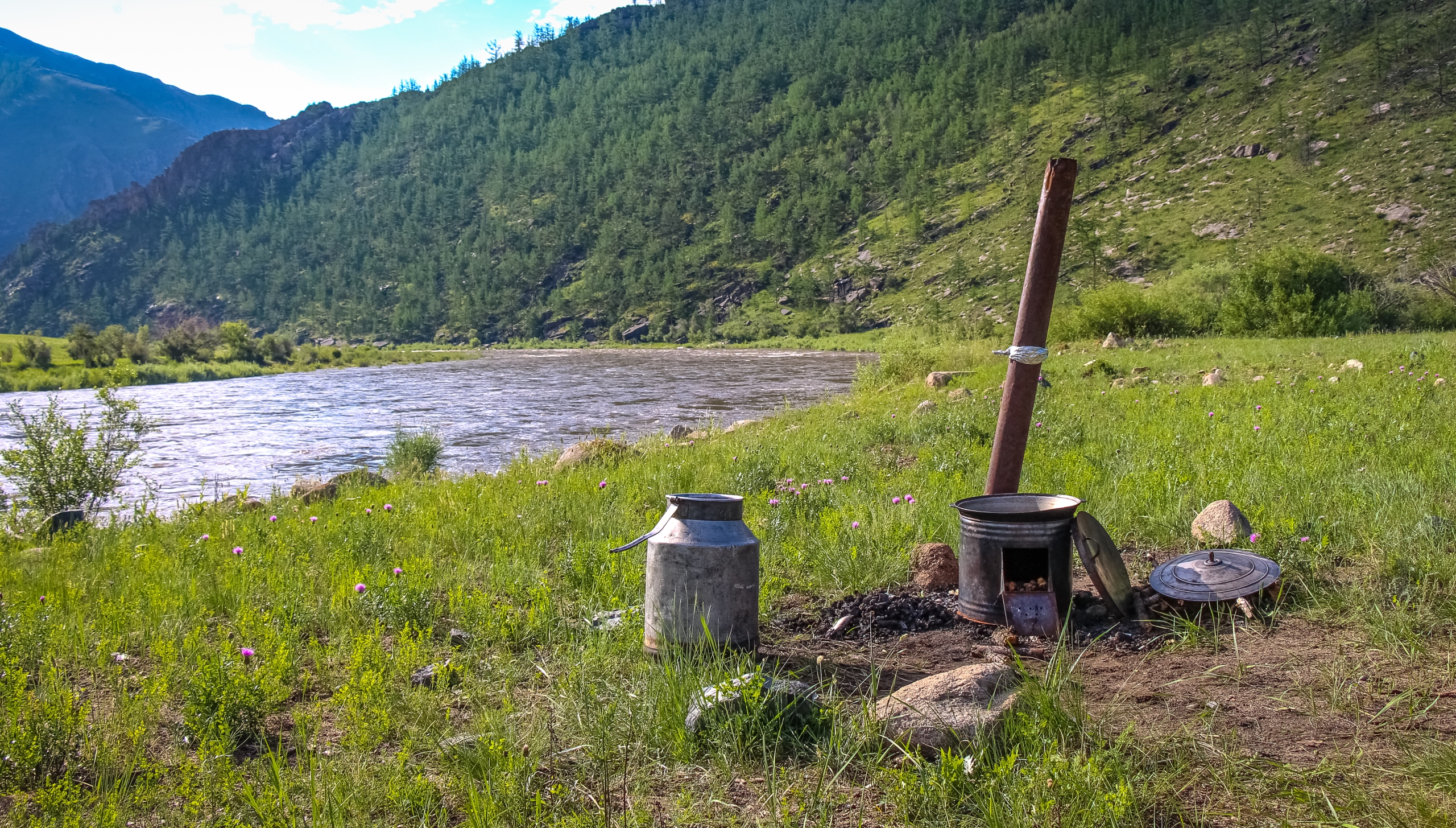
To understand khorkhog, one must first picture the scene: a fire burning in the open steppe, a group gathered around the flames, dark stones heating until they glow, and a sealed metal container holding its contents under pressure. There is no hurry. No one cooks alone. Khorkhog is not improvised; it is convened.
The steppe as kitchen
Mongolian foodways cannot be separated from geography. Mongolia is among the least densely populated countries in the world, and for centuries much of its population has lived—largely continues to live—a nomadic life. This means moving with livestock, assembling and dismantling the ger (yurt) several times a year, and relying almost entirely on animals for food, clothing, and heat.
Within this framework, the kitchen is not a fixed room or a set of appliances. It is the landscape itself. Fire is made where possible. Tools must be few, durable, and portable. Meat—primarily lamb, mutton, or goat—forms the core of the diet, not by culinary preference but by ecological logic.
Khorkhog emerges precisely from these conditions. Cooking an entire animal outdoors with readily available elements—fire, stones, a repurposed metal vessel—is not an eccentricity. It is a culturally refined response to life in an extreme environment.
Cooking with stones: An ancestral technique
The principle behind khorkhog is straightforward and remarkably effective. River stones are heated directly in the fire until red-hot. These stones are then placed inside a metal container along with large cuts of meat, bones, and a small number of hardy vegetables – typically potatoes, carrots, or cabbage – plus a modest amount of water. The container is sealed, and the stored heat of the stones cooks the contents from within, producing steam and pressure.
The result does not fit neatly into familiar categories. It is neither purely roasted nor stewed nor grilled, yet shares qualities of all three. The stones trap heat, the steam tenderizes the meat, and the slowly melting fat permeates everything. The meat emerges exceptionally tender and moist, with a deep, lightly smoky flavor.
To describe khorkhog solely as a technique, however, misses the point. What matters is not only how it is cooked, but why. This method works without an oven, a permanent stove, or fixed infrastructure. It represents a form of practical knowledge refined over generations of herders—a mobile culinary technology shaped by necessity.
Not an everyday meal, but a celebration
Although meat is central to Mongolian cuisine, khorkhog is not prepared daily. Its defining feature is abundance. Traditionally, it involves cooking an entire animal, making it a meal intended for groups rather than individuals.
Khorkhog appears at birthdays, weddings, family gatherings, national festivals such as Naadam, or when an important guest arrives. Preparing it signals deep hospitality: you are welcome; you merit our time and resources; we will share what we have.
In a culture shaped by travel and seasonal movement, hospitality carries particular weight. Khorkhog gives that value a tangible form. It is not cooked quickly or out of convenience, but to mark the presence of others.
Fire as a social center
While the khorkhog cooks, something as significant as the cooking itself takes place: people gather. Fire functions not only as a tool but as a social anchor. Around the flames, people talk, drink, exchange stories, and sing. Cooking is collective rather than hidden labor.
This shared time is integral to the meal. Khorkhog underscores a perspective often diminished in urban settings: food does not begin when it reaches the table, but long before.
When the container is finally opened, the moment carries a restrained ceremonial quality. Steam escapes forcefully, the meat glistens, and the stones – blackened and scorching – are removed one by one.
Stones passed from hand to hand
One of the most distinctive gestures associated with khorkhog occurs just before eating. The hot stones are distributed among the participants, who briefly hold them and pass them from hand to hand. Popular belief attributes circulatory or health benefits to the warmth infused with animal fat.
Beyond any medical claims, the gesture is symbolically charged. Everyone touches the same heat. Everyone participates in the process. The stones that enabled the cooking become shared objects, linking preparation and consumption.
Eating follows. Meat is taken by hand, cut with personal knives. Bones, vegetables, and broth are shared without formal hierarchy or elaborate tableware. Khorkhog is a deliberately horizontal meal.
A shared nomadic tradition
Khorkhog does not exist in isolation within Central Asia. Other nomadic traditions rely on comparable methods, such as Mongolian boodog, where meat is cooked inside the animal’s skin, or Kyrgyz tash-kordo, which buries meat with hot stones underground.
All respond to the same logic: cooking without a kitchen, harnessing retained heat, turning the environment into a tool. These are cuisines of movement rather than settlement, transmitted around fires rather than through written recipes.
Khorkhog stands out for its social accessibility. Less extreme than boodog and more adaptable, it functions as the celebratory expression of Mongolian nomadic cooking.
Khorkhog today: A living practice
Unlike some traditional dishes, khorkhog has not been standardized for mass tourism. It rarely appears on restaurant menus, even in Ulaanbaatar. Its preparation remains slow and complex, poorly suited to commercial service.
Where it endures is within families, at celebrations, and in thoughtfully designed travel experiences where visitors do not simply consume a dish but take part in a cultural scene. For many travelers, sharing khorkhog on the steppe becomes one of the most lasting memories of Mongolia—not only for its flavor, but for what it embodies.
In an accelerated world, khorkhog offers a reminder that cooking can be a way of slowing down, that shared meals can articulate identity, and that in some cultures, fire still organizes social life.
AI Transparency Notice
PilgriMaps uses artificial intelligence tools to assist in the research, drafting and translation of editorial content. All AI-assisted content is reviewed, edited and verified by our editorial team before publication. We contrast information against primary sources, specialist literature and on-the-ground knowledge to ensure accuracy, cultural sensitivity and editorial integrity.
AI is one tool among many in our workflow. The judgement, curation and responsibility for everything published on this platform remain entirely human.
Viator Media S.L. — in compliance with the EU Artificial Intelligence Act (Regulation EU 2024/1689).
This post is also available in: