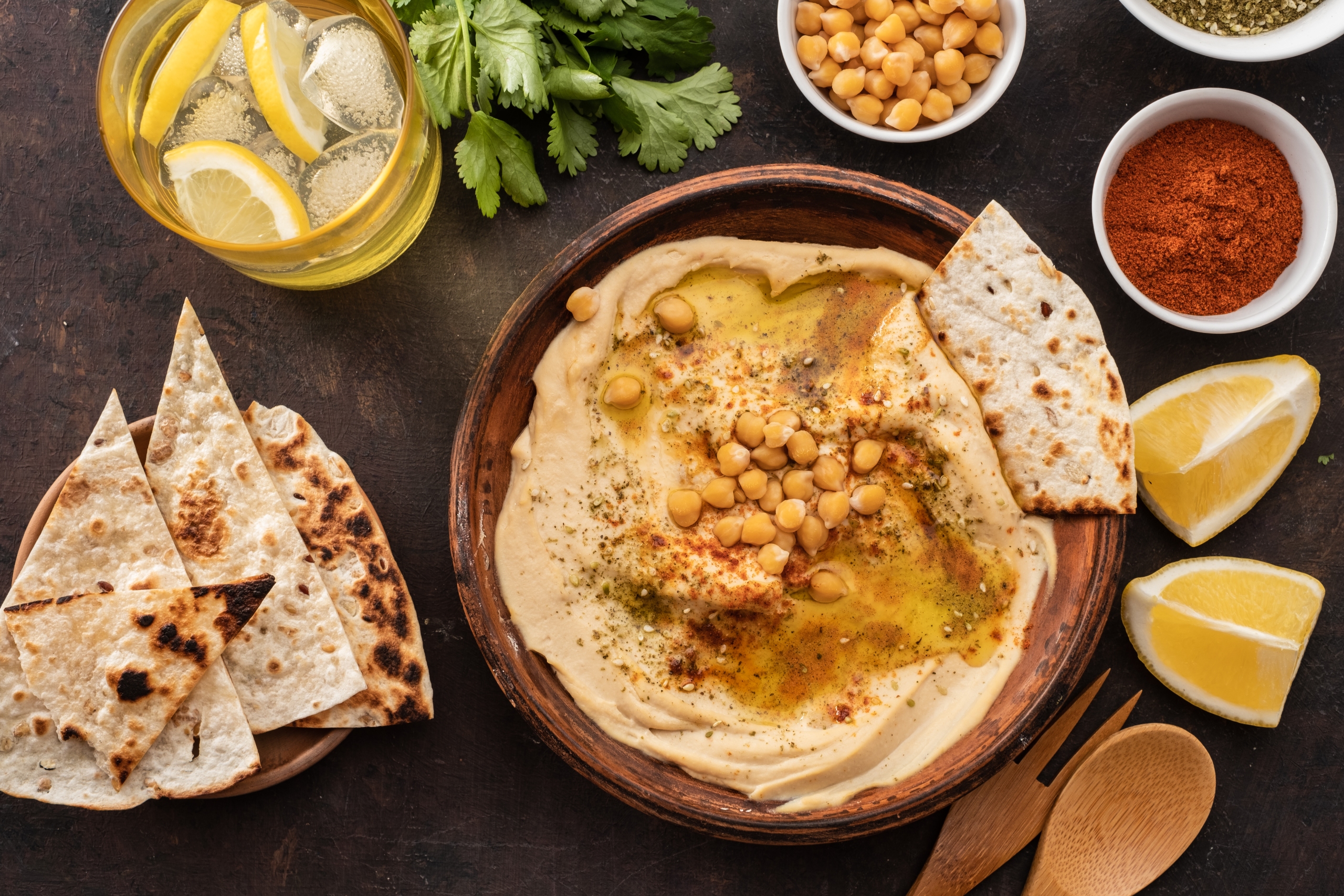
There is something distinctly compelling about a bowl of hummus. It sits at the center of the table, its golden well glistening with a thread of olive oil, waiting. Waiting for someone to tear a piece of pita, dip it in, and begin the ritual. A gesture repeated for millennia, requiring no utensils or ceremony—only hands, bread, and a velvety blend of sesame, lemon, and the Mediterranean.
The name itself reflects a certain linguistic restraint: hummus, in Arabic, simply means “chickpeas.” It is like calling bread “flour” or wine “grapes.” Yet behind this modest term lies one of the most compelling culinary histories in the world.
Ten thousand years of chickpeas
To understand hummus, one must begin with its primary ingredient. Chickpeas rank among the earliest cultivated legumes, with evidence of their use dating back over ten thousand years in the region archaeologists define as the Fertile Crescent—an arc spanning present-day Iraq, Syria, Lebanon, Jordan, Israel, and Palestine. This region is often described as a cradle of early urban societies.
The full name of the dish – hummus bi tahina – reveals its two essential components: chickpeas and tahini, a paste made from sesame seeds. The precise moment these ingredients were first combined remains unclear, as is often the case with deeply rooted culinary traditions.
Written references to dishes resembling modern hummus appear in 13th-century Arabic cookbooks from Cairo. The Aleppine historian Ibn al-ʿAdīm mentions a similar preparation in a manuscript from the same period. Notably, that early Egyptian recipe included chickpeas, vinegar, lemon, spices, and oil, but did not yet feature tahini or garlic – elements now considered essential. The dish existed, but its definitive form was still evolving.
Along caravan routes
One might imagine long caravans crossing the deserts of the Middle East: evening stops beneath open skies, tents set against sharp temperature shifts between day and night. In this context, hummus proved practical. Its ingredients were simple, its shelf life extended by the acidity of lemon, and its nutritional value substantial. It was a food suited to travel, to be shared after a day’s journey.
Over time, chickpea purée moved with merchants, intersecting with other regional staples such as falafel and tabbouleh. It crossed boundaries that had yet to be drawn on maps, adapting to local tastes, incorporating new spices, and finding a place in diverse kitchens. Culinary traditions rarely recognize borders.
In more recent decades, hummus has entered European and American food cultures, supported by increased interest in plant-based diets, vegetable proteins, and balanced yet flavorful dishes. Today, it is difficult to find a supermarket without multiple varieties in its refrigerated section.
One bowl, many interpretations
Asking for the “authentic” hummus recipe yields no single answer. Like many traditional dishes, it varies from household to household, each version shaped by memory and preference.
The foundation remains consistent: cooked chickpeas, tahini, lemon juice, garlic, extra virgin olive oil, and salt. Beyond this base lies a wide range of interpretations.
In Lebanon, hummus appears in numerous forms. A Beirut-style version may include yogurt, cumin, and a hint of chili. Hummus kawarma arrives topped with fried lamb, toasted pine nuts, and fresh parsley. Specialized establishments—hummusiya, often located within markets—prepare and season the dish to order.
In Israel, hummus functions across meals: breakfast, lunch, dinner, or snack. It may be served with whole roasted chickpeas, smoked eggplant, or boiled eggs, sometimes still warm from preparation.
In Greece and Turkey, it is commonly presented as part of a meze, accompanied by raw vegetables such as carrots, cucumbers, and peppers—a lighter interpretation suited to warmer climates.
In Egypt, despite hosting some of the earliest written records of the dish, hummus does not occupy a central role in contemporary cuisine. Culinary traditions shift over time, following patterns that are not always linear.
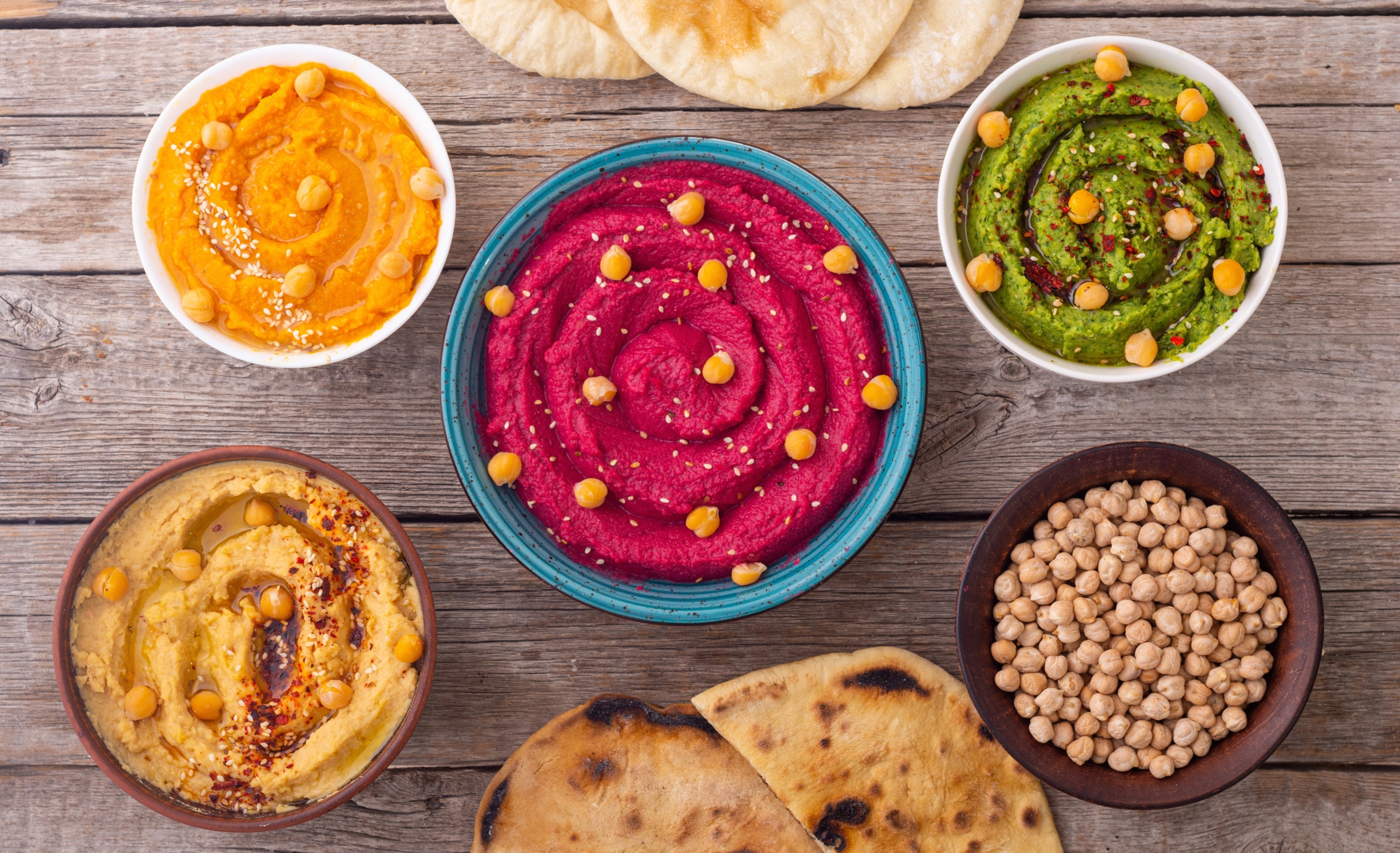
Contemporary variations extend further: beetroot hummus, with its vivid color and subtle sweetness; versions with avocado or roasted peppers; interpretations incorporating curry and coriander in South Asia; even truffle-infused adaptations in modern restaurants. The chickpea base demonstrates a notable capacity for adaptation without losing its core identity.
The gesture of sharing
Across the Mediterranean and Middle East, food often functions as an expression of hospitality. Offering nourishment to a guest carries social significance that transcends cultural and religious distinctions.
Hummus reflects this principle through its mode of serving. Presented in a single bowl at the center of the table, it invites collective participation. There are no divisions within the dish—only hands reaching, bread dipping, and glances exchanged across the shared space.
A passage from the Book of Ruth describes a landowner inviting a foreign woman to join harvesters at a meal, offering her roasted grain. The scene conveys a gesture of inclusion that resonates with similar acts of shared eating across centuries. A bowl of hummus offered to a guest today communicates a comparable intention.
Since 2012, World Hummus Day has been observed annually on May 13, emphasizing the role of food as a connector across communities. The idea is straightforward: shared meals can reduce distance, even if briefly.
Practical considerations
After history and symbolism, attention turns to preparation. Homemade hummus can vary significantly in quality, often depending on small details.
Chickpeas: Smaller varieties tend to produce a smoother texture. Larger types, such as Spanish or Mexican chickpeas, are better suited to other dishes.
Cooking: Dried chickpeas, soaked overnight and cooked thoroughly, yield optimal results. Canned chickpeas remain a practical alternative when rinsed well.
Tahini: Quality matters. It should be smooth and balanced, without bitterness.
Cold water: Adding very cold water during blending helps create a lighter, more aerated texture.
Blending time: Achieving a refined consistency requires patience—several minutes rather than a quick mix.
A spread that maps a region
Hummus can be read as an edible map of the Mediterranean and Middle East. It reflects movements of people, exchanges of ingredients, and evolving practices. Its simplicity allows depth: a few components combined in ways that carry long histories.
Each preparation contributes to an ongoing tradition. Regional accents—cumin in one place, mint in another, smoked chili elsewhere—extend rather than replace its identity.
When encountering a bowl of hummus, one might pause briefly: observe the surface, the oil, the scattered spices. Consider the routes it has traveled, the kitchens it has entered, the tables it has gathered around.
Then take a piece of bread, dip it, and participate in a practice shaped over thousands of years—an everyday act that continues to connect people through shared food.
Hummus can be stored in the refrigerator for three to four days in an airtight container. Before serving, allow it to return to room temperature and add a drizzle of fresh olive oil. It is traditionally paired with warm pita, though raw vegetables, whole-grain crackers, or even a spoon serve equally well.
AI Transparency Notice
PilgriMaps uses artificial intelligence tools to assist in the research, drafting and translation of editorial content. All AI-assisted content is reviewed, edited and verified by our editorial team before publication. We contrast information against primary sources, specialist literature and on-the-ground knowledge to ensure accuracy, cultural sensitivity and editorial integrity.
AI is one tool among many in our workflow. The judgement, curation and responsibility for everything published on this platform remain entirely human.
Viator Media S.L. — in compliance with the EU Artificial Intelligence Act (Regulation EU 2024/1689).
This post is also available in: