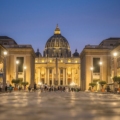
Circumambulation—the ritual act of moving around a place in a prescribed direction—appears in pilgrimage traditions across cultures and historical periods. Unlike linear pilgrimages that emphasize departure and arrival, circumambulation centers on repetition, orientation, and spatial relationship.
The pilgrim does not move toward a distant goal but instead moves around a focal point, engaging with place through rhythm. Across traditions, this circular movement has served as a way to mark significance, structure devotion, and inscribe meaning onto landscapes and built environments.
The term “circumambulation” is often used in scholarly contexts to describe practices that are locally named and understood in different ways. Despite theological and cultural differences, these practices share a common logic: walking a defined circuit establishes a relationship between the participant and a site regarded as meaningful, central, or foundational.
Spatial meaning and the logic of the circle
Circles have long carried symbolic weight in human societies. As spatial forms, they suggest continuity, enclosure, and balance. In pilgrimage contexts, circumambulation transforms these abstract ideas into action. Walking becomes a way of acknowledging boundaries, reaffirming orientation, and participating in a collective tradition shaped by earlier generations of walkers.
Circumambulation routes are often short and repeatable, but they can also extend across entire landscapes or cities. Some are completed once; others require multiple circuits. Direction is frequently prescribed—clockwise or counterclockwise—reinforcing a shared spatial grammar that links participants across time.
South Asian traditions
One of the most widely documented forms of circumambulation appears in South Asian religious landscapes, where the practice is commonly known as parikrama or pradakshina. Pilgrims walk around temples, shrines, or natural features such as hills and rivers, often in a clockwise direction.
A prominent example is the circumambulation of Govardhan Hill in northern India, a route extending more than 20 kilometers. Pilgrims complete the circuit on foot, sometimes over multiple days, engaging with villages, shrines, and resting points along the way. Here, circumambulation functions as physical exertion and spatial narration, linking dispersed sites into a coherent sacred geography.
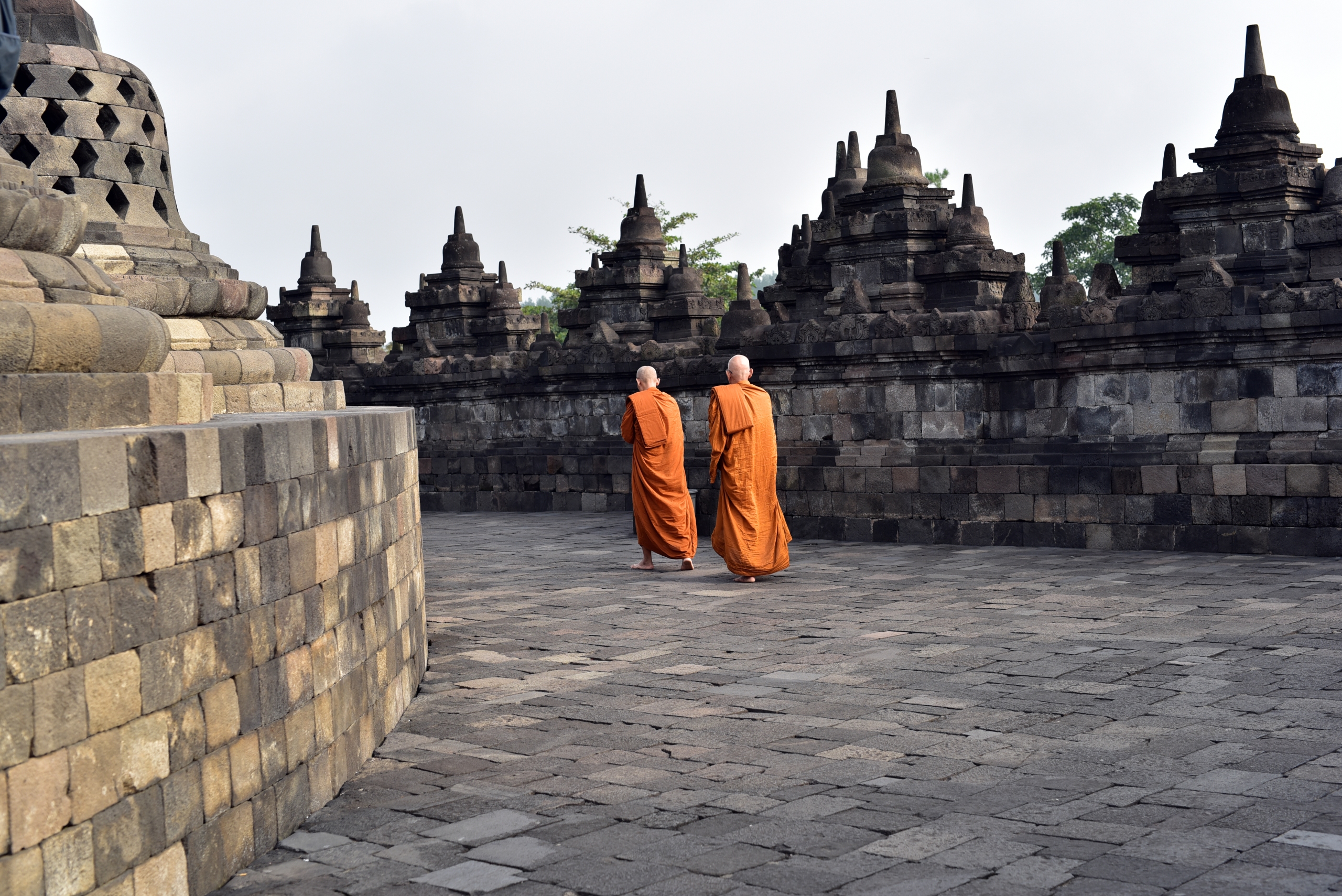
In Buddhist contexts, circumambulation is also central. Pilgrims walk around stupas such as those at Sanchi or Boudhanath, maintaining a clockwise direction that mirrors cosmological models. The repetitive motion emphasizes mindfulness and attentiveness to movement itself rather than progression toward a distant destination.
East Asian and Japanese Practices
In Japan, circumambulation appears in several pilgrimage traditions, most notably in the Shikoku circuit associated with Kūkai. The Shikoku Pilgrimage consists of 88 temples arranged around the island, forming a roughly circular route of about 1,200 kilometers. Pilgrims traditionally travel clockwise, though modern participants may adapt the order.
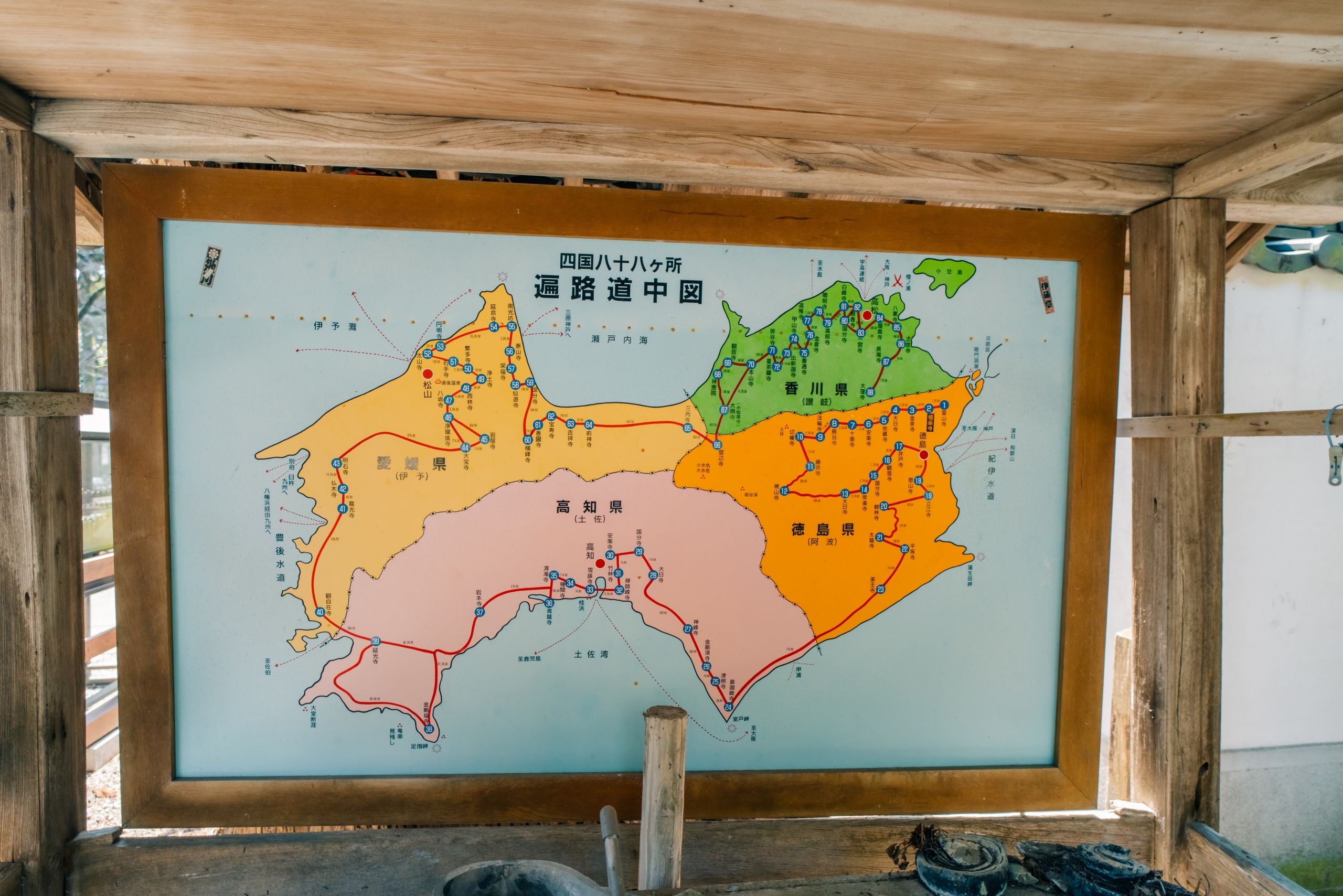
While linear in execution, the route’s circular logic is fundamental: the pilgrimage returns walkers to their point of origin, reinforcing themes of completion and renewal. Circumambulation here operates at a regional scale, integrating coastlines, mountains, towns, and rural paths into a single, continuous loop.
Christian Contexts
Circumambulation has appeared in Christian pilgrimage in both formal and informal ways. In medieval Europe, pilgrims often walked around shrines, relics, or church interiors as part of devotional practice. In Ireland and Scotland, this practice became embedded in outdoor landscapes through routes known as turas or “rounds.”
One example is the pattern of walking around early monastic sites such as those on Iona or at local holy wells. Pilgrims followed established circuits, often moving clockwise, stopping at designated points for reflection. These routes linked bodily movement to place-based memory, reinforcing local religious identity rather than long-distance travel.
On a larger scale, the medieval practice of walking the perimeter of cities or sacred precincts—sometimes referred to as “beating the bounds”—also shared elements of circumambulation, blending civic, agricultural, and religious concerns.
Islamic Pilgrimage
Perhaps the most globally recognized example of circumambulation is the tawaf performed during the pilgrimage to Mecca. Pilgrims walk seven times around the Kaaba at the center of the Masjid al-Haram, moving counterclockwise. This ritual is integral to the Hajj and to the lesser pilgrimage known as Umrah.
The Kaaba: its Abrahamic significance and centrality in Islam
Here, circumambulation establishes a collective spatial focus. Millions of participants perform the same movement within a tightly defined architectural setting, creating a powerful sense of simultaneity and shared orientation. The act is highly regulated, yet the experience varies widely depending on crowd density, time of day, and individual perspective.
Indigenous and local traditions
Circumambulation is not limited to formally codified pilgrimage systems. Many Indigenous traditions include circular movement around mountains, lakes, or settlements as part of seasonal gatherings or commemorative journeys. These practices often resist strict categorization, blending ritual, travel, and social exchange.
In the Andes, for example, pilgrims walk circuits around highland shrines during festivals that integrate Indigenous cosmologies with Christian calendars. The emphasis lies less on doctrinal interpretation and more on maintaining relationships among communities, landscapes, and cycles of time.
Contemporary interpretations
In modern pilgrimage contexts, circumambulation continues to adapt. Urban walking routes that loop around cities, memorial circuits around sites of collective trauma, and ecological pilgrimages that trace watershed boundaries all draw on the logic of the circle. These contemporary forms often emphasize reflection, sustainability, and shared responsibility rather than formal ritual obligation.
Circumambulation’s persistence across traditions suggests its versatility as a human practice. By privileging return over arrival, and orientation over conquest, circular pilgrimage routes offer an alternative way of engaging with place. They remind participants that meaning can be generated not only through distance traveled, but through attentiveness to where one stands—and walks—in relation to others and to the world itself.
AI Transparency Notice
PilgriMaps uses artificial intelligence tools to assist in the research, drafting and translation of editorial content. All AI-assisted content is reviewed, edited and verified by our editorial team before publication. We contrast information against primary sources, specialist literature and on-the-ground knowledge to ensure accuracy, cultural sensitivity and editorial integrity.
AI is one tool among many in our workflow. The judgement, curation and responsibility for everything published on this platform remain entirely human.
Viator Media S.L. — in compliance with the EU Artificial Intelligence Act (Regulation EU 2024/1689).
This post is also available in: