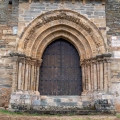
The church of San Juan Bautista de Palacios de Goda is a historical monument that combines defensive and religious elements, located in the region of Avila, La Moraña. Its origins date back to the period between 1158 and 1214, during the reign of Alfonso VIII, with the construction of a square almenara tower, which served as a defensive structure before being adapted as a bell tower. This masonry and brick tower is one of the oldest Mudejar elements in the region and preserves two stages of construction: a solid lower body and an upper part, added in the 14th century, with pointed openings to house the bells.
The construction of the church attached to the tower began at the end of the 14th century. The original temple had a single nave and was enlarged in the 18th century, adding a side nave. The interior is notable for its Mudejar coffered ceiling and its 18th-century Baroque altarpiece, divided into three aisles and an attic, with scenes of the Baptism of Christ and sculptures of Saint John the Baptist, Saint Joseph and Saint Anthony. Among the images, the Cristo de Gracia (Christ of Grace), a 14th century carving, stands out. The church also has an organ built by Isidro Sillenta at the end of the 18th century, which consolidates its artistic and cultural wealth.
- Address
C. de San Juan, 3, 1, Palacios de Goda, Ávila - Web
None - Visiting Hours
Unknown - What to see
Cristo de la Gracia
AI Transparency Notice
PilgriMaps uses artificial intelligence tools to assist in the research, drafting and translation of editorial content. All AI-assisted content is reviewed, edited and verified by our editorial team before publication. We contrast information against primary sources, specialist literature and on-the-ground knowledge to ensure accuracy, cultural sensitivity and editorial integrity.
AI is one tool among many in our workflow. The judgement, curation and responsibility for everything published on this platform remain entirely human.
Viator Media S.L. — in compliance with the EU Artificial Intelligence Act (Regulation EU 2024/1689).
This post is also available in: