High on the windswept Altiplano of Bolivia, in the mining city of Oruro, thousands gather each February to dance, walk, and pray their way into the earth. The Carnaval de Oruro, recognized by UNESCO as an Intangible Cultural Heritage of Humanity, is not merely a festival—it is a ritualized journey. At its heart stands the Virgin of Socavón, the patroness of miners and protector of the underground.
But in the margins of this grand devotion, and in the dark shafts beneath it, another figure persists in whispered stories and folk memory: Chiru-Chiru—a thief, a hermit, a believer, a contradiction. His tale, still alive in Oruro’s collective imagination, binds together two poles of Andean spirituality: the sacred and the profane, the underground and the divine, the outlaw and the pilgrim.
A pilgrim in the shadows
The legend of Chiru-Chiru is difficult to date precisely. Like many figures of oral tradition, his story has changed with each retelling, yet certain details endure. He is remembered as an outlaw who lived in a cave near Oruro, a man of contradictions—devoted to the Virgin of Socavón even as he stole from others. After each theft, he is said to have lit candles before her image, perhaps in gratitude, perhaps seeking forgiveness.
His death, violent and shrouded in mystery, varies by account: some claim he was killed by the authorities, others that he was mortally wounded and dragged himself back to the Virgin’s shrine. In every version, however, he is found close to her—sometimes with a candle still burning, sometimes clutching her image, sometimes lying at her feet. His end, though tragic, becomes an act of devotion; his life, ambiguous and flawed, finds redemption not through confession but through closeness to the sacred..
The Virgin of Socavón: Protector of the underground
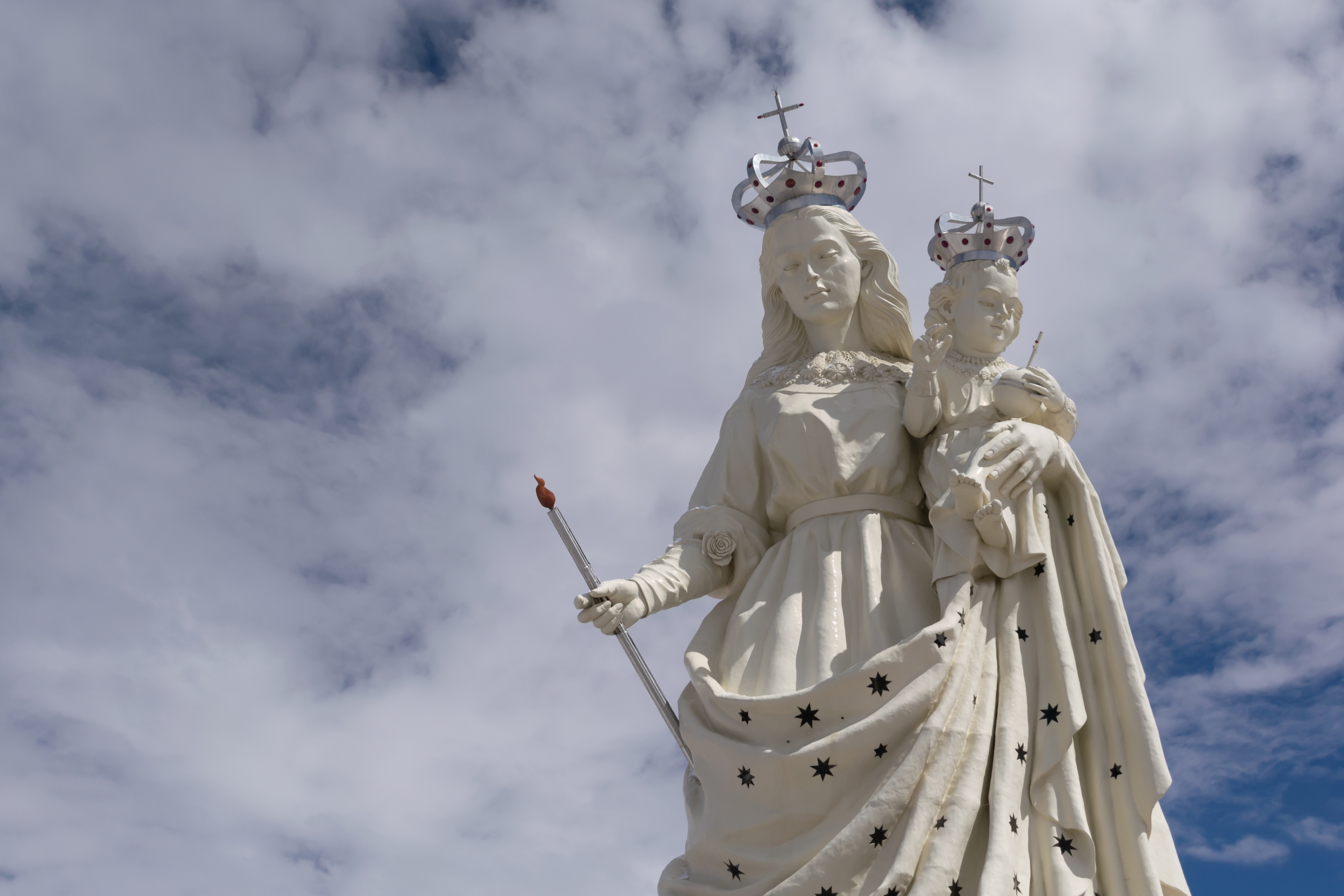
The Virgen del Socavón (Our Lady of the Mineshaft) is a Marian figure unique to this region. She is deeply connected to mining culture, and her sanctuary, carved into a hillside overlooking Oruro, is built over what were once pre-Columbian sacred sites tied to the Andean deity Wari and later reconfigured through colonial evangelization.
In the Andean worldview, the earth is animate—a body with spirits, both nurturing and dangerous. The Virgin, when placed inside a mine, becomes a kind of mediator: an intercessor not just with heaven, but with the powerful subterranean world.
Miners today still conduct rituals to both the Virgin and El Tío—a horned figure considered the lord of the underworld, protector and punisher. Candles, alcohol, coca leaves, and cigarettes are offered to El Tío to ensure safety inside the mines. In contrast, offerings to the Virgin are made to seek protection outside, in the civic-religious world.
Chiru-Chiru stands precisely at this threshold—caught between above and below, law and transgression, fear and faith.
Oruro as a pilgrimage city
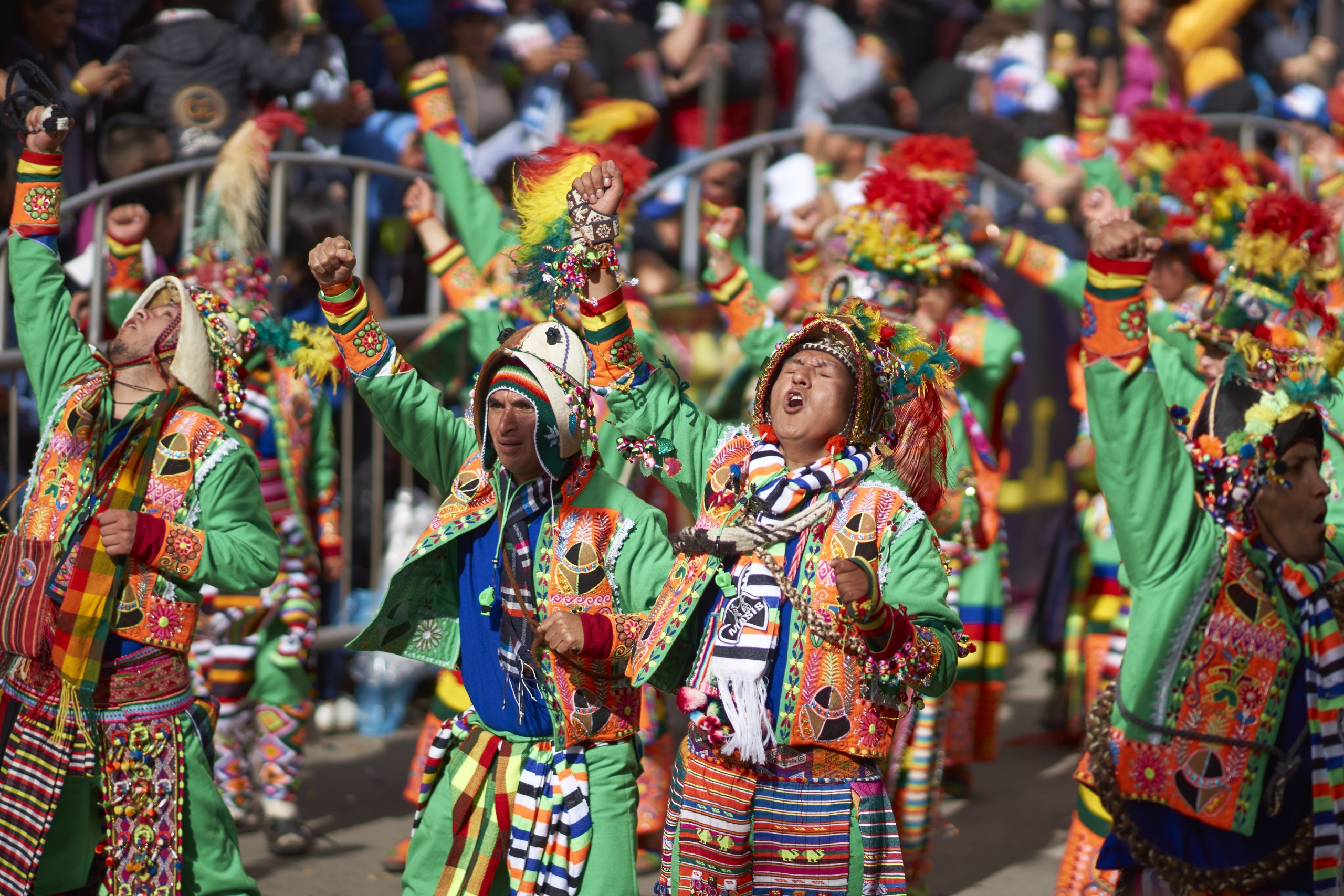
Each year during Carnaval, Oruro becomes the destination of a pilgrimage-in-motion. Thousands of dancers, musicians, and pilgrims process for kilometers in elaborate costume, performing traditional dances such as the diablada (dance of the devils), which dramatizes the battle between good and evil. The procession ends at the Santuario del Socavón, where dancers descend a final staircase into the sanctuary—symbolically and literally entering the earth.
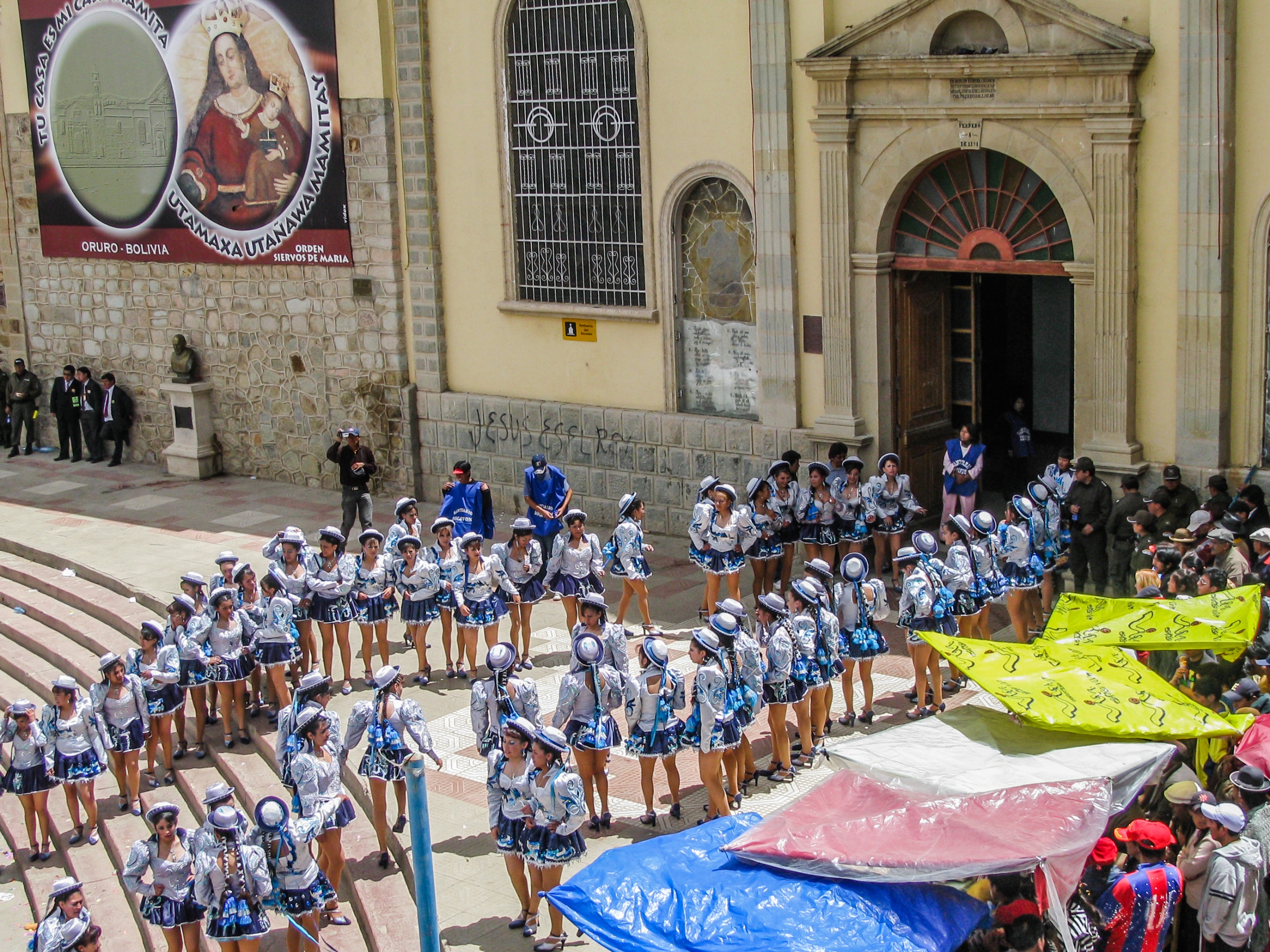
The final act is not performance, but devotion: dancers and pilgrims kneel before the Virgin, removing masks and helmets, some in tears, others in silence. It is a ritual of exhaustion and renewal.
For many, the journey is more than celebration—it is a promise fulfilled. Pilgrims come to give thanks for healings, for safe returns, for family members still working in the mines. Some carry photos of the deceased. Others wear the red and black of Chiru-Chiru’s cave, walking in the memory of those who lived on the margins.
Although deeply Andean, the Carnival of Oruro shares a symbolic kinship with certain “devilish” festivals in Spain, such as those of Almonacid del Marquesado or Valverde de Júcar in Castilla-La Mancha. In both traditions, dancers dressed as devils parade through the streets with the sound of bells, embodying the eternal struggle between evil and the divine, earth and heaven.
This ritual language of masks, penance, and celebration has roots in old European carnivals brought by the colonizers and reinterpreted by Indigenous communities. Oruro thus becomes a transatlantic mirror, where ancient dramatizations of good and evil are reborn—fusing Hispanic heritage with the soul of the Altiplano.
Syncretism in the Altiplano
What makes Oruro—and the legend of Chiru-Chiru—especially significant is the way Catholic and Indigenous cosmologies remain interwoven. The Virgin is honored in a colonial Baroque sanctuary, but she is also embedded in a landscape once sacred to Andean mountain spirits.
Also, the miners’ protector is a devil-like figure (El Tío), but he receives offerings in a structure of reciprocity aligned with Andean ritual logic. Chiru-Chiru is neither canonized nor forgotten. He is venerated unofficially, remembered in songs, prayers, and even graffiti.
In this context, syncretism is not dilution—it is survival. It is the re-articulation of belief through time, under conquest, under labor, under resistance.
Chiru-Chiru as folk saint
While Chiru-Chiru has no official feast day or religious status, some locals treat his cave near the Socavón as a site of quiet veneration. Candles are still lit. Children are told his story. His name appears in corridos and popular poetry, and his image—often depicted as a lone man with a candle and a handkerchief—is painted on walls and shrines.
He belongs to the same constellation as figures like Gauchito Gil in Argentina or Jesús Malverde in northern Mexico: unofficial saints of the poor, complex characters who speak to justice outside institutions.
Pilgrimage to Oruro is not just about the Virgin—it is about walking into a terrain of layered beliefs, where figures like Chiru-Chiru reveal the enduring power of local memory.
A journey through light and shadow
In modern pilgrimage discourse, much is made of personal transformation, inner peace, or sacred landscapes. But in Oruro, and in the legend of Chiru-Chiru, pilgrimage is also about ambiguity: the unresolved tension between belief and institution, between devotion and survival, between earth and sky.
Chiru-Chiru’s story does not offer moral clarity. What it offers is an invitation—to see the sacred not only in cathedrals, but in caves; not only in saints, but in strangers.
To walk the streets of Oruro, to descend into the sanctuary of the Socavón, to light a candle for someone forgotten, is to become a pilgrim of memory, not just faith.
If you go
Best Time: February, during Carnaval de Oruro, coinciding with Candlemas and pre-Lenten festivities.
Key Site: Santuario de la Virgen del Socavón, located at the foot of Cerro Pie de Gallo, the symbolic center of Oruro’s pilgrimage geography.
Chiru-Chiru’s Cave: Near the sanctuary, some locals can guide visitors to the site believed to be Chiru-Chiru’s final refuge. It is unmarked, unofficial, and deeply felt.
Ritual Objects: Candles, coca leaves, small offerings are often left at both the Virgin’s shrine and local altars to El Tío and Chiru-Chiru.
The pilgrimage to Oruro is not a journey to escape contradiction. It is a walk through it. And in that tension, something remains—burning quietly, like a single candle left in a cave.
AI Transparency Notice
PilgriMaps uses artificial intelligence tools to assist in the research, drafting and translation of editorial content. All AI-assisted content is reviewed, edited and verified by our editorial team before publication. We contrast information against primary sources, specialist literature and on-the-ground knowledge to ensure accuracy, cultural sensitivity and editorial integrity.
AI is one tool among many in our workflow. The judgement, curation and responsibility for everything published on this platform remain entirely human.
Viator Media S.L. — in compliance with the EU Artificial Intelligence Act (Regulation EU 2024/1689).
This post is also available in: